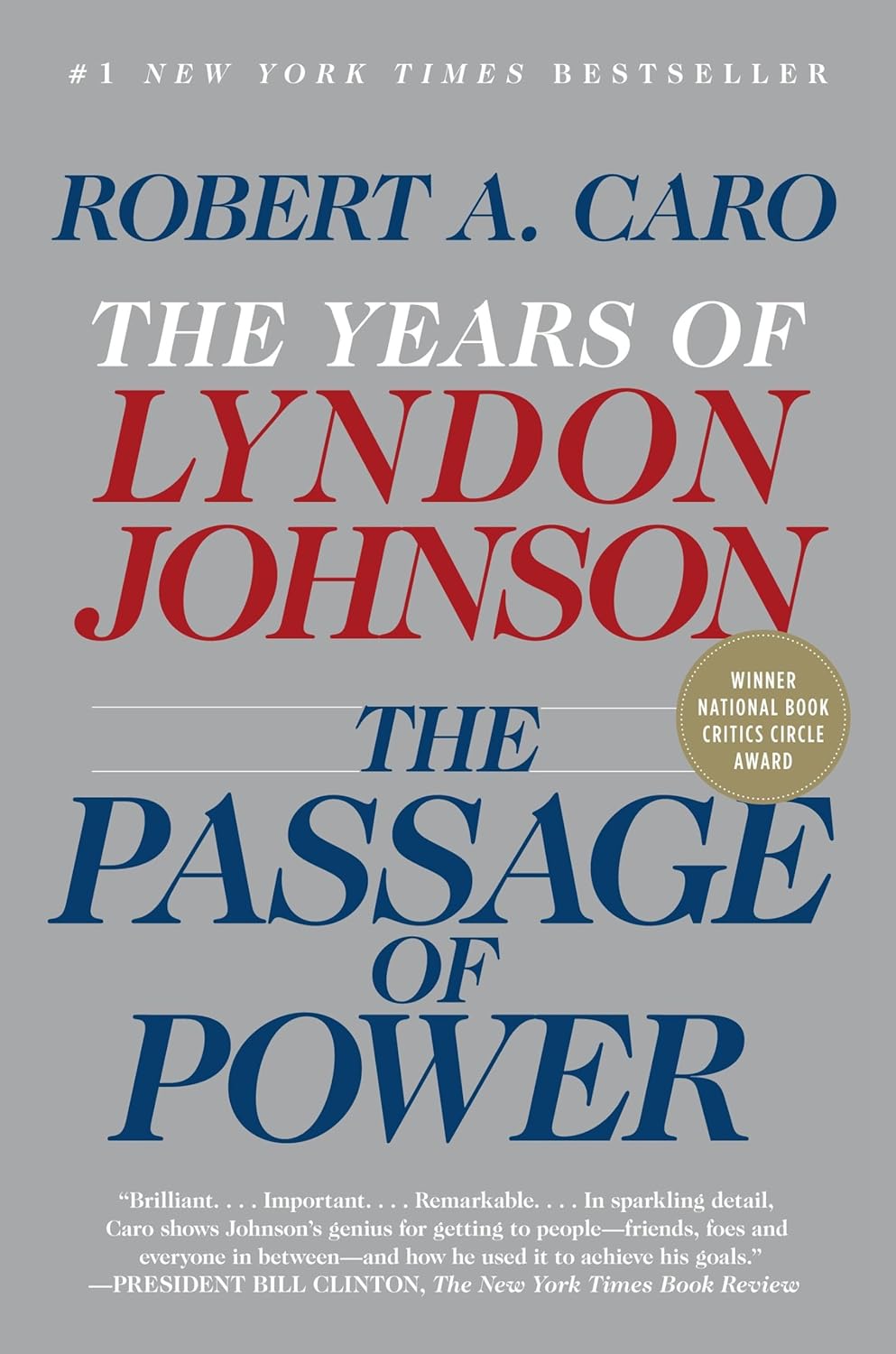
The latest in Robert Caro’s monumental biography of Lyndon Johnson, “The Passage to Power” opens with LBJ’s perplexing performance in the 1960 Democratic presidential nomination. Perplexing because of Johnson’s uncharacteristic political naiveté and his complete failure to size up his competition. In short, Johnson purposively kept out of the race until just weeks before the Democratic National Convention in Los Angeles believing that no one would win the nomination on the first ballot, which would send the process to the “back rooms” where his stature as Senate Majority Leader and his political acumen would prevail.
In the first three volumes of “The Years of Lyndon Johnson” Caro describes Johnson as a political virtuoso with an uncanny ability to read men and a willingness to out-hustle any opponent. Those legendary skills evidently failed him in 1960. He completely underestimated John F. Kennedy, who he viewed as a political lightweight, just a sickly rich kid with no legislative victories of any kind to his name. He was, Johnson is rumored to have said, “pathetic as a congressman and as a senator,” often absent from Congress for over half of the session, missing critical votes on important legislation. His age and Catholicism alone made his nomination a veritable impossibility, Johnson thought. Moreover, Johnson believed that his own tight relationship with the “Old Bulls” in the senate ensured they would deliver their state’s delegations when the time came. But the time never came and Kennedy swept to a first ballot victory on the wings of his telegenic presence and a well managed, hard working, nationwide campaign orchestrated by his imperious little brother, Bobby.
Perhaps even more perplexing was Johnson’s decision to accept the second spot on the ticket with Kennedy. After all, as Senate Majority Leader he was arguably the “second most powerful man in Washington.” Why give that up for an office fellow Texan and former Speaker of the House and two-term vice president John Nance Garner once said, “Wasn’t worth a bucket of warm spit”? Caro claims that the decision came down to cold political calculus. By 1960, only one man had gone directly from the Senate to the presidency: Warren Harding. However, ten had come from the vice presidency directly to the top office in the land. As vice president, Johnson would finally attain a truly national role, allowing him to dampen the southern “taint of magnolias” from his image. Furthermore, Johnson firmly believed that “power is where power goes.” He had a remarkably good track record of turning roles nobody wanted into powerful political positions. He believed he could do the same with the vice presidency.
Caro describes Johnson’s three-year tenure as vice president as a painful one of isolation and humiliation. “Lyndon Johnson, who had devoted all his life to the accumulation of power, possessed no power at all, and as Vice President the only power he would ever possess was what the President might choose to give him.” And Kennedy didn’t give him much. Johnson’s initial attempts at broadening the role and influence of the vice presidency were unceremoniously ignored, the first time he had ever failed at power acquisition. Meanwhile, he had become a figure of ridicule to the dapper Kennedy New Frontiersmen, many of whom referred to him caustically as “Rufus Cornpone.”
There has long been speculation that Johnson’s place on the Democratic ticket for 1964 was insecure. Despite emphatic denials by many of the leading players – President Kennedy foremost among them – Caro isn’t so sure. In fact, he sees plenty of reasons why Johnson might have been dropped. To begin with, Bobby Kennedy, very much Johnson’s bête noire (Caro calls their relationship “perhaps the greatest blood feud of American politics in the twentieth century”), had eyes on the 1968 nomination himself. Putting Johnson out to pasture would undeniably have supported the younger Kennedy’s grand ambitions. Second, Johnson’s main function on the ticket was to win the South. However, Kennedy’s civil rights agenda was increasingly putting the entire region at electoral risk. His path to re-election very well may have depended more on California and the mid-west, making Johnson’s role completely irrelevant. Finally, the ammunition for dumping Johnson was conveniently emerging in November 1963 in the form of a corruption and sex scandal engulfing his former protégé on Capitol Hill, the Secretary of the Senate Bobby Baker. All told, Caro makes a credible case that Johnson’s political days were numbered just as Kennedy made his fateful trip to Dallas.
Caro describes the events of the Kennedy assassination and the first weeks of the Johnson presidency in exacting detail as the new president sought to project an image of stability and continuity. Indeed, the winter of 1964 takes up a full third of the book. Caro lauds the deliberately cool, calming influence Johnson had during the remarkable transition from the Kennedy administration as he desperately and humbly sought, and retained, the services of the late president’s best and brightest advisors. Despite all of his governmental experience and political success, Johnson felt grossly ill prepared for the one role he had been striving for his entire life. He lacked Kennedy’s education, his charm and his self-assured good looks – and he knew it. “Nothing the Kennedys felt about Lyndon Johnson could be any worse than what Lyndon Johnson felt about himself,” Caro writes.
Johnson immediately picked up Kennedy’s ambitious but stalled legislative agenda – a new sub $100 billion federal budget, economy-stimulating tax cuts and, most importantly, civil rights – and made them his own, displaying once again the masterly control of the legislative process that he had demonstrated as Majority Leader. The new president delivered on all accounts, including the landmark Civil Rights Act of 1964. Despite his initial misgivings and feelings of inadequacy, Johnson’s performance was nothing short of spectacular, according to the normally more critical Caro. By March, a Gallup opinion poll placed Johnson’s approval rating at an astounding 77%.
 What's Tim Reading Now?
Leave a comment