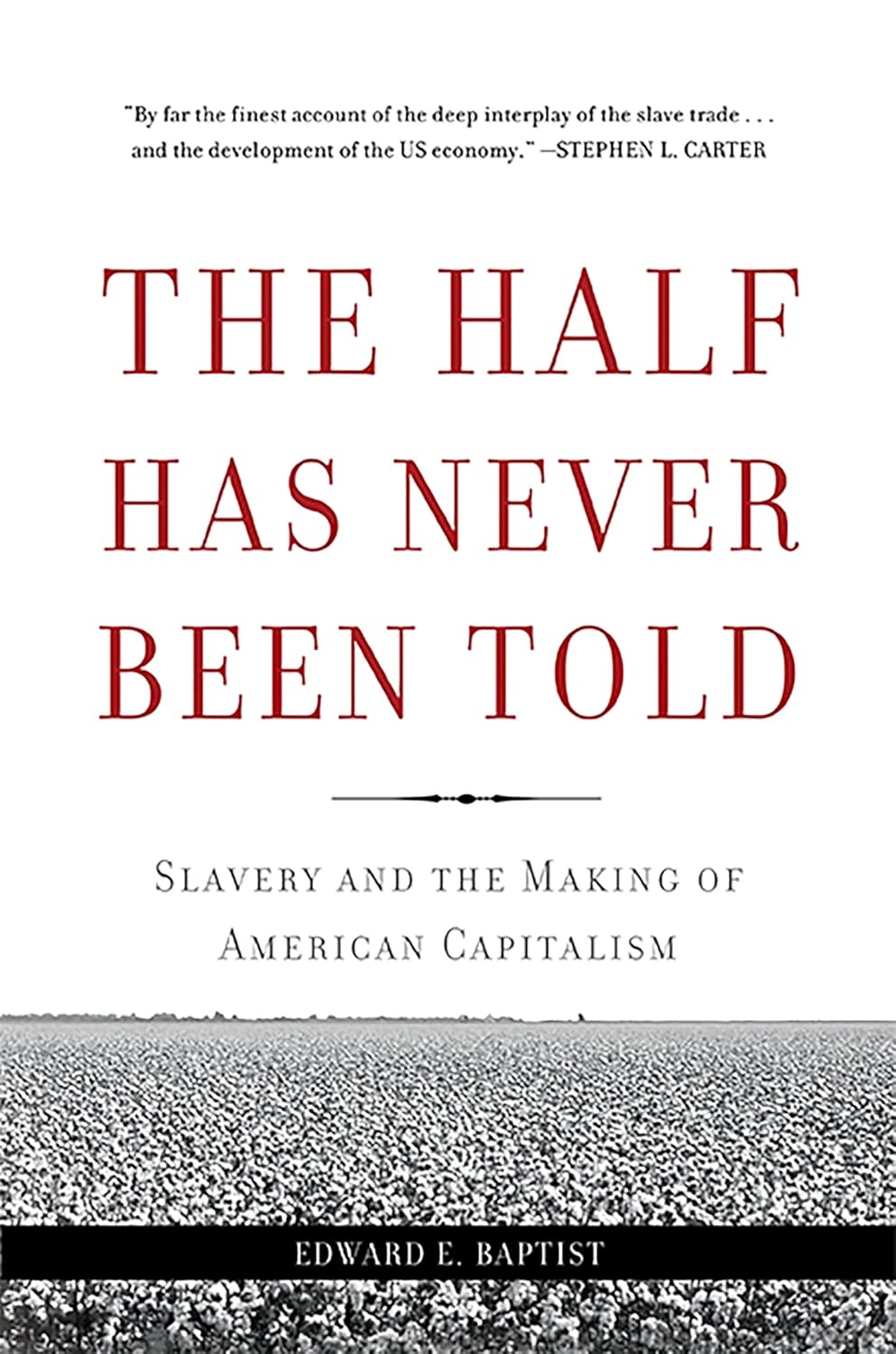
The year 2014 witnessed the publication of two weighty historical works on the seemingly mundane subject of cotton: Sven Beckert’s “Empire of Cotton” and Edward Baptist’s “The Half Has Never Been Told.” The former was better critically received, winning the prestigious Bancroft Prize and being named as a Pulitzer-Prize finalist; the latter arguably generated more “buzz,” including a critical book review in The Economist that was later formally retracted by that venerable publication. In this reviewer’s opinion, what “The Half” lacks in the polish and historical craftsmanship found in “Empire of Cotton,” it makes up for with verve, punch and opinion.
The anonymous reviewer in The Economist concluded that “The Half Has Never Been Told” was not objective history, but rather base “advocacy.” In fairness, Baptist uses the afterward to the paperback edition to unapologetically embrace his role as a supporter of the Black Lives Matter movement, to confess his doubts about the “kind of triumphal history that credits the brilliance of white people for the West’s wealth and dominance,” and to “plead guilty” to the belief that black labor was “disproportionately important to the nineteenth-century creation of the modern world economy.”
The author tells the story of American slavery and the supercharged, antebellum industrial cotton complex almost solely from the perspective of enslaved African-Americans, mostly gathered from New Deal era first-person interviews, an undeniably fabulous and important source. And, as The Economist argues, Baptist adopts the language and perspective of an advocate. For instance, in his narrative southern cotton farmers are “enslavers,” Mississippi Delta plantations are “slave labor camps,” John Brown’s accomplices in seizing a Federal arsenal at Harpers Ferry are “warriors,” the recent destruction of inner city Baltimore after the Freddie Gray verdicts “an uprising.” Thus, it seems to me, there is undeniably an undercurrent of contemporary “advocacy” that permeates this book.
But is “The Half Has Never Been Told” good history? I’d say: Yes and No.
The foundation of Baptist’s argument is that “slavery constantly grew, changed, and shaped the modern world,” making the United States rich and powerful in the process. It was the role of African-American slaves, at once “modernizing and modern,” that has never been told. Far from the civilizing, unprofitable, inefficient system of labor it has often been characterized as, slavery was, according to the author, a dynamic and creative engine of economic growth. “For seventy years, southern and northern economic and political elites – and many average white citizens – had cooperated to extract profit and power from the forced movement and exploitation of enslaved people’s bodies and minds,” he writes.
Let me start by highlighting what I think Baptist does well and “gets right” from a political-economic perspective. First, his brings to living-breathing life the agonizing, brutal reality of what our nation did to millions of innocent people of color during the first half of the nineteenth century. Forced marches south to cotton-growing regions in chained coffles, families arbitrarily ripped asunder to pay some improvident master’s debt, the humiliation of being auctioned off at Mospero’s coffee shop in New Orleans along with cattle and other commodities, sexual violations, and, of course, the sadistic brutality of the so-called “whipping machine.” The personal slave stories that Baptist tells are powerful and important. I think that I am a better American for having read them.
Second, I think that the author’s claim that slaves played an outsized role in the growth of the American economy during the antebellum period is irrefutable. In “Empire of Cotton,” Beckert authoritatively presents a simple syllogism that supports Baptist’s central argument: the wealthy western world we live in today was created by the Industrial Revolution; the Industrial Revolution was driven by massive productivity gains in textile manufacturing; cotton was the essential raw ingredient that powered textile manufacturing; the massive and cheap amounts of raw cotton needed to feed those textile plants were supplied overwhelmingly by slave labor in the American South. Therefore, by that tight logic train, African-American slaves literally created the modern world.
Baptist’s description of an early American Republic driven by the muscular and entrepreneurial expansion of slavery is convincing. That expansion, he explains, was driven by a potent cocktail of three necessary ingredients, all of which were supported by the U.S. Federal government to one extent or another. First was providing suitable land for cotton growing. Beginning with the disputed Yazoo claims of the late eighteenth century and culminating in the decisive Treaty of Fort Jackson of 1814 and the Indian Removal Act of 1830, both orchestrated by slaveholder Andrew Jackson, massive new territory was forcefully expropriated by the U.S. government, primarily for cotton farming, some 25 million acres or roughly the size of the state of Kentucky.
Second was tapping capital from outside the region to finance the expansion of plantations. In 1832, Andrew Jackson, that inveterate hater of banks, played a pivotal role by defeating the renewal of the charter of the Second Bank of the United States (BUS), an early version of a central bank. In the wake of its destruction, dozens of new, locally chartered Southern banks were formed, all of them freed from the regulatory constraints of the BUS. These new cotton belt banks effectively securitized slaves, liberally offering bonds that paid 6%-8% yield based on future cotton harvests. New York and Europe gobbled them up, flooding the region with millions of dollars of capital looking to be put to work. Suddenly, a “cotton bubble” formed in the American South and West as easy credit drew thousands of would-be plantation magnates into the region, financing their dreams – which included buying property and slaves – with other people’s money. As difficult as it is to imagine today, one must remember that many ambitious young men moved “west” (Mississippi, Louisiana, Alabama) in the early 1830s in pursuit of easy riches the way young people today move to Silicon Valley. Thanks to the actions of the Jackson administration, fecund land was readily available and so too was easy credit. Which brings us to the third leg of the stool: human chattel.
An Act of Congress abolished the international slave trade in 1807. Therefore, finding enough “hands” to make a southwestern cotton plantation work required the development of an extensive domestic slave trade. A certain arbitrage trade system developed, as young enslaved men in the slave-rich states of the tobacco-growing mid-Atlantic, such as Virginia, commanded in New Orleans twice what they were worth locally. A strong young man of 22 might fetch $250 at a slave auction around Richmond in 1835. That same “hand” would draw perhaps $700 at Mospero’s in New Orleans. Thus, a new occupation was born: the slave broker: men who traveled to the Mid-Atlantic, haunting various slave auctions and pro-actively offering to purchase hands from working farms, all with the intent to drive dozens of chattel overland by foot, chained together in coffles, to the lucrative slave markets of the easy credit southwest. Or as the author puts it succinctly and acidly: “So enslaver-generals took land from Indians, enslaver-politicians convinced Congress to let slavery expand, and enslaver-entrepreneurs created new ways to finance and transport and commodify ‘hands’.”
Thus, by the mid-1830s, new cotton plantations were popping up left-and-right; most of them financed on credit and supported by the seemingly insatiable demand of the British factories around Manchester and to a lesser extent those outside of Boston and Providence. The only way to keep up with the demand for raw cotton was torture, Baptist writes. “Using torture, slavery’s entrepreneurs extracted an amount of innovation equal in numerical measure to all the mechanical ingenuity in all the textile mills in the Western world.” That’s a bold claim. And one that likely won’t stand up to the cold and impartial light of economic data.
So how did plantation overseers contrive to expand production? Simple: a new “pushing system.” In short, each slave was responsible for a certain weight quota of cotton picked each day. Moreover, an overseer would stay out in the field with the slaves all day, driving the lead picker to maintain the fastest pace possible. In the words of one plantation slave: “the whip was as important to making cotton grow as sunshine and rain.” Indeed, “Hard forced labor multiplied US cotton production to 130 times its 1800 level by 1860.” And therein lies the bulk of the author’s forceful argument.
Baptist is hell-bent on demonstrating that American slavery was somehow modern and innovative. I suppose that is necessary to support his claim that African-American slaves played a key role in not only growing the American economy, but that they did so in an inimitable, dynamic fashion. Here is where I felt that the author’s arguments fell apart. In Baptist’s own words: “This book argues that a system of torture and measurement, which we might call a technology, helped drive the astonishing increase in cotton-picking productivity that, from 1800 to 1860, supplied the growing factory system of the Western world with raw materials at an ever-lower cost.”
In other words, giving an enslaved person an unreasonably large quota of cotton picking to achieve and then whipping them mercilessly if they fail to deliver is something “we might call a technology”? By this thinking then, the Pharaohs that built the Pyramids were kind of like a pre-modern-Steve-Jobs. I beg to differ. The cotton gin was a technological innovation. The spinning jenny was a technological innovation. The steam engine was a technological innovation. The assembly line was a technological innovation. Intermodal shipping was a technological innovation. Beating another human being to a bloody pulp to make him or her work harder than they could ever imagine is not a technological innovation.
Perhaps the biggest puzzle to solve (or maybe rectify) is the relative efficiency of slave labor. Baptist seems to feel confident that the “slave labor camps” of the American South were the most ruthlessly efficient system of cotton-picking known to man until the advent of automated cotton harvesting machines in the 1930s. But is that true? Data from Beckert’s “Empire of Cotton” would suggest that the answer is an unambiguous “No.” For instance, raw cotton, which traded for $0.11 per pound in 1860 and remained as high as $0.24 in the years during and immediately after the Civil War, but then began to drop precipitously, down to $0.07 per pound by the 1890s, all while global consumption of cotton doubled. If the “whipping machine” of American black slavery was so utterly necessary to feeding the global Industrial Revolution, how can one explain a fifty percent real reduction in the price of cotton while demand doubled in a world without slaves?
And then there is the price of slaves themselves, which admittedly is a touchy subject, even 175 years after the fact. Baptist’s arduous research shows that the average price of a slave in the markets of New Orleans fluctuated from a high of around $1,000 right before the major financial panics of the age (1819, 1837, 1857) and fell to about $450 in the proceeding recessions. What Baptist never adequately explains is why this human chattel was so relatively inexpensive, especially for a commodity whose supply was more or less fixed. Baptist cites a source that says a good “hand” will produce “from 5 to 6 bales weighing 400 lbs.” At a standardized price of $0.15/pound, that means that an average slave costing maybe $600 would return $300 in year one, would break even from an investment perspective in year two, and after that be more or less pure profit. What type of capital investment today would be so attractive? The basic numbers, from a purely capitalistic ROI perspective, suggest that the said “hand” would only have perhaps three good years in the fields. Or perhaps the number had to be normalized for inevitable deaths from disease, overwork or torture (Baptist shows that only a tiny fraction – less than 1% — were able to escape slavery via the underground railway)? And why didn’t the price of slaves climb more dramatically with the gains from the “pushing” system? By the start of the Civil War, the author writes, slavery’s productivity “was higher than ever – some 700 pounds per enslaved man, woman, and child in the cotton country, twenty-two times the rate of 1790.” He presents a graph that seems to show the “value of cotton output per slave” fluctuating closely with the “average price of slaves,” but how can one explain that productivity growth of twenty-two times with an average slave price increase of only two times? These are the kinds of questions that I wished Baptist spent more time trying to answer. But, in the end, he is a liberal arts historian and not a heartless economist, so perhaps I should give him a pass.
In any event, “The Half Has Never Been Told” is an important book and deserves to be read widely by both a professional and lay audience. That said, if you want to read just one book on the role of cotton and the creation of the modern world, stick with Beckert’s “Empire of Cotton.”
 What's Tim Reading Now?
Leave a comment