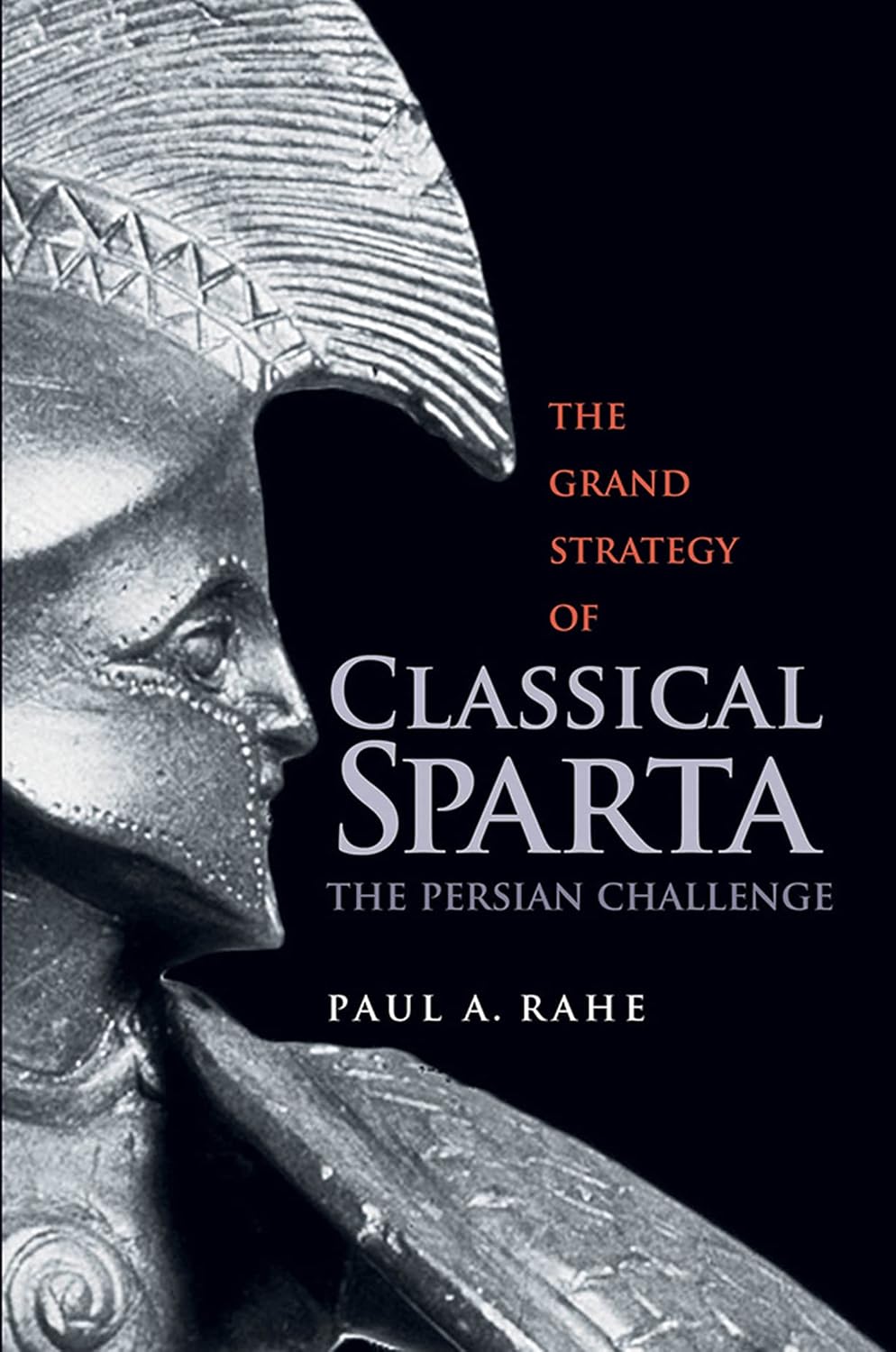
They say you shouldn’t judge a book by its cover. The same could even be said for its title. Paul Rahe’s latest effort, “The Grand Strategy of Classical Sparta: The Persian Challenge,” is an excellent book, it just doesn’t have all that much to do with the grand strategy of classical Sparta. Rather, it is a comprehensive narrative of the Greek wars against Persia in the early fifth century BC. Or as Rahe explains: “[‘The Grand Strategy of Sparta’] describes a clash of civilizations in which liberty successfully withstood the assault of despotism and a collection of diminutive and impoverished self-governing cities defeated one of the greatest empires the world has ever known.”
Before leaving the topic at hand, did the Spartans have a grand strategy? And what is “grand strategy,” anyhow? Duke political scientist Peter Feaver defined the term this way in a thoughtful essay in Foreign Policy Magazine in 2009: “Grand strategy is a term of art from academia, and refers to the collection of plans and policies that comprise the state’s deliberate effort to harness political, military, diplomatic, and economic tools together to advance that state’s national interest.” In the case of the Spartans, most of the “plans and policies” centered on the creation of a warrior elite. Everything about a young Spartan’s upbringing was controlled by the state and, according to Rahe, was meant to foster “stamina, grit, endurance, and courage.” The author quotes extensively from the Spartan poet Tyrtarus, whose great works praise the virtue and valor of dying in the frontline of battle and the immortal shame of retreat. The male citizen body was “a legion of men-at-arms,” which likely never numbered more than 10,000. A permanently enslaved community of Messenians, known as Helots, who outnumbered the Spartans perhaps seven-to-one, conducted all non-military labor. Due to the constant threat of slave revolt and the relatively small number of citizen warriors, the Spartans could never afford to either venture very from their homeland on the Peloponnese nor risk losing too many of their elite soldiers in battle. All-in-all, Spartan “grand strategy” doesn’t sound all that grand.
The Athenians, on the other hand, had a grand strategy. Themistocles, the father of the vaunted Athenian navy, was reported to have said: “I cannot tune a harp or play a lyre, but I know how to make a small city great.” He wasn’t kidding. Prior to the fifth century, Athens was a minor Greek city-state in Attica of little political, military or economic importance with no history of seafaring. Themistocles would almost single-handedly change all of that. His vision was simple but incredibly bold and far-sighted. Athens would make itself a virtual island. The city would be enclosed in massive walls with a fortified corridor running nearly five miles down from the Acropolis to the harbor at Piraeus. The proceeds from a recent silver mine strike at Laurium would be used to build over 100 triremes, the most modern naval warship of the day. All political opponents to Themistocles’ grand strategy were systematically ostracized from Athens to ensure the plan was fully implemented. Contemporary military historian Eliot Cohen has recently dismissed the entire concept of grand strategy as “an idea whose time will never come, because the human condition does not permit it.” I’m generally inclined to agree with him, but the story of Themistocles and the Athenian navy is a truly remarkable exception.
The threat confronting the elite Spartan band of warriors and the upstart Athenian fleet was enormous. The Persian Empire was vast by any measure. At its height, the Persian realm, stretching across much of the modern Middle East and Central Asia, included as much as 40% of the world’s total population, more than any other empire in history up till then or since. And it aimed for more. In fact, according to Rahe, it aimed for world domination. “Universal empire was the raison d’etre of the Persian monarchy,” he writes. “It was the imperative driving the regime.” The leaders of the empire, the so-called King of Kings, “operated like spiders at the center of a great web.” They moved from one part of the empire to the other tirelessly and endlessly. For over half-a-century the kingdom enjoyed a succession of intelligent, quick-witted, and aggressive leaders: Cyrus (ruled 559-529), Cambyses (529-522), and Darius (522-486). That would come to an end with Xerxes (486-465), a man Rahe calls “weak, self-indulgent, and more than a bit of a fool.”
The Persians had received “earth and water” – a ritualistic expression of subservience – from scores of Greek communities along the eastern Aegean, making those city-states the “bandaka” of the King, the Persian word for slave, but also expressing a general dependence. These Greek states of Ionia revolted in 499. Athens came to their assistance. Arguably, this Athenian support marked the beginning of the Persian Wars. Rahe writes that Darius clearly had aims of universal empire and would have invaded Greece sooner-or-later. Others, including the Spartans, felt that the Athenians provoked the Persians. “One thing is clear,” Rahe says, “had the Ionian revolt succeeded, the Greek heartland would have been safe.” The revolt raged on for half-a-decade until the decisive naval battle of Lade in 494 off the coast of Miletus in which a large contingent of Ionian ships defected, leaving their outnumbered fellow Greeks to the mercy of a giant Persian fleet of some 600 triremes. On the issue of Athenian assistance to the Ionians, Darius would neither forgive nor forget, and the Athenians knew it.
“The Greek David could defeat the Persian Goliath,” Rahe says, “but only … if he could dictate the terms on which the contest took place.” And that is precisely what the Greeks would do time and again in the Persian War. At Marathon in 490, Miltiades ensured that the Persian cavalry, so dangerous to the hoplite phalanx, would play no role in the battle. The narrow pass at Thermopylae in 480 allowed a few hundred Spartans under their king, Leonidas, to inflict thousands of casualties on the Persians. Themistocles tricked the Persian fleet into engaging the much smaller Greek navy in the narrow waters off Salamis, negating the influence of the Persian’s superior numbers and maneuverability. Finally, the young Spartan Pausanias would do the same over the broken plains of Plataea in 479. Rarely in history has such an outnumbered force performed so well, so consistently.
Rahe relays everything with an authoritative voice and exhaustive research. This is not a popular narrative history meant for the lay-reader. It is a definitive account of the Persian Wars taking all available sources into consideration, with no detail too small for Rahe’s discerning scholarship. Consider the case of Sicinnus, the slave of Themistocles who delivered the critical message to the Persians the night before the battle of Salamis, tricking them into attacking the Greeks in the narrow straits at dawn the following morning. Here is how Rahe reviews the simple question of Sicinnus’ ethnicity and whom he delivered his message to that night: “Aeschylus reports that Sicinnus was a Greek and that he delivered Themistocles’ message to Xerxes himself. Herodotus says nothing about his nationality and implies that he met with Xerxes’ admirals but not with the Great King. Plutarch asserts that Sicinnus was of Persian extraction, and he and Diodorus presume that he met with the King of Kings. Athenaeus reports a claim that he hailed from Crete. We are left to guess at the details, and guess we will.” This is but one example of Rahe’s tireless (one might say excessive) effort to get at the truth.
The Persian Wars would loom much larger in the memory of the Greeks than that of the Persians. The defeated Persian Empire would flourish for well over another century. The events in Greece had been nothing but a sideshow so far as the King of Kings was concerned. Xerxes could – and did – emphasize the positive: the victory at Thermopylae (never mind the details); the death of the Spartan King, Leonidas; the sack of Athens; and the capture of many Greek slaves.
For the Greeks, especially the Athenians, the war had been a defining moment. The Hellenic League, cobbled together to resist “what was arguably the largest army and most formidable fleet ever assembled,” had proven a remarkable success. The Athenians slid comfortably into the role previously played by the Persians in the Aegean. The Ionian Greek city-states had merely changed one master for another, albeit a native Greek master. The annual tribute once postmarked to Susa was now payable to Athens. The maritime alliance once created to defend the Greek homeland from foreign invasion was now repurposed to defend and expand Athenian political, economic, and military hegemony from the island of Crete through the Aegean Sea and Hellespont to the rich granaries of the Black Sea. In the course of a single generation, the Athenians had transformed themselves from a community of sleepy Attic hill farmers to the most powerful naval empire the world had ever known.
Now that’s grand strategy!
 What's Tim Reading Now?
Leave a comment