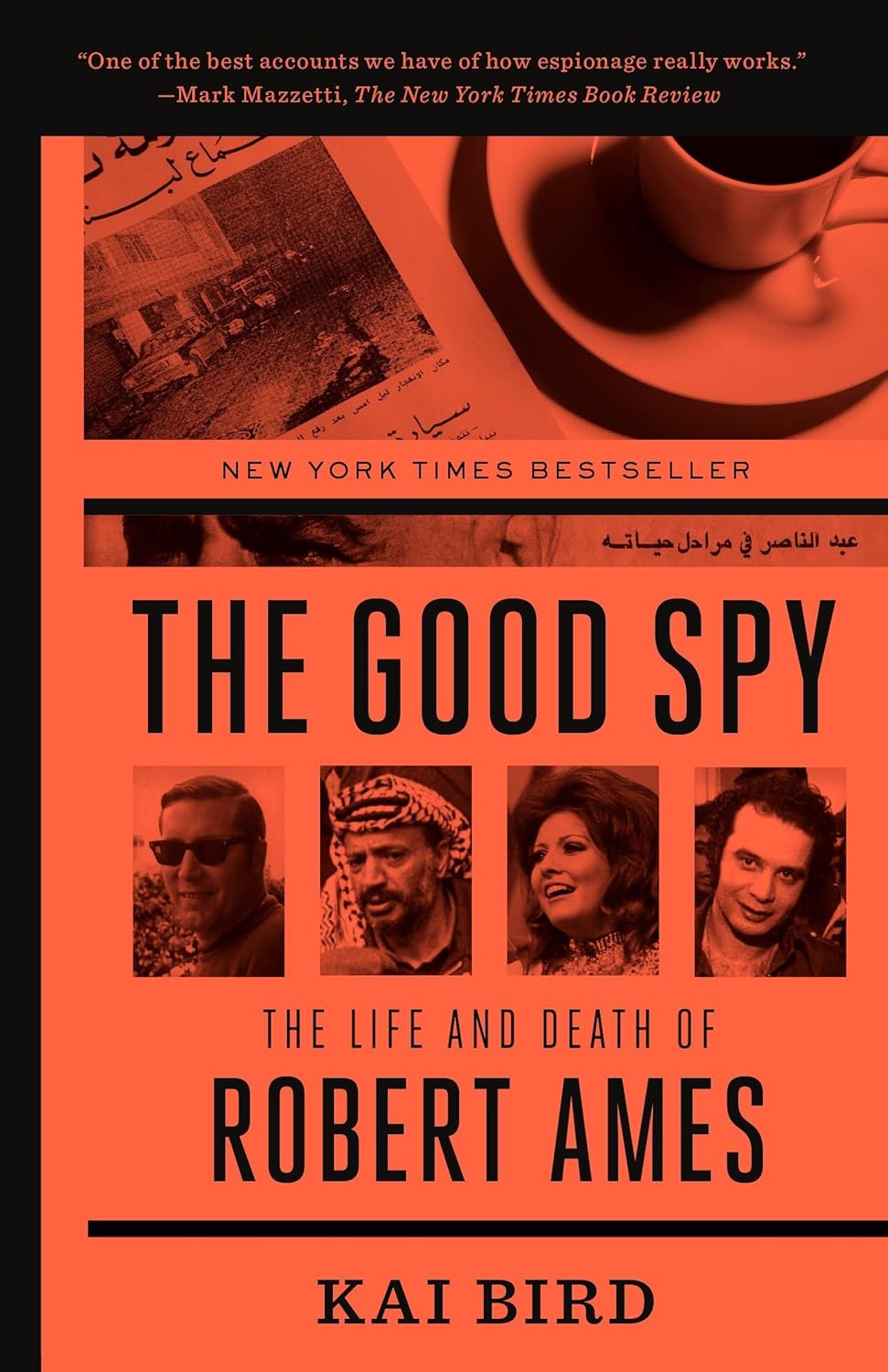
Unfortunately, the Israeli-Palestinian conflict is as thorny, intractable and relevant in 2016 as it was thirty-plus years ago when the civil war in Beirut dominated the headlines. This page-turner of a book, “The Good Spy: The Life and Death of Robert Ames” by Kai Bird is a fabulous view into the reality of late twentieth century spycraft.
“The Good Spy” is ostensibly a biography of Robert Ames, the legendary CIA Arabist killed in the car bombing of the US embassy in Beirut in April 1983, but in fact it is a sobering assessment of the value of covert operatives in general.
Naturally, Ames is the hero of the story. Tall, handsome, intelligent, hard working and, perhaps most important of all, deeply empathetic, his only fault, in Bird’s flattering narrative, was that “he loved those damned, troublesome Arabs too much.” The story is roughly broken into two parts. The first covers Ames’s career as a clandestine operative in the Middle East in the 1960s and 70s when he developed “soft recruitment” back channels to key PLO contacts, especially Ali Hassan Salameh, one of Yasir Arafat’s main lieutenants.
Ames’s cultivation of Salameh was highly controversial. The U.S. government claimed to have no contact with the terroristic Palestinian Liberation Organization (PLO), but in fact Ames, then still a mid-level operative, was the sole secret conduit. “Bob Ames befriended Ali Hassan Salameh, someone whose resume at the time spelled ‘bad guy.’ But most people would probably agree today that Ames’s calculation was a moral one. He was bringing Salameh in from the cold to a place where he could end violence and bring some definition of justice for his people: a two-state solution to the Palestinian conundrum.” In the end, Salameh paid for his relationship with Ames with his life; he was assassinated by the Israeli Mossad in Beirut in January 1978. Salameh was believed to have played a central role in planning the 1972 attack on the Israeli Olympic team in Munich, but his role as the diplomatic back channel to the U.S. government was reason enough for the Israelis to eliminate him.
The narrative of Ames’s years in the field provides a great view into the life and career of a CIA clandestine officer. Far from the romantic, fast-paced world depicted in James Bond movies, Bird describes a low paying, unfulfilling and generally ineffective job in a sprawling, backstabbing bureaucracy. Indeed, Bird writes that “A CIA survey of the DO [Directorate of Operations] covering the three decades prior to 1985 concluded that less than 5 percent of DO case officers recruited someone capable of producing protected, significant information.” In other words, the vast majority of CIA operatives never once accomplish the primary mission to which they have dedicated their careers and risked their lives.
Not only is the job dangerous and penurious (the Ames family lived paycheck-to-paycheck their entire lives and a financial consultant advised Ames to leave government service if he had any hopes of sending his six children to college), it also has limited influence on policymaking. According to Graham Fuller, a fellow clandestine officer cited by Bird, “The loss of innocence comes in stages…you have this notion that all that you need to do is get the right skinny, the right facts before the policymakers – and things would change. You think you can make a difference. But gradually, you realize that the policymakers don’t care. And then the revelation hits you that U.S. foreign policy is not fact-driven.”
Suffice it to say, this is not the kind of book that will make readers want to run out and join the clandestine service.
The second half of the book deals with Ames’s Washington years as the National Intelligence Officer for the Near East and South Asia (NESA) when he emerged as a key advisor to senior policymakers in the early Reagan administration. Much of this part of the book reads like a basic history of the war in Lebanon, known as “Israel’s Vietnam.” Bird describes well the chaos and viciousness as rival Sunni, Shiite, and Maronite militias battered each other silly while the Israeli army stalked the suburbs of Beirut. It is also where Ames’s story ends. On April 18, 1983 he was one of nearly two dozen Americans killed in the truck bombing of the U.S. embassy. Most amazingly, it had been his first trip back to the Middle East in five years (!).
In all, “The Good Spy” is a level-headed and sobering account of a highly successful CIA career. For those with an interest in the Israeli-Palestinian conflict or spycraft, this is a fun and fast read.
 What's Tim Reading Now?
Leave a comment