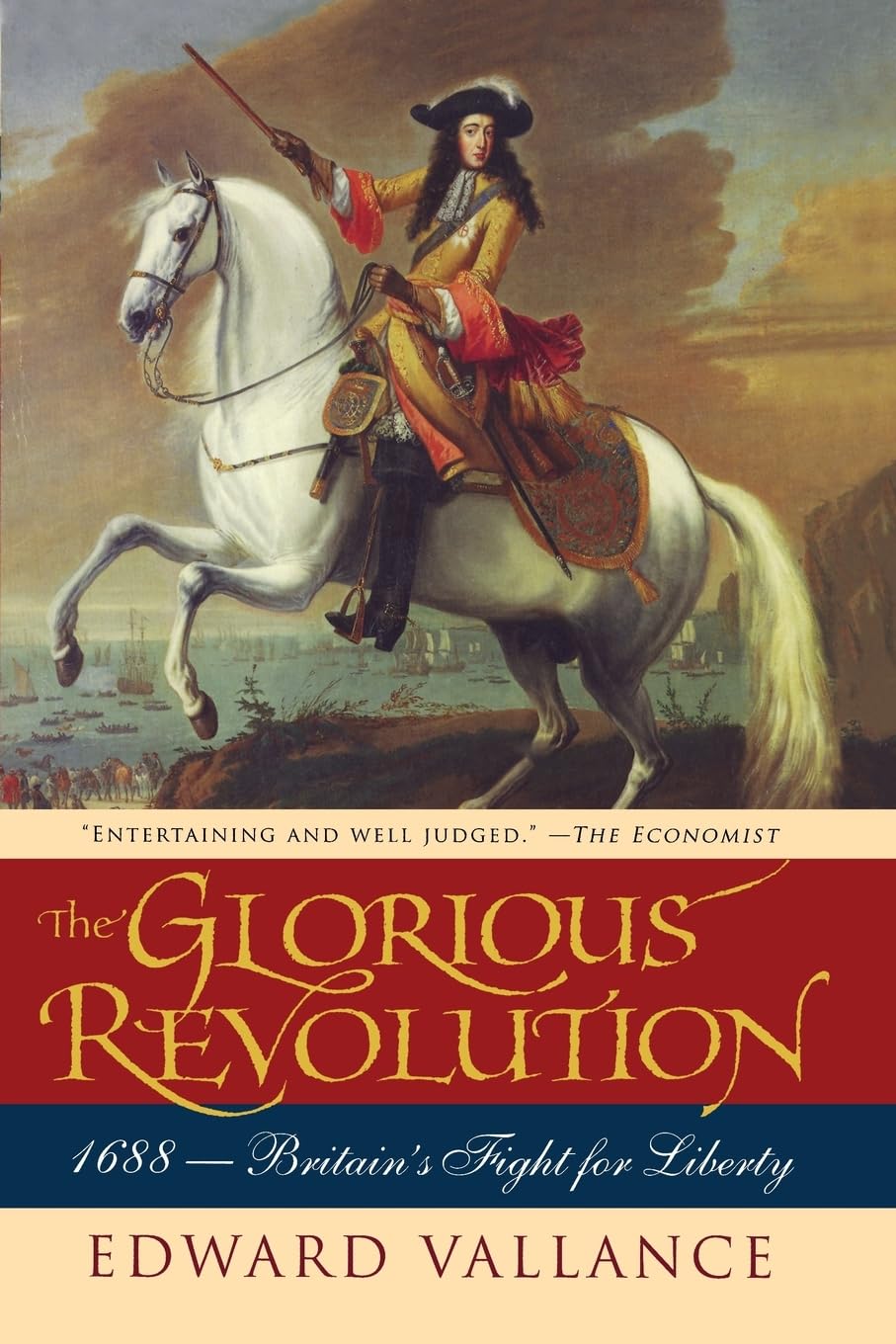
I love to read popular histories by authors such as David McCullough, Candice Millard, Stacy Schiff and Roger Crowley. I was hoping that the “The Glorious Revolution” would be cut from the same mold. I was persuaded by the back cover of the paperback edition, which claims the book is, “A thrilling narrative account of Britain’s ‘bloodless’ revolution of 1688, which reads as dramatically as the best historical novel.” Such praise is patently absurd. Edward Vallance’s history is neither thrilling nor novelesque. It is a dry and plodding, yet learned account of the pivotal events of the 1680s.
In 1685, Lord Monmouth, nephew of the recently crowned Catholic King James II, landed a small, ragtag invasion force on the shores of England. His goal was to return the British crown to himself, a Protestant. The expedition was ill-fated from the start and easily crushed by the royalist army. Monmouth and hundreds of his followers were executed. The British countryside, not to mention the city center of London, failed to rise up against their Catholic king. That support, however, would prove to be short lived.
Vallance cites three events that greatly swayed British public opinion. First, the French revoked the Edict of Nantes (1598) and began to openly persecute the French Huguenot minority. It was something many feared the English king would attempt in England. Second, James II began appointing Catholics to positions of public office and encouraging the open practice of Catholicism. Finally, the king’s wife, Mary of Modena, gave birth to a healthy baby boy ensuring that James had a direct heir and raising the prospect of an indefinite Catholic British monarchy.
Overall, Vallance is quite sympathetic to James II. In short, he claims “James did not seek the forcible reversion of England back to Catholicism and that his aims were limited to securing the political and religious emancipation of Catholics and [Protestant] dissenters.” However, his Tory and Anglican opponents saw a much more sinister plot developing. A relatively large standing army along with a royal campaign against the carrying of arms by private individuals alarmed many. The king’s “brusque and authoritarian personality” and what many perceived as pro-Catholic actions in Ireland, Scotland and the American colonies further set the royal opposition on edge, Vallance says.
The Dutch army under William of Orange landed on English shores on 5 November 1688. The invasion force was massive, four times the size of the Spanish Armada a century before, according to Vallance. They were preceded by what we would today call a psychological warfare operation. England was flooded with Dutch propaganda fliers calling into question the legitimacy of James’s newborn heir and suggesting that the King’s pro-Catholic government in Ireland was a model for his future government in England. Vallance notes that William’s expedition may have been presented “as a crusade to liberate the isles from popery and arbitrary government” but that “a war sold as a mercy mission was really instigated for reasons of geopolitical and economic self-interest,” namely the Dutch fear of an alliance between James and the Sun King, Louis XIV.
The royalist army was roughly twice the size of the invasion force, but support for James melted away with astonishing rapidity. “James’s formidable army had been disbanded with hardly a shot fired in anger,” Vallance writes. “His navy had failed even to engage the Dutch armada.” His daughter, Princess Anne, defected to the Protestants while mass anti-Catholic riots rocked English towns and villages. Unfounded rumors of gruesome Irish Catholic soldier attacks on Protestants stoked the flames of unrest even further. His kingdom lost, James absconded to France.
As an American with scant background in early modern British history, I naturally learned a lot from “The Glorious Revolution.” I only wished the book was easier and more enjoyable to read. There are many books to choose from on the subject. I can’t help but believe that there are better places to start than here.
 What's Tim Reading Now?
Leave a comment