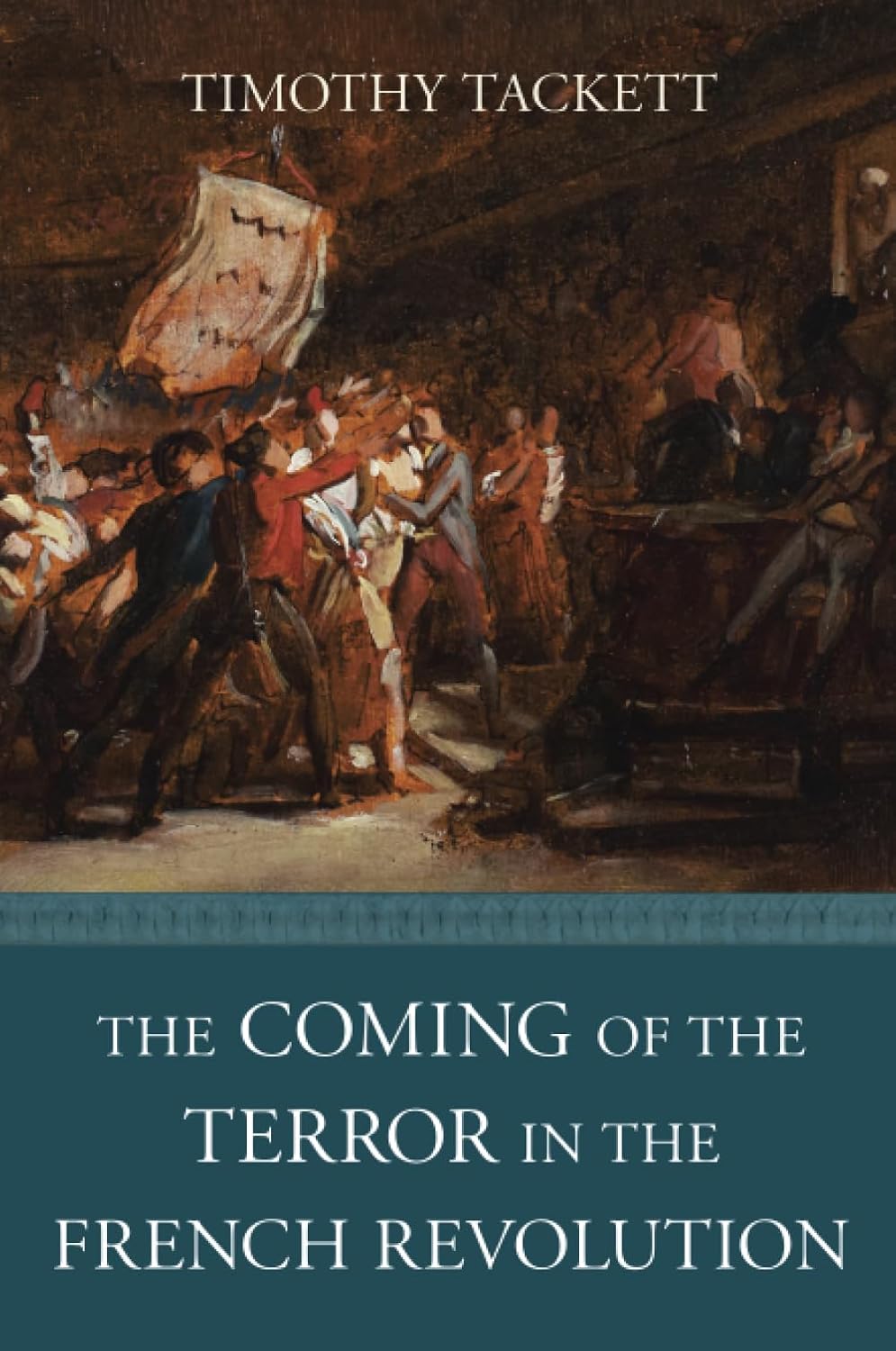
“How had the high ideals of 1789 turned to the violence and terror of 1794?” That is the question that Timothy Tackett, professor emeritus of history at the University of California, Irvine, seeks to answer in his well-acclaimed 2015 book “The Coming of the Terror in the French Revolution.”
It’s a great question and one that had been vexing me, too. I’ve devoted the better half of 2017 to reading about the tumultuous early years of the French Revolution. It is shocking and perplexing to read how the earnest men of learning and reason who led France away from the ancien regime and toward an enlightened republic could turn on one another with such passion and hatred. Indeed, Tackett writes “The origins of such passionate rivalries remain one of the more mysterious aspects of the Revolution.”
Tackett seeks the answer to this mystery by focusing primarily on the development of a political culture of violence among the leadership, particularly among those on the Left. He emphasizes three aspects: 1) the process of revolution as it evolved over the first few years; 2) a focus on the well-educated, middle-class urban professionals that made up the political elite; and 3) a study of the evolving mindset and psychology of the revolutionary leaders. These Leftist leaders all believed in liberty and equality, but struggled with one another in determining the limits of both.
In his analysis, Tackett focuses on personal relationships and emotions, especially fear – fear of invasion, fear of chaos, fear of anarchy, fear of revenge. That collective fear was made more destabilizing by two additional factors. First, it was fear mixed with an unprecedented sense of hope, what the author calls “a complex mixture of contradictory emotions, the feelings of both fervor and fear, optimism and pessimism…” The achievements of the first few months of the Revolution were truly breathtaking. Even those who had lived through it and played key roles in the events could hardly believe it. It was, in the words of deputy Nicolas Ruault, as if “woodcutters had brought down an entire forest in a few hours.” Suddenly, anything seemed possible. It was a glorious time to be alive – and to be French!
But the Revolution was threatened on all sides, or at least that was the universally held opinion among revolutionary leaders of all stripes. This omnipresent threat of conspiracy was the second factor that made the situation so combustible according to Tackett. In fairness, there was plenty of anecdotal evidence to suggest that not all Frenchmen were being completely transparent with their opinions and their loyalties and that large scale efforts were being taken to undermine the Revolution. For instance, the early patriotic hero Mirabeau was later found to have been in secret communication with the Bourbon Court; King Louis XVI himself, despite many public professions of support, attempted to flee his own kingdom, while personal papers discovered later demonstrated that his earlier proclamations were completely disingenuous; some of the most famous and successful pro-revolutionary generals (e.g. Lafayette and Dumouriez) defected to the Austrians; tens of thousands of peasants around France rose in open, bloody revolt against the new government; the preponderance of European powers, in conjunction with the Catholic Church and disaffected French emigres, were openly allied in their hopes of crushing the Revolution by any means necessary.
With so much to lose and so much uncertain, a decidedly Manichean worldview took hold among the revolutionary factions. Dissent quickly became treason. Moderation was seen as a sign of conspiratorial complicity with the aristocrats or continental powers. Ironically, so too was support for more radical policies, such as de-Christianization, which some thought were secretly abetted by France’s enemies in an effort to make the Revolution look bad. Tackett concludes that “It was perhaps above all the profound and deep-seated fear of conspiracy arising above all from the revolutionary process itself, that lead to the moralization of factional options, to the dehumanizing and demonization of one’s opponents, and ultimately to that toxic form of factionalism that would that would eventually be prepared to embrace violence and the physical elimination of one’s political rivals.”
Something else struck me as remarkable when reading “The Coming of the Terror,” although the author does not dwell on it: how the revolutionary process produced a steady Leftward drift up until the Thermidorean reaction of 1794.
In hindsight, the Revolution clearly went through several stages the produced increasingly radical Leftist governments. At the beginning of each new phase it seemed as though political accommodation and stability was finally possible, only to witness former political bedmates turn against each other until the more extreme elements achieved complete victory, ushering in the next phase of radicalization. For example, the process started with the Estates General in 1789. Perhaps half of the delegates to the Constituent Assembly might have been called revolutionaries or patriots; the rest were royalists and aristocrats. When the Legislative Assembly met in 1791 all of the deputies were left-wing patriots, but they quickly split between the more conservative Feuillants and the radical Jacobins supported by the Paris street. By the time the National Convention met in 1792 the Jacobins had triumphed. The once far Left Jacobins now split between (relative) right and left, with the Girondins supporting some form of constitutional monarchy while the hardline Montagnards promoted pure republicanism based on the ideals of the Enlightenment. By 1793 the Montagnards were firmly in control and dominated the new Committee on Public Safety. And, again, once in power the leftwing split into competing moderate and radical factions, this time the Indulgents or Citras led by Georges Danton and the Ultras associated with Jacques Herbert. Only this time the far left would not win out. Instead, Robespierre sought to destroy both, leaving only himself to govern from the relative middle. It worked for just over one hundred days in the summer of 1794.
A mere 72-hours after the fall of Robespierre, two-thirds of the Paris Commune (87 out of 140) were dead. Militant Paris had been decisively defeated. By threatening only a handful of deputies by name, Robespierre had inadvertently threatened them all, hold-over Citras and Ultras alike, along with uncommitted members of the Plain. The Terror arose “neither through Old Regime culture, nor through the influence of a few individuals, nor through circumstances alone,” according to Tackett, but rather “through a concatenation of developments emerging out of the very process of the Revolution itself.”
 What's Tim Reading Now?
Leave a comment