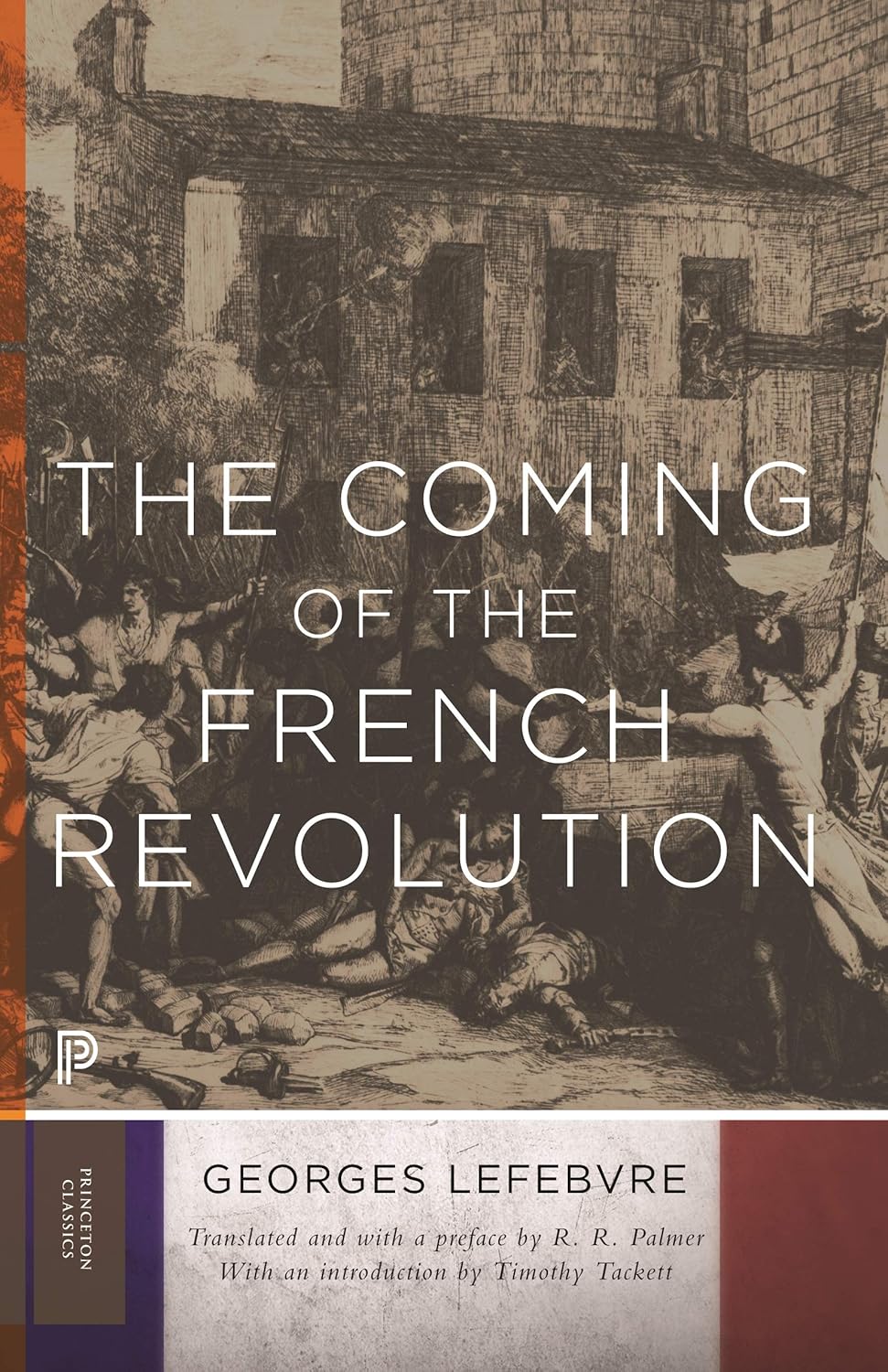
God only knows how many books have been written about the French Revolution. “The Coming of the French Revolution” by Georges Lefebvre, first published in 1967, is one of the few that has endured as a bona fide classic, regularly assigned as required reading as “the classical interpretation” of events from 1788-89 in university-level courses around the world.
“The Coming” may be relatively short and neatly organized, but it isn’t a light or easy read. Lefebvre’s thesis is tidy and cogent; his writing is academic and sterile. He argues that the French Revolution was ignited by the concatenation of four separate but interrelated events, each propelled by different segments of French society in response to the event before it. Namely, he writes about four revolutions.
First, the aristocratic revolution, began in 1788 as the upper classes in French society bridled at the hint of major fiscal reforms required to stave of imperial bankruptcy in the wake of expensive efforts to defeat the British in the Seven Years War and then the American Revolution. “Technically,” the author writes, “the crisis was easy to meet: all that was necessary was to make everyone pay [their fair share of taxes].”
The French aristocracy, very much the 1%ers of their day (there were roughly 400,000 nobles in 1789 France out of a population of some 26 million, or 1.5%), quickly expressed their readiness to make political concessions to the so-called Third Estate (the 98% of society that weren’t nobles or clergy), such as guarantees of individual liberty and freedom of the press, but were unwilling to budge on tax and social privileges. “By threatening the tax privileges,” Lefebvre says, the proposed reforms “aimed a blow at the social structure of the Old Regime.” The aristocracy was willing to negotiate on increasing tax payments, but not on social equality or any denigration of their honorific rights. Often land-rich but relatively impoverished and legally barred from engaging in the most lucrative private sector professions, the nobility were ferociously protective of their status as social elites. In many cases, it was all that they had. They wanted more. “There can in fact be no doubt that the aristocracy had entered the struggle against absolutism in the name of the nation, but with the firm intention of governing the nation and especially not being absorbed by it.” In other words, Lefebvre argues, the French Revolution, which would destroy the French nobility, was ultimately set in motion by the French nobility.
Second came the bourgeois revolution. What became known at the Revolution of 1789 was, at its core, a social struggle, a “class war,” according to Lefebvre. All three orders agreed on the basics of political and administrative reform: the end of royal absolutism; the voting of new taxes and legislation to occur at regular meetings of the Estates General; freedom of the press and individual liberty. Indeed, one wonders why the French Revolution ever occurred when reading the early narrative as depicted by the author. “But the agreement of the orders turned to radical dissension when they looked to their respective positions in the state … the Revolution of 1789 was above all the conquest of equal rights.” Lefebvre’s historical interpretation has an unmistakably Marxist undertone.
“The King was willing to become a constitutional monarch,” according to the author, “and so the purely political problem at least in principle was solved.” However, he was not willing to compromise when it came to preserving the traditional social order. On June 20, 1789 the Third Estate declared their Tennis Court Oath. No longer would the mass of French society, represented mainly by the bourgeois in the National Assembly, seek permission from the King and nobles and clergy. The nation of France, which they represented, was sovereign and required the acquiescence of no man or group of men. The aristocracy may have forced the meeting of the Third Estate in an attempt to establish their political dominance, but by June the Third Estate was stealing their initiative.
Third, there was the popular revolution. A full 3 million people in France – or well over 10% of the population – at the time of the revolution were homeless and rather aggressive beggars. Rising bread prices and stagnant real wages pinched an economically stressed population to the limits of endurance. Lefebvre writes that it is “beyond dispute that the economic distress should be included among the immediate causes of the Revolution.” Worse still, there was widespread belief that there was a conspiracy of the aristocracy to hoard grain to raise prices, the so-called “Famine Plot.” Indeed, the active belief in a conspiracy driven by the nobles played a fundamental role in the germination and explosion of the French Revolution, according to the author.
Just as the calling of the Estates General symbolized the revolution of the aristocracy and the Tennis Court Oath symbolized the revolution of the bourgeois, the storming of the Bastille symbolized the popular revolution. The impetus for the attack was a combination of the news of finance minister Necker’s firing on July 12th and rumors that the Bastille contained a cache of arms (others argue that it was gun powder that the mob was seeking … everyone agrees that freeing political prisoners didn’t play into anyone’s motivations). The author stresses that much of the popular actions and violence in Paris in July were motivated by rumors and alleged actions of nobles against the popular assembly and the grain supply. “The aristocratic conspiracy is one of the keys to the history of the Revolution,” Lefebvre writes. It forms the keystone to his overall narrative.
Fourth and finally, the revolution of the peasants presents “one of the most distinctive features of the Revolution in France,” in the author’s assessment. He claims that the calling of the Estates General had an enormous impact on the countryside as the peasantry had long-standing grievances against the weighty taxes leveled upon them by both the nobility and clergy. When the Estates General finally met and appeared to take no action on the peasants’ explicit complaints, it was again attributed to a plot by the aristocracy. Lefebvre writes “the peasant rising would be inconceivable without the extreme excitement produced by of the Estate General.” The peasants were struggling against a poor harvest, rising manorial dues, and the threat of increasingly large groups of poverty-stricken brigands who plundered what little material possessions the poor had. All of this was seen as encouraged, if not outright directed, by the venal aristocracy, the lords of the manor who took so much and gave so little to their subjects. Thus, the storming of the Bastille had a “decisive influence” in the setting the countryside aflame in riots and in search of food, a period of rumor and destruction the spread across France in the late summer of 1789 known as “The Great Fear.”
The upshot from this train of unforeseen events was the promulgation of The Declaration of the Rights of Man and Citizen by the National Assembly on August 26, 1789. Lefebvre says that the primary authors in the Constituent Assembly were “hypnotized by the past” and thus created a document that was “essentially the death certificate of the Old Regime.” It opens famously: “Men are born and remain free and equal in rights,” later articulated as “liberty, property, and resistance to oppression.” It tiptoes around freedom of religion for fear of alienating the liberal clergy upon whom the National Assembly depended; it is silent on the rights of property, mainly because the Old Regime had long defended them; it says nothing about the right of association, assembly, and petition as the details on those topics in a post-Estates General world were still being hashed out; and its defense of violent resistance to oppression was unambiguously drafted to protect those who had recently committed the assault on the Bastille. Thus, the Declaration was at once abstract and philosophical, echoing many of the core principles of Enlightenment thinking, yet decidedly “looked to the past more than the future” and very much reflected the state of affairs in August 1789.
In closing, Lefebvre declares that the Revolution of 1789, the product of four distinct revolutions (aristocratic, bourgeois, popular and peasant), had four remarkable characteristics: 1) the fall of absolute monarchy and advent of liberty henceforth guaranteed by constitutional government; 2) the advent of equality before the law; 3) the assertion that the people were sovereign; and 4) that liberty and equality are a common birthright of mankind. It was the admixture of the four revolutions, each of them unforeseen, which propelled the movement along at breakneck speed. The author wonders “whether the year 1789 might not have become the first phase of an evolutionary movement, during which the nobles would have gradually come to accept the status of mere citizens” if it weren’t for the power of the popular resistance. “Without popular pressure the Constituent Assembly would no doubt have pruned down the manorial system, but it is doubtful whether it would have dealt it so rude a blow” as it did, Lefebvre argues. It’s hard to disagree.
 What's Tim Reading Now?
Leave a comment