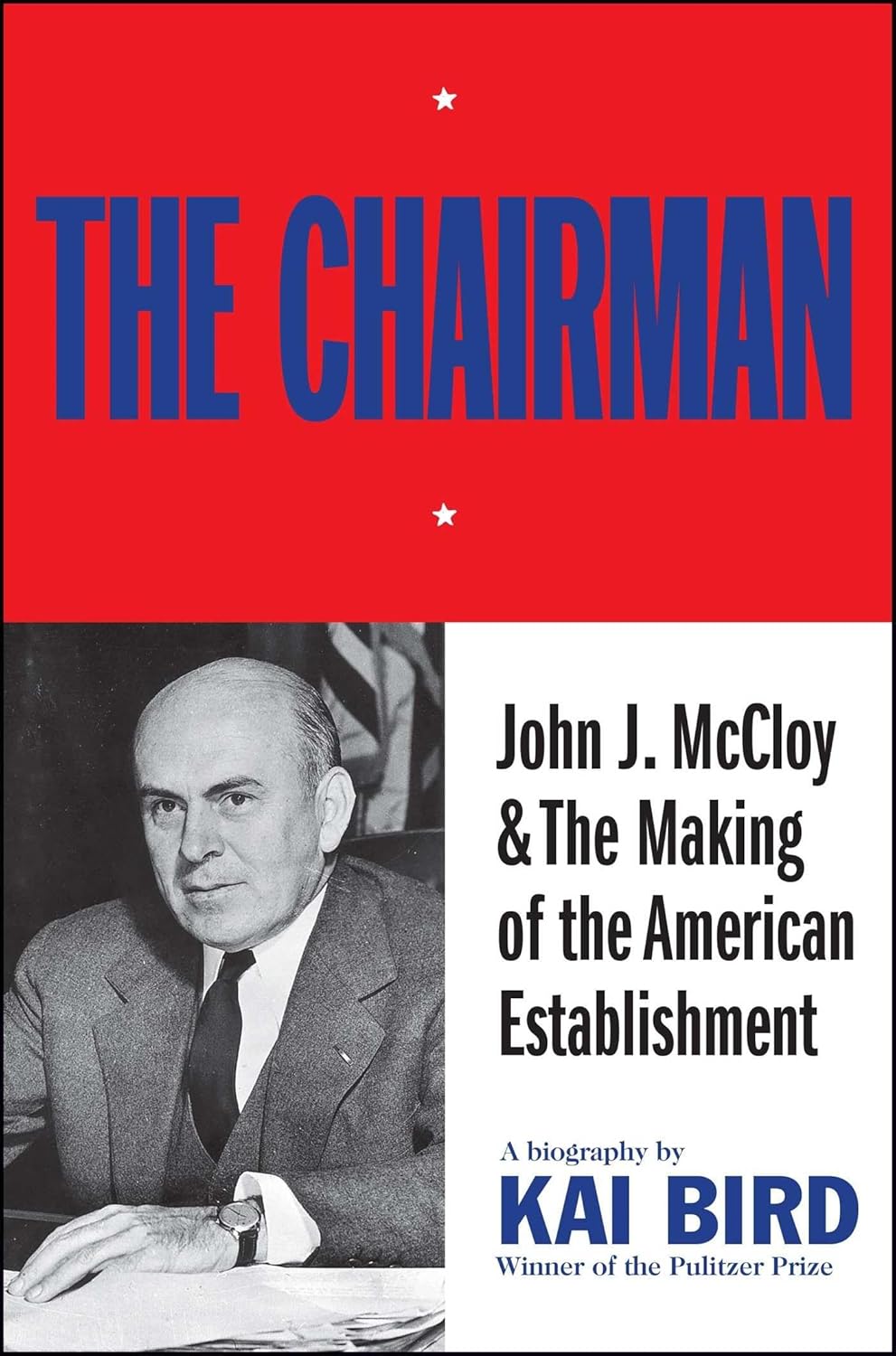
They don’t make them like John J. McCloy any more, influential men who serve presidents of both parties on issues of enormous national importance. Kai Bird tells McCloy’s amazing life story in this lengthy single volume biography first published in 1992.
McCloy came from rather humble beginnings. His insurance executive father died when he was just six-years-old, leaving his mother with little money. She supported the family by serving as a hairdresser to the elite families of Philadelphia. Despite straightened economic circumstances, McCloy was well educated, receiving a private school primary education before graduating from Amherst and then Harvard Law School.
McCloy made his professional mark in New York City, where he rose to managing partner of the prestigious Cravath law firm. One of his cases dealt with the World War I era German sabotage of the New York rail yard and depot known as Black Tom. The work would make McCloy something of an expert on intelligence and covert operations at a time when few government resources were dedicated to such things. This expertise led directly to McCloy’s recruitment to the War Department under secretary Henry Stimson in the year before American entry into the Second World War when McCloy was in his mid-40s. A committed internationalist and strongly in favor of preparedness, once war came McCloy believed the needs of the armed forces trumped even basic civil liberties. The Constitution was to him a “mere scrap of paper,” according to Bird, a shocking perspective coming from a distinguished attorney.
During his service in the War Department, McCloy played a central role in the internment of Japanese Americans. “More than any other individual,” Bird writes, “McCloy was responsible for the decision … Black Tom had convinced him that the enemy would inevitably engage in sabotage.” Despite such a prominent role in such a controversial act, McCloy’s reputation soared. He played key roles in a wide variety of strategic initiatives, everything from the building design of the new Pentagon to post war occupation policy (Bird also notes that McCloy bears “substantial responsibility” for the failure of US forces to target Nazi death camps prior to their liberation in 1945). He often attended Cabinet meetings with or in place of Stimson. By the end of the war, McCloy was, according to Bird, one of the most respected public servants in Washington and in high demand.
The title of this book is fitting. At one point in the 1950s, McCloy served simultaneously as chairman of Chase Manhattan Bank, the Ford Foundation, and the Council on Foreign relations (not to mention the bevy of other boards he sat on as a director or trustee), all while serving as vizier on foreign affairs and national security to president Eisenhower. “He seemed to be everywhere – in Washington, New York, Bonn, London and Paris – and to know everything,” Bird glows. How he was able to juggle all these responsibilities at once is not entirely clear. McCloy was certainly a man of high intelligence with a tremendous work ethic, but he is never described as conspicuously talented, some sort of man of genius. Rather, he possessed something the ancient Romans called “gravitas”: a unique blend of objectivity, honesty, prudence, common sense and most of all experience. Or as Bird writes, McCloy symbolized “bipartisanship, a deep and long familiarity with the law, and a reputation for sound and sober judgment.”
Two other points bear mentioning. First, McCloy was a lifelong Republican who nevertheless served Democratic administrations just as often and loyally as Republican ones. He represented the moderate, internationalist wing of the Republican Party, the type of perspective that would likely get him tagged as a RINO (“Republican in Name Only”) in today’s hyper partisanship environment.
Second, McCloy’s power came from his influence, his “gravitas,” rarely positional authority. In fact, McCloy held few official positions of power in the federal government over the course of his long career and never once at the cabinet level. After serving as assistant secretary of defense, he held a rocky two-year stint as president of the World Bank during the infancy of that institution and then served as high commissioner to occupied Germany until 1953 (where he again courted controversy by offering clemency to several Nazi war criminals, including the industrial war baron Alfried Krupp).
Shockingly, those would be the only official positions he held in government. He would go on to serve as the primary advisor to president Kennedy in the creation of the Arms Control and Disarmament Agency, then on the Executive Committee during the Cuban missile crisis where he was put in charge of negotiating the final settlement with the Soviets, and then was a member of the Warren Commission investigating Kennedy’s assassination. All of these positions he filled as a private citizen. During the Johnson administration, McCloy served as one of LBJ’s “Wise Men” in the 1965 discussion on the escalation of the war in Vietnam (“McCloy had counseled Johnson to use whatever force was necessary, to go in decisively with the intention of quickly bringing Ho Chi Minh to the negotiating table … Once the commitment of American prestige had been made, the country and the president had to await an honorable resolution”) and later served the government on secret missions to the Middle East, which McCloy viewed as far more strategic than Vietnam.
McCloy returned to the law as a named partner at the firm Milbank, Tweed and maintained an office there into the 1980s. He remained a fixture in Washington policy circles well into his eighties (he served on Reagan’s foreign policy transition team at the age of 85).
Late in his life, Harper’s magazine ran a cover story on McCloy calling him “the most influential private citizen in America.” After reading Bird’s meticulously crafted biography it’s easy to see why.
 What's Tim Reading Now?
Leave a comment