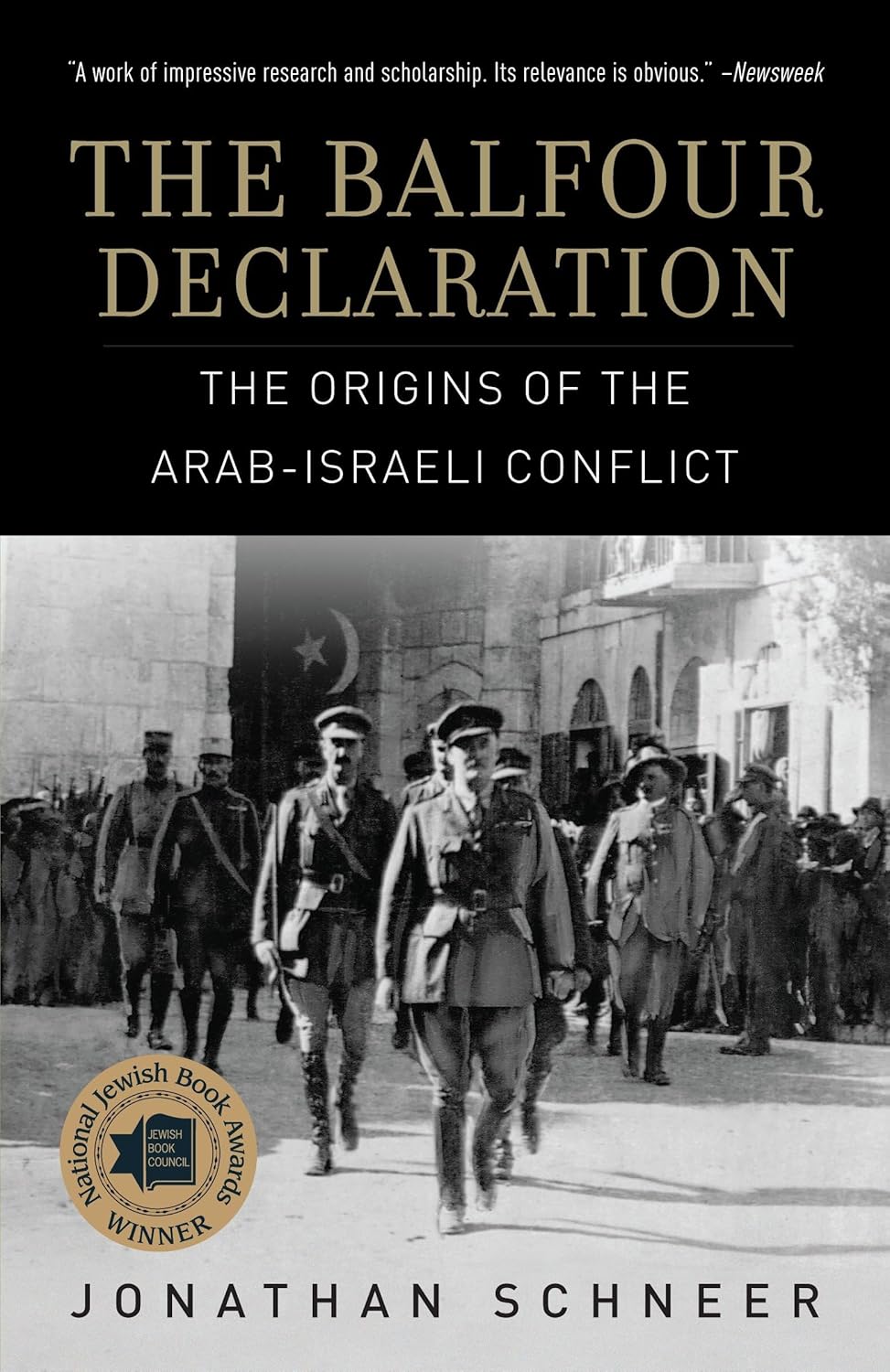
On November 2, 1917, with the First World War still raging fiercely along the Western Front and crackling in the Middle East as the Arabs revolted against their Turkish overlords, British foreign secretary Arthur Balfour made a stunning declaration: “His Majesty’s Government view with favor the establishment in Palestine of a national home for the Jewish people, and will use their best endeavors to facilitate the achievement of this object, it being clearly understood that nothing shall be done which may prejudice the civil and religious rights of existing non-Jewish communities in Palestine, or the rights and political status enjoyed by Jews in other countries.”
It was a momentous occasion and a decision, as author Jonathan Schneer demonstrates in “The Balfour Declaration: The Origins of the Arab-Israeli Conflict,” based on several fundamental miscalculations.
In 1915, the war was going poorly for Great Britain. The Gallipoli campaign had recently ended in disaster and Bulgaria had entered the war on the side of the Central Powers. Those in favor of an “eastern” approach to ending the war envisioned the defeat of the Ottoman Turks from within by fomenting an Arab revolt in the Middle East. The British believed that they had found their man to lead the revolt in Ibn Ali Hussein, Grand Sharif of Mecca. In exchange for launching a rebellion and defeating the Turks, the British promised to support the creation of a future Arabia led by the Grand Sharif. The borders of the future state were left somewhat ambiguous, as was the nature of British authority in the region. This is the backdrop against which the story of the Balfour Declaration is told.
Schneer’s overly detailed narrative often loses sight of the forest for the trees. Here are the main points and insights that he makes. First, Zionism may have had many champions, but it possessed only one true and gifted leader, and that was Chaim Weizmann. More than any other individual, Schneer writes, Weizmann “would orchestrate the wartime campaign of British support of a Jewish homeland in Palestine.” The Russian-born chemist effectively developed a political influence campaign that eventually reached the upper echelon of the British War Cabinet. “By the fall of 1917,” Schneer writes, “Weizmann could turn the key to most doors in Whitehall.”
Second, all of Weizmann’s prodigious efforts may have come to naught if not for the steady and vigorous support of the ebullient Sir Mark Sykes, “a sort of human champagne,” and one of Britain’s most respected Middle East experts. Sykes, a devout Catholic, sympathized with the plight of Jews in British society and unabashedly asserted the main object of Zionism to any British official who would listen: “to evolve a self-supporting Jewish community which should raise not only the racial self-respect of the Jewish people but should also be a proof to the non-Jewish peoples of the world of the capacity of Jews to produce a virtuous and simple agrarian population.”
Third, and perhaps most ironically, the greatest obstacle to British support of Zionism was not the Arabs but rather fellow Jews. According to Schneer, Lucien Wolf was “Weizmann’s anti-Zionist Doppelganger.” Wolf and those like him favored assimilation. They fundamentally rejected the idea that Jews constituted a nation and were not mere adherents to a belief system. Wolf feared that Zionism would undercut the tremendous social gains made by Jews in Britain and elsewhere in the western world. “The idea of a Jewish nationality, the talk of a Jew ‘going home’ to Palestine if he is not content with his lot in the land of his birth, strikes at the root of all claim to Jewish citizenship in lands where Jewish disabilities still exist. It is the assertion not merely of a double nationality … but of the perpetual alienage of Jews everywhere outside Palestine.” Likewise, another powerful British Jewish anti-Zionist Edwin Montagu feared that “Palestine will become the world’s Ghetto.” The Zionists, for their part, sneered at such thinking. Rabbi Moses Gaster, a vocal and disputatious British Zionist, warned his fellow British Jews, “The claim to be an Englishmen of the Jewish persuasion – that is, English by nationality and Jewish by faith – is an absolute self-delusion.”
Fourth, the Arabs suffered because they had no equivalent to Chaim Weizmann in London – or anywhere else for that matter. Grand Sharif Hussein was a marginal figure even in the Arab Middle East let alone the corridors of Whitehall. T.E. Lawrence cut a dashing figure, but had limited influence in government policymaking. Above all, Schneer notes that Zionism never really crossed the radar of the Arab nationalist movement until it was too late. On the eve of the First World War, there were just 85,000 Jews in Palestine, making up less than 10% of the total population. Moreover, Schneer estimates that only half of those Jews were committed Zionists (the same can be said for Great Britain where only some 2% of the country’s 300,000 Jews were Zionists). The likelihood of a Jewish homeland with official British protection seemed remote. In any event, Hussein and his colleagues believed that Palestine had been promised to him in the so-called Damascus Protocol of 1915, “at once the foundation document and the lodestar of the Arab Revolt.” Had it been? Schneer says the issue is foggy even a century after the fact. There may have been an honest misunderstanding relating to the use of the Arabic word “vilayet” that can mean district or environs. Indeed, according to Colonel Cyril Wilson, British official intimately familiar with the situation, “we have not played a straight forward game with a courteous old man who is … one of Great Britain’s most sincere and loyal admirers.”
Finally, and above all else, British policy concerning the Zionist caused rested on fundamental misconceptions, themselves rooted deeply in anti-Semitic thought. In short, London genuinely believed in the vast subterranean global power wielded by Jews. Robert Cecil, cousin to Arthur Balfour and influential Conservative member of Parliament remarked, “I do not think it is possible to exaggerate the international power of the Jews.” Even Mark Sykes, Weizmann’s indispensable collaborator in government believed “With ‘Great Jewry’ against us, there is no possible chance of [winning the war].” The British war effort was foundering. The Liberal government of Herbert Asquith fell in December 1916. The new Conservative government of David Lloyd George was pressured to do something, anything to bring victory. From this perspective, the Balfour Declaration was something of a “Hail Mary pass” to break the bloody deadlock. Furthermore, there was fear that Germany might pressure her ally Turkey to grant a Jewish homeland first, an idea Schneer derides as risible.
In sum, “The Balfour Declaration” is a deeply researched and authoritative history of one of the most consequential foreign policy decisions of the twentieth century. It is not, however, an easy or simple read. Much of Schneer’s narrative bogs down in unnecessary detail. Nevertheless, for those with a keen interest in the history of Israel or British foreign policy in the First World War you won’t find anything that compares to this.
 What's Tim Reading Now?
Leave a comment