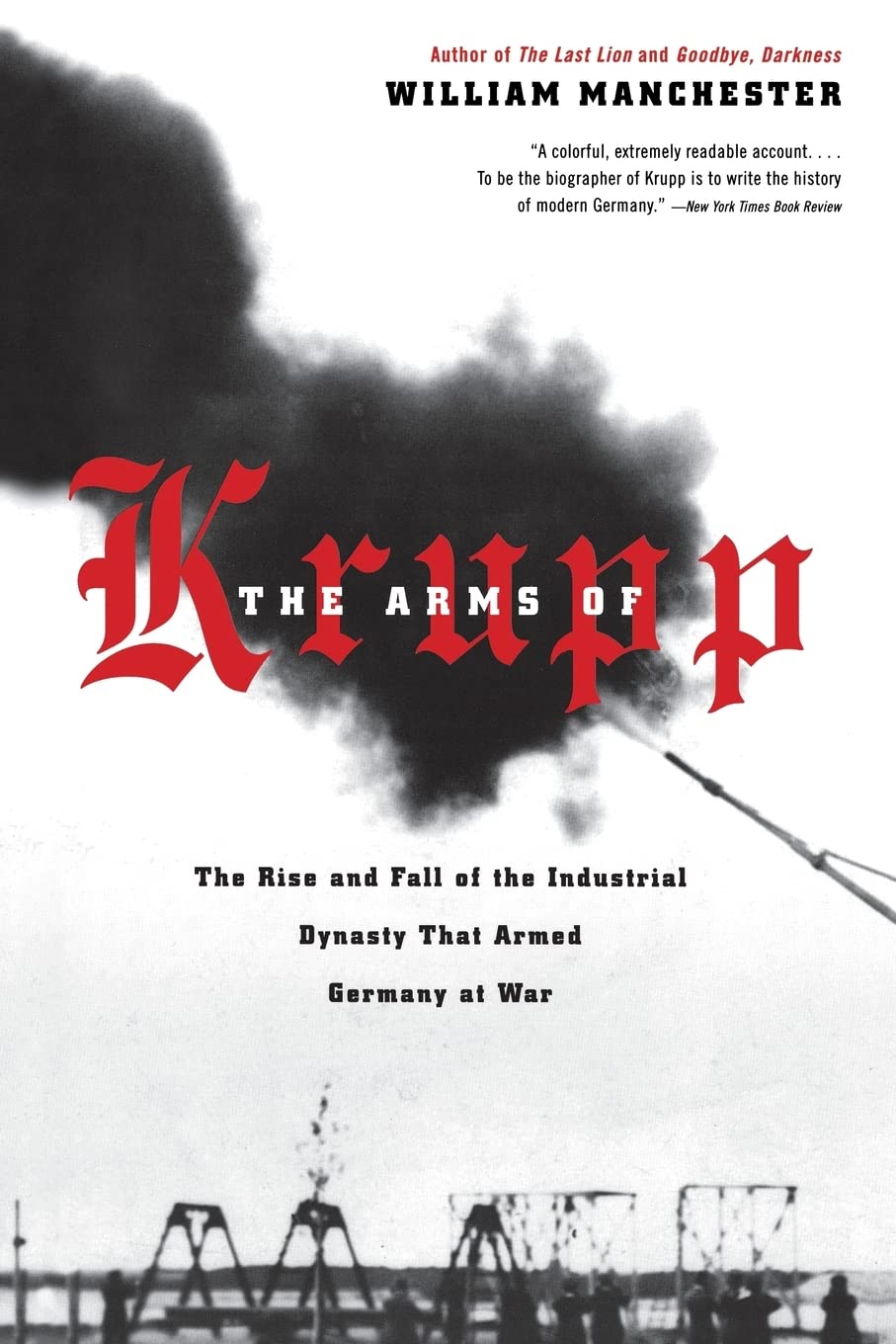
Originally published in 1964, “The Arms of Krupp” has earned the title of a non-fiction classic. Highly readable, the tale William Manchester tells is fascinating and all the more enjoyable for his mordant wit. At over 800 pages in length, however, it is a daunting read and at times can feel overwhelming.
The Krupp steel company shuffled along on the brink of insolvency in the Ruhr Valley town of Essen for several generations before Alfred Krupp (1812-1887) took over the company at the preposterously early age of 14. His father had left him a small foundry with less than ten employees on the verge of bankruptcy. Half a century later Alfred would leave his son, Fritz (1854-1902), the largest industrial enterprise in the resurgent Second Reich with over 20,000 workers and a reputation for excellence known the world over.
It wasn’t easy for Alfred Krupp, the man who would become known as the “Cannon King.” In many ways, as is often the case in business, luck had something to do with it. Through grit and sagacious management, Alfred had grown the Krupp steel works slowly but competently over several decades. Arms had never been their primary product. Rather, Alfred had perfected his process for smelting steel just in time for the surge in demand from the explosive growth of railroads in the 1850s. His patented process for forging seamless railroad wheels would bankroll his entry into the global arms market.
A major theme of “The Arms of Krupp,” somewhat surprisingly, is the stodgy, often blinkered view of the Prussian officer corps when it came to Krupp innovations in artillery. Far from being a truculent partnership in the cooperative development of new machines of death, the military often resisted Krupp’s latest inventions, Manchester argues. For instance, in the 1860s Krupp was promoting steel cannon over brass, which had been the standard since Napoleon’s defeat at Waterloo. “[Steel] represented change,” Manchester writes, “and the ossified brass regarded all progress with slit eyes.”
Amazingly, in this reviewer’s opinion, Krupp’s most steadfast opponent was the famed military innovator Albrecht von Roon. It was only after Prussia’s stunning defeat over the French in 1870 – a victory according to many owed largely to the superiority of Krupp steel artillery over the brass cannon of the French manufacturer Schneider – that the Krupp reputation as a world class arms dealer was made. But industrial political relations with Berlin remained strained as Krupp insisted on the right to sell arms broadly on the international market but expected an exclusive relationship with the Prussian military. Indeed, for much of the nineteenth century the Essen-Berlin alliance remained strained.
Fritz Krupp inherited an industrial behemoth and then expanded the enterprise beyond anyone’s dreams. He was, Manchester writes, “the most successful, baffling, charming, repulsive and most enigmatic of all the Krupps.” He was also a notorious homosexual with a preference for young Italian boys. The ensuing scandal would lead to his suicide. But before his untimely death in 1902 he had galvanized the relationship between the House of Krupp and the House of the Hohenzollern. He got on fabulously with the new Kaiser, Wilhem II, who Manchester characterizes as an “irresponsible, pompous, impulsive popinjay.” The Essen-Berlin alliance was firmly established. Indeed, Manchester claims that the Hohenzollern without Krupp behind them was “a house of cards.”
The next in line was Kustav Krupp von Bohlen und Holbach, the husband of Fritz’s eldest daughter Bertha. They were married in 1908 and, contrary to tradition, he took her name. A cheerless martinet and former diplomat, Manchester claims, “It is in fact doubtful that he entertained a single original thought in his entire life.” If unimaginative, he was certainly not uncommitted. Even more than his predecessor, Gustav ensured that the Krupp works were welded to the German military. At the height of World War I, Krupp was employing over 150,000 men and was churning out 9 million shells and 3,000 cannon each MONTH. The massive Krupp 420 howitzers decimated the supposedly impregnable defenses of Liege. The Kaiser was more than satisfied with his arms maker in Essen.
Even more consequential to the overall story, Gustav was committed to rearmament after the war and collaborated with the General Hans von Seekt in circumventing the restrictions of Versailles. The Krupp family came late to the National Socialist party, but when they came they did so with gusto. The alliance between Hitler and Krupp was tight and consequential. Hitler bestowed special privileges upon the Krupp works and the Krupp works bestowed upon Hitler the war machines necessary to fulfill his destiny. The story of that relationship, first with Gustav and then, after his retirement in 1943, with his son, Alfried, takes up half of the book, a total of 400 pages. Indeed, the narrative becomes overwhelming. The great surprise is that the backward, “inferior” Slavs of the Soviet Union would outpace Krupp in terms of both quantity and quality during the war. Soviet weapons designed and manufacture was something of a miracle, according to Manchester.
The last quarter of the book deals with the fate of Alfried Krupp, convicted of war crimes and stripped of his property at Nuremberg, only to be pardoned by American proconsul in Germany, John J. McCloy. Manchester sees the clemency as a miscarriage of justice. “If you were to say that Krupp was not guilty, it would be as true to say that there had been no Auschwitz fuse factory, no company concentration camps, no Rothschild gassed, no basement torture cage, no infant corpses, no slain, no crime, no war.” Yet, Alfried emerged from the Landsberg prison in 1951 a free and very rich man – and a national hero.
In closing, “The Arms of Krupp” isn’t for everyone. While readable and at times brilliant, it is, in the end, excessive and stilted. Manchester is no fan of the Germans in general and, most of all, is appalled at the clemency shown to Alfried after the Second World War. The general reader should probably avoid this tome, but for those with a deep interest in German history and particularly the Nazi military-industrial complex it is not to be missed.
 What's Tim Reading Now?
Leave a comment