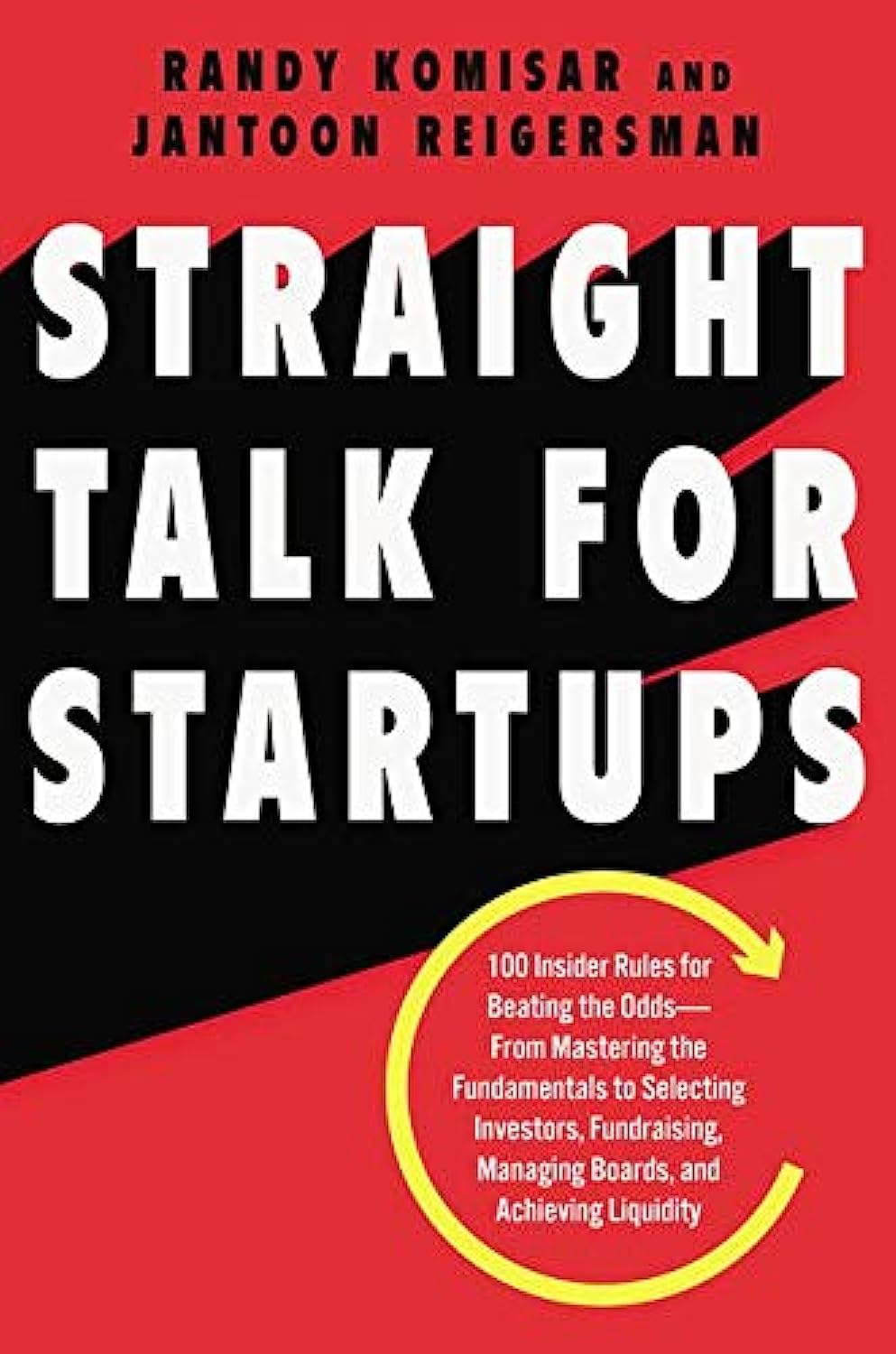
’ve written over 300 book reviews here on Amazon over the past couple of decades, but this one for “Straight Talk for Startups” by Randy Komisar and Jantoon Reigersman is one where my opinion is something very close to “expert.” I’ve worked in Silicon Valley for nearly twenty years, most of it spent as a corporate development executive at Oracle and Intuit focused on partnering with and acquiring promising tech companies. Over the past five years, I’ve lived on the other side of the equation, leading and growing startups across a variety of sectors, making countless venture capital pitches, and ultimately raising tens of millions in venture financing for three companies. Based on my experience, “Straight Talk for Startups” lays out everything an entrepreneur will need to think about as they nurture their business over time.
First, a few words of disclosure and opinion. I’ve known co-author Randy Komisar for many years. In fact, he was the lead investor in one of the startups I’ve worked for. He is a world-class investor, coach, and all-around human being. He brings a wealth of experience and insight from his years as an operating executive and active board member. He and Reigersman have collected here 100 “rules” for startups, but I’d encourage the reader to think of them more as highly informed, but generalized “thoughts” to be considered by aspiring entrepreneurs. Each journey is different and no two problems will require precisely the same remedy. Keep that in mind as you digest the many pearls of wisdom that Komisar and Reigersman offer here.
I’d encourage any entrepreneur to read this book cover-to-cover and keep it handy for periodic check-ins throughout the life of your business. That said, here are the “rules” that I have found most important based on living the life of a Silicon Valley startup and acquiring them on behalf of billion-dollar tech companies.
Rule 16: Use financials to tell your story. In a perfect world, this would be true. However, many young companies will find that you’ll need to lean on other tangible, but non-monetary metrics to tell your story. For instance, many venture capitalists are most interested to see rapid customer acquisition growth and high user retention for our innovative mobile web browser, Cake Browser, understanding that monetization is relatively easy for that type of product.
Rule 20: Unit economics tell you whether you have a business. Amen! Startups need to get a clear and early understanding of average customer acquisition cost (known as CAC) and the long-term value of each retained customer (known as LTV). This CAC to LTV ratio will be the linchpin of your business case and investor pitch. Allocate significant time and energy to getting it right.
Rule 31: Avoid venture capital unless you absolutely need it. Always remember that 90% of venture-backed companies fail. Moreover, if you’re successful, the “cost of capital” of venture financing will be enormous given how much equity you will be giving up. Lots of people treat tier 1 venture-backing as a source of pride and achievement (e.g. “Benchmark led our A-round…”), and to a certain extent that’s understandable, but keep in mind that venture capital is a means to an end and should never be treated as an end in itself. If you can bootstrap your company and/or fund operations responsibly out of personal savings, do it.
Rule 35: Choose investors who think like operators. Admittedly, this is a personal bias. I don’t put much faith in the opinions of investors who’ve never run a product or built a business themselves. You’d think that entrepreneurial experience would be required to work at a leading venture firm, but you’d be wrong. Lots of investors are what I like to call “book smarts” – gilded academic pedigrees, MBAs from top-ranked schools, and a few years at leading investment banks or strategy consulting firms. Those people are, in my opinion, great targets for recruitment to corporate strategy and development teams at big tech firms, but not venture firms.
Rule 36: Deal directly with the decision makers. This one is easier said than done. Even after decades in the Valley with lots of VC contacts, I still find myself pitching junior partners in the hopes of getting to the decision makers eventually. My two cents for beginners here is that getting meetings, even with junior folks, is harder than you might imagine. Once you get your foot in the door, you’re working to get the next meeting. Always be sure to temper your expectations, because a highly enthusiastic response from an associate analyst doesn’t mean much. And when the firm tells you that they are passing, more often than not they don’t provide much in the way of reasoning or feedback. All that said, the authors are correct that you’ll need to get a general partner on your side if you have any hope of closing the deal. Eventually, that partner will become an ally working to convince the rest of the firm to approve the investment.
Rule 41: Strategic investors impose unique challenges. This is another personal bias of mine. In short, I hate strategic investors (i.e. the venture arm of large corporations). One of the startups I’m associated with has raised significant strategic venture money and perhaps it will pay off eventually, but I’ve found that those investors are slow, overly cautious, and have an inherently muddled business model. Moreover, the lead “investors” are often “wannabe” VCs who lack both valuable operational experience (see Rule 35) and internal clout. In a perfect world, I’d avoid strategic investors altogether.
Rule 50: Never stop fundraising. This is important because, as Rule 52 states, fundraising takes more time than you think. By the time your A-round closes, it’s time to start thinking about your B-round raise. Why? Because you need to figure out which investors are good fits and then figure out how to get to and eventually win over the senior decision makers (see Rule 36). It’s no exaggeration to say that fundraising will consume 50% of a startup CEOs time over the first few years of operation. Plan for it.
Plan 53: The pitch must answer the fundamental questions about the venture. Komisar and Reigersman have put together here a fantastic outline for a great venture pitch. Use it.
Rule 54: Make it personal. As much as metrics will ultimately tell your story (see Rules 16 & 20), whenever possible include personal anecdotes in your pitch. For example, when pitching Nav, a startup that seeks to help small business owners understand and leverage personal and business credit scores, we had our CEO tell stories for when he owned and operated a neon and awning business in Idaho and was denied loans because of poor business credit ratings. These stories made our pitch more tangible and more memorable. It also helped convince our eventual investors that we were genuinely passionate about the problem we were tackling because we had lived it ourselves.
Rule 62: Don’t take rejection personally. You’re likely going to be rejected – a lot. You’ll get frustrated that investors don’t share your view that your business idea is a sure winner. Keep your head up and keep plugging away at it.
Rule 71: Each director must commit to spending meaningful time. Don’t get caught in the trap of recruiting celebrity directors. If someone can’t commit to attending 75% of meetings and showing up prepared, save them for your “advisory council.” More often than not, the more famous your directors the less you’ll get out of them. If you ever find yourself getting “board of director envy” just remember the case of Theranos.
Rule 88: Individuals need liquidity, too. If all goes well, your company will be a success and you and your colleagues will soon be paper millionaires. Remember that there’s a reason for the qualifier “paper” before millionaire. Many leading executives will take significant pay cuts in order to work for your startup. In the absence of a liquidity event, you’ll eventually need to consider how (and if) they can cash out at least a portion of their paper fortune. The same will likely hold true for you and your co-founders.
Rule 96: Build a relationship with potential acquirers; don’t cold call. Inexperienced entrepreneurs will fret that getting too close with potential acquirers risks giving away trade secrets. That’s hardly ever the case. Do your best to meet and build relationships with the corporate development executives at the companies most likely to acquire your business. You’ll likely find that you’ll learn more from them than they will learn from you. Moreover, you want those teams to like you personally and believe that you and your business will be a great fit in their corporate structure. Never underestimate the power of personal connections.
In closing, “Straight Talk for Startups” is a treasure trove of pointers for entrepreneurs. Hopefully, my additional insights help add even more value to the book. Best of luck to you and your team!
 What's Tim Reading Now?
Leave a comment