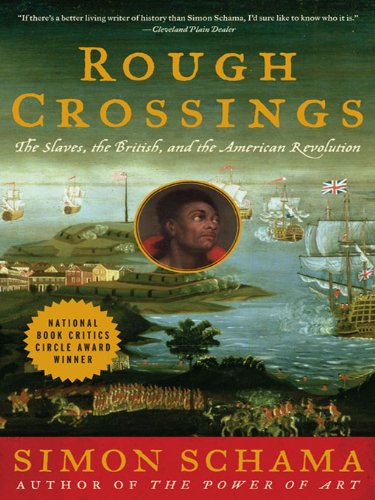
For far too long the African-American experience has not been fully or accurately captured in American history books. At the time of the American Revolution, 20% of the 2.5 million people in the colonies were black. In the plantation provinces, such as Virginia, that proportion could be as high as 40%. Of the roughly 500,000 slaves in America in 1776, author Simon Schama estimates that somewhere between 80,000 and 100,000 left the plantations during the war. It’s a staggering figure and a sadly ignored aspect of the well-documented Revolutionary period.
The first thing any prospective reader should know is that “Rough Crossings” doesn’t tell the full story of blacks and the American Revolution or what happened to those 100,000 souls who fled the plantations. Rather, it tells just one side story, but a fascinating one: how over 1,000 impoverished ex-slaves living in Nova Scotia after the war emigrated to an experimental new British-backed colony in Sierra Leone on the west coast of Africa in the 1790s. Thus, “Rough Crossings” is more the story of the foundation of Freetown, Sierra Leone than it is the story of the African-American experience during the Revolution.
Schama breaks “Rough Crossings” into two equal parts, the first of which lacks a clear narrative structure. It is the backstory to the Nova Scotia exodus (and frankly I’m not sure it was necessary). Titled “Greeny,” it is dedicated to Granville Sharp, the founding father of the British abolitionist movement, a man Schama calls “an eccentric but famously resolute warrior on behalf of slaves in England” and in fervent opposition to what he called “The Accursed Thing.” Sharp made his reputation by defending slaves in British courtrooms – and was surprisingly successful at it.
Most famously, in 1772, Sharp defended James Somerset, an erstwhile slave who was kidnapped and bundled off in chains to be returned to slavery in Jamaica. Sharp sought to use the case to establish that “no man can be a slave, being once in England, the very air he breathed made him a free man [and] that he has a right to be governed by the laws of the land” on exactly the same basis as any other man. The final verdict, however, was much less limited in nature. The Lord Chief Justice Mansfield had indeed set Somerset free, but had gone to great lengths to not make a general ruling on the legality of slavery in England. Specifically, he ruled that Common Law did not recognize a master’s right to transport his slave against his will out of England to a place where he might be sold. However, the widely held impression of the Somerset verdict was much wider; both sides believed the verdict made slavery illegal in England, and that rumor quickly made its way to the enslaved masses in America. “It had made the idea of British freedom a germ of hope,” Schama writes. “There was hardly a black, free or slave, in North America who did not know those two words: Granville Sharp.”
Thus, when revolution came, America’s enslaved population saw England as the true land of freedom and escaped to the British lines whenever they could. Soon, tens of thousands of slaves across the colonies were risking life and limb to join the British. “Despite all the physical and material ordeals, brutal disappointments and betrayals endured by the blacks,” Schama writes, “the stark fact that the British were their enemies’ enemies made them keep coming to the royal standard.”
In 1783, the British capitulated; they abandoned a community of some 750,000 loyalists, including 100,000 in New York alone, in what Schama calls “the greatest cost-cutting exercise in British history.” The primary destination for many of these refugees was Nova Scotia. Around 15% of the incoming loyalists were black, about 5,000 in total; only perhaps half were free. Nova Scotia was no promised land by any stretch for the black emigrant population. It was known for “its martinets, its bitter, hostile white disbanded soldiery, its sanctimonious churchmen, its procrastinating clerks and its partial magistrates.”
Sharp’s advocacy for ex-slaves extended beyond the courtroom to his seemingly quixotic Province of Freedom, a resettlement colony at the mouth of the Sierra Leone River. The first attempt at colonization was to resettle London’s indigent black street population, an effort that ended in disaster. Sharp and his key collaborator, Thomas Clarkson, however, were not ready to give up on the project. They looked to the ex-slave population barely clinging to existence in Nova Scotia as a potentially better candidate for resettlement.
Part Two, “John,” focuses on Thomas Clarkson’s idealistic younger, naval officer brother who led the effort to recruit and transplant willing, impoverished blacks from Nova Scotia and then served as the first governor of the newly minted Freetown in Sierra Leone. Part Two possesses the narrative arc that Part One lacks. Also, it’s a story that’s well told in a 2007 BBC docudrama hosted by Schama that’s available for free on YouTube.
In Schama’s learned estimation John Clarkson is a hero: earnest, noble and fair. From beginning to end, he treated the destitute emigrants with dignity, respect, Christian charity and, above all, fairness. He promised the desperate ex-slaves a better life in their native Africa, a new community where they could start their lives over, playing a leadership role ffor the first time. It began with a perilous journey from Halifax to Sierra Leone, a righteous armada of 15 vessels carrying 1,200 ex-slaves to Freetown in 1792. Schama stresses that Clarkson wanted the return journey to Africa to be as comfortable as possible, as unlike the horrid middle passage as he was able to create. “What John Clarkson had designed,” Schama writes, “was an inter-racial, floating Christian republic: bound for freedom, glory and merited blessings of God.”
Two other characters play a pivotal role in Schama’s narrative in Part Two: ex-slaves Thomas Peters and the Baptist minister David George. The BBC docudrama pays particularly close attention to the rivalry that developed between Clarkson, the formal leader of the expedition, and Peters, the de facto indigenous leader, which was only settled by the untimely death of the latter.
The settlers eked out a tenuous existence from the forbidding terrain. Disease became rampant. Hundreds died. Yet, under Clarkson’s unwavering and competent leadership they persisted. He was the lone white official worth his salt, according to Schama, the rest being indolent, mildly racist drunkards. Nevertheless, Clarkson would be removed from governorship by the leadership of the Sierra Leone Company back in London. It was feared that he had “gone native” and lacked the ability to effectively manage the native population and promote the interests of the company. The idea of a free, black democratic community quickly fell apart.
In closing, “Rough Crossings” provides an inspiring read of a forgotten page in history, if not necessarily American history per se.
 What's Tim Reading Now?
Leave a comment