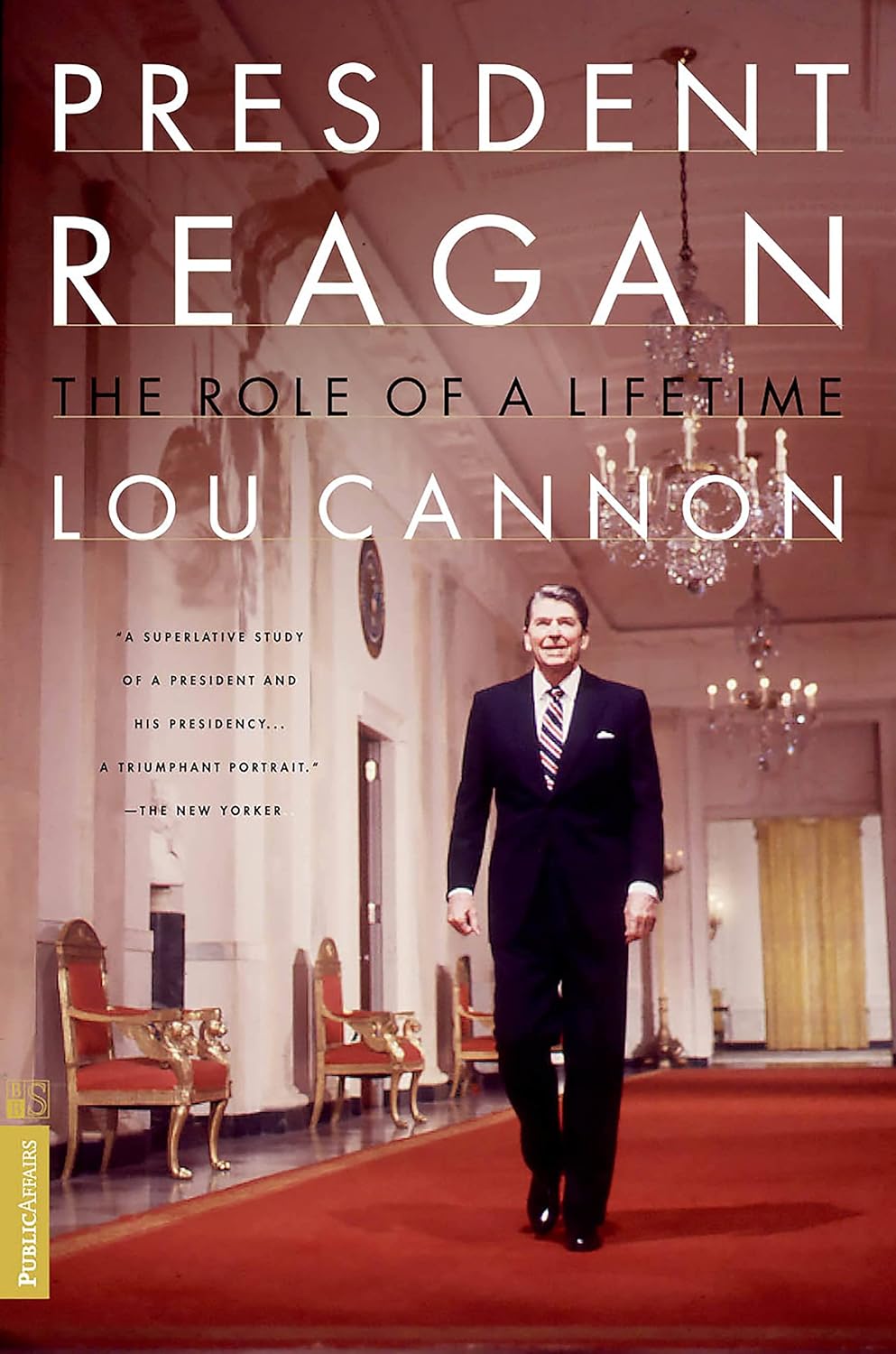
Ronald Reagan isn’t the kind of president that many Americans are on the fence about. Either you love him and believe he belongs in the pantheon of great presidents alongside Washington, Lincoln and FDR or you think he is one of the most incompetent (albeit lucky) chief executives in American history. Lou Cannon’s “President Reagan: The Role of a Lifetime” is written largely for the latter group, I’m afraid, although the author concedes “It was clear to me that [Reagan] was not a dunce, amiable or otherwise. But it was difficult to understand how his mind worked.”
At over 800 pages in length, there’s lots of detail in this narrative of the Reagan administration, some flattering, lots of it not. However, two threads seem to tie the narrative together: Republican political infighting and the resulting scandals that emerged when Reagan inevitably split the difference between his advisors’ recommendations.
First and foremost, Cannon claims that the Reagan administration was run by the president’s subordinates. “Too often,” he says, “Reagan was a performer and presidential leadership an empty shell…[he] held the reigns of power so lightly that he did not appear to hold them at all.” Moreover, his subordinates were split into two fiercely competitive camps – the pragmatists (led by Howard Baker, George Shultz, Michael Deaver, David Gergen, Nancy Regan and Richard Darman) and the conservatives (including Edwin Meese, William Clark, Bill Casey, Caspar Weinberger, Jean Kirkpatrick, and Pat Buchanon), neither of which trusted the president’s personal judgment on anything. “The sad, shared secret of the Reagan White House,” Cannon writes, “was that no one in the presidential entourage had confidence in the judgment or capacities of the president…Pragmatists and conservatives alike treated Reagan as if he were a child monarch in need of constant protection. They paid homage to him, but gave him no respect.” It’s a sad testimony coming from a reporter who was as close to Reagan and his White House as any other in journalism.
Worse yet, the president had a tendency to believe “any story, statistic, or policy recommendation that squared with his prejudices,” especially those that included a human-interest element (for that reason he was especially fond of Reader’s Digest). The situation was so dire that advisors had to physically hide the far Right newspaper “Human Events” (something of the Breitbart News of the 1980s) fearing that Reagan would swallow whatever crank story he read in its pages and regurgitate it as established fact in some public setting.
That said, for all of the talk about pragmatists versus conservatives, many of the intense internal battles were more over personal rivalries and personal preferment than a struggle over policy. The disdain with which leading administration officials held each other, such as Shultz and Weinberger, is often astonishing. As conservative Jean Kirkpatrick concluded, politics within the Reagan administration were more “Shakesperian” than “Machialvellian.” And it was the personalities, none more so than Donald Regan, that came to dominate the White House in the second term that doomed the Reagan administration. What had been a well-oiled political machine at the White House in the first term completely went off the rails in the second. It was “…with remarkable casualness and virtually no consideration of the consequences, [that] Reagan began his second term by agreeing to break up the team that had been largely responsible for his first-term success,” Cannon writes in exasperation.
In retrospect, some of the Reagan era scandals seem harmless, almost quaint. For instance, the controversy that erupted in May 1985 when Reagan presided over a wreath-laying ceremony with Chancellor Helmut Kohl at a military cemetery in Bitburg, Germany that interred 2,000 World War II German soldiers, including 49 SS troops. Cannon devotes a full chapter to the episode. Today, it feels like a footnote.
More weighty were the Reagan administrations twin foreign policy disasters. First, the US involvement in Lebanon, which Cannon argues is a classic example of Reagan’s approach to difficult decisions and divided counsel. Cannon stresses Reagan’s “proclivity for splitting the difference” between his advisors or retreating “to the lowest common denominator of agreement”, which led to tragedy in Lebanon as American Marines stumbled into an ill-advised and ill-defined peacekeeping role that ultimately left 241 soldiers dead.
Far more serious was the Iran-Contra scandal, a subject to which Cannon devotes nearly a fifth of the book. Reagan’s national security advisers, of which he had plenty, often “wielded insufficient influence and excessive power.” Such was the case with the arms-for-hostages deal. The pivot upon which the events turned, according to the author, was Reagan’s face-to-face meeting with the families of the Beirut hostages in Chicago in 1985, a meeting his advisors tried to cancel precisely because they knew how deeply affected the president was by personal encounters with Americans with heart-breaking stories. Ultimately, Cannon argues, Reagan “cared too much” for the hostages in the Middle East; he could never resist a human-interest story.
Shortly after the tear-jerking meeting with the families Reagan quoted Teddy Roosevelt in a speech referencing the hostage situation: “Let no one doubt our resolve…the American people are slow to wrath, but once their wrath is kindled, it burns with a consuming flame.” It certainly did for Reagan. He was willing to take any risk to get the hostages back, despite the vocal opposition and dire warnings of both Shultz and Weinberger in a rare instance of partnership. “Ronald Wilson Reagan believed in God, his luck, his mother, Nancy Reagan, and the United States of America,” Cannon writes. In the case of arms-for-hostages, his remarkable luck finally ran out.
In closing, Cannon clearly came to respect Reagan, even if he never grew to admire him. “Reagan’s greatest service was in restoring the respect of Americans for themselves and their own government after the traumas of Vietnam and Watergate, the frustration of the Iran hostage crisis and a succession of seemingly failed presidencies…[he] may not have been a great president, but he was a great American who held a compelling vision of his country.” Indeed, “Reaganism was a time bomb with a delayed fuse.”
Or as Reagan himself grandly summarized his tenure in January 1989: “We meant to change a nation, and instead we changed a world.” It’s difficult to argue against him.
 What's Tim Reading Now?
Leave a comment