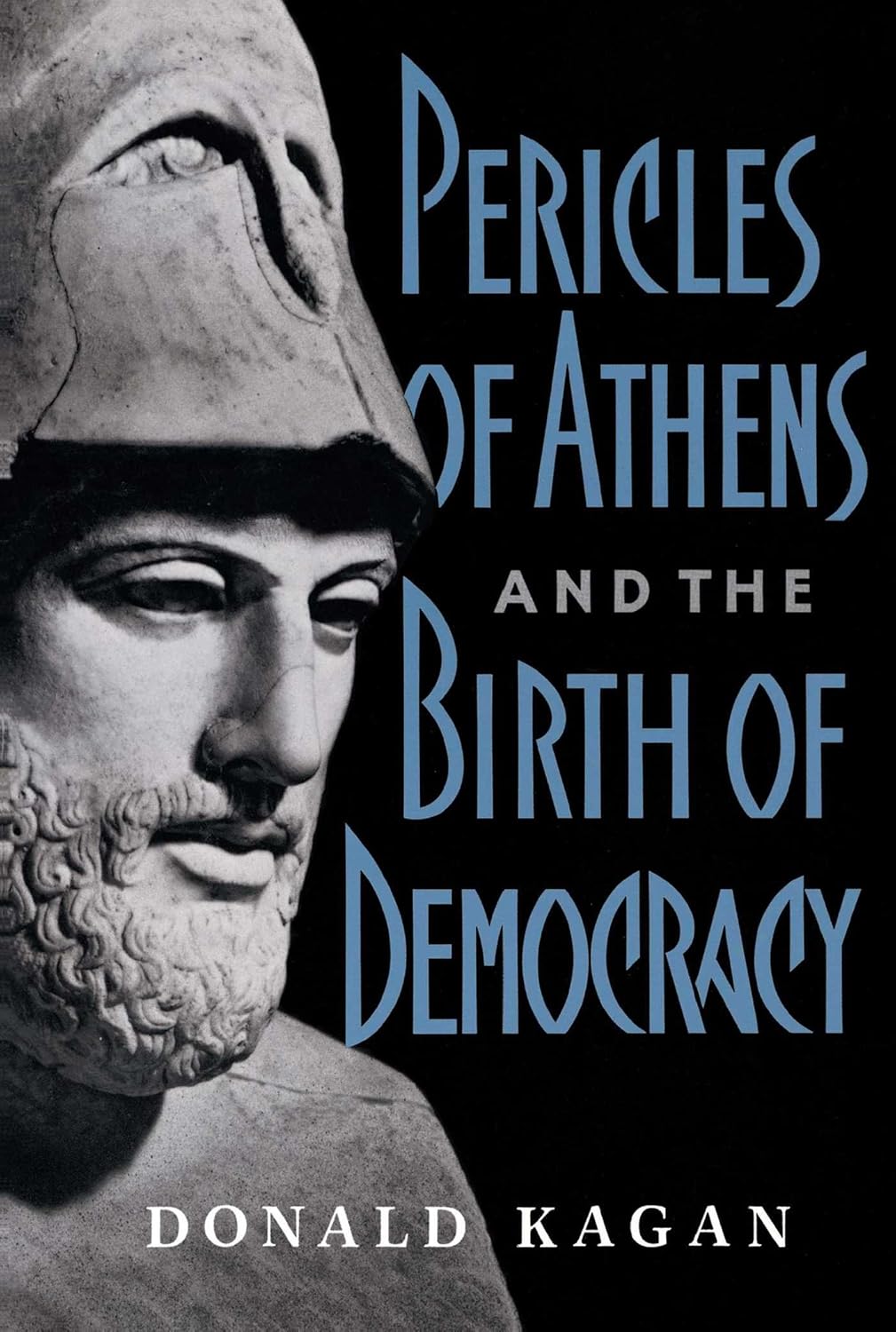
The great Greek historian Thucydides remarked that Athens in the 430s BC “was in name a democracy, but really a government by the first person.” That first man – “protos amer” in Greek – was Pericles, son of Xanthippus, the hero of the Battle of Mycale against the Persians in 479, mentee of the radical democrat Ephialtes, guardian of the precocious Alcibiades, and rival of the aristocratic leader Cimon, who put the finishing touches on the democratic government bequeathed to Athens by Solon and Cleisthenes. If Herodotus is the father of history and Themistocles the father of the vaunted Athenian navy, then Pericles may be thought of as the father of the democratic Athenian empire.
Donald Kagan, perhaps the greatest American classical scholar ever to live, is unabashed in his fondness for his subject in “Pericles of Athens and the Birth of Democracy,” a book first published in 1991 as the nations of the former communist bloc in Eastern Europe were beginning their shaky transitions to democracy. Kagan argues, “If the new democracies of our time are to succeed, they [like Periclean Athens] must offer more than economic prosperity.” They must see the intrinsic value in virtue, the rule of law, respect for individual rights, and political equality.
The author stresses that Pericles had no substantial wealth and no long-term of office to insulate him from the electorate. He was just one of ten annually elected generals and thus had to persuade his fellow citizens of the wisdom of his policies. Thucydides claimed that Pericles had once summarized the qualities necessary for a democratic statesman as “to know what must be done and to be able to explain it; to love one’s country and to be incorruptible.” The paradox at the heart of democracy – in our time as well as in ancient Greece – is that to be effective it requires freethinking and independent citizens on the one hand, and extraordinary individual leadership on the other.
Despite having limited primary resources (nearly everything we know about Pericles comes from just two sources: Thucydides, who was a contemporary; and Plutarch, who lived 500 years later), Kagan weaves together a complete and credible biography of the great statesman. The titles of the chapters (Soldier, Politician, Peacemaker, Visionary, Educator, Statesman, Strategist, Hero, etc.) spotlight the enormous and varied role that he played during his thirty years in public life. Above all, Pericles possessed a clear and mighty vision for his polis: “an imperial city at peace,” where reason and intelligence guided the people and their policies, not avarice or hubris. The achievement of that vision had two basic requirements: 1) a leader of extraordinary ability; 2) an outside world that recognized and honored Athenian sovereignty within the limits of its Aegean empire.
In Kagan’s view (not to mention Pericles’ own), Pericles met the first requirement. The second would be achieved by the tangible demonstration of Athenian invulnerability to Peloponnesian land power. Scholars from the time of Thucydides down to our own day have debated the causes of the Peloponnesian War endlessly. This book presents Kagan’s learned hypothesis on that timeless question.
Why did the war with the Spartans come when it did? Why did Pericles prove so obstinate in compromising over the Megarian Decree when nearly all of his other earlier diplomacy was a case study in moderation and graduated pressure (e.g. a purely defensive alliance with Corcyra, sending only 10 triremes to the Battle of Sybota, responding to Megara’s support of Corinth with only economic pressure)? The Spartans demanded that the Athenians rescind the Megarian Decree, which prevented the Spartan ally of Megara from trading within the Athenian empire. Pericles insisted that they submit the dispute to arbitration, as stipulated in their existing peace treaty. To do otherwise would be taking actions under duress, which would undermine their freedom and sovereignty. Thus, the great Peloponnesian War started over an issue of principle rather than the substance of the casus belli.
Kagan claims “[Pericles] believed that only one strategy could bring victory, and only he could impose and direct it.” War had to come when Pericles was still unchallenged, the influential protos amer who could convince the demos to adhere to a policy of passive defense. The Athenians would refuse battle in Attica. The Spartans would be allowed free reign to destroy their homes and crops while the men, women, and children of Athens hid behind the walls protecting their city. Meanwhile, the Athenian navy would launch amphibious attacks all along the coast of the Peloponnese, wearing down the enemy’s resolve to continue and leading to a negotiated settlement based on status quo ante, an agreement not much different than the existing Thirty Years Peace, but secure and lasting after the invincibility of Athens had been convincingly demonstrated. Pericles knew it would be a highly controversial and unpopular strategy to pursue, and only he (in his not-so-humble opinion) possessed the intelligence and nerve to execute it. “Pericles’ strength and uniqueness lay in his extraordinary confidence in reason and intelligence, especially his own,” Kagan writes, and it was “his stubborn adherence to reason [that] brought him down.”
Pericles believed that the Athenians needed to convince the Spartans that they were invulnerable and that the integrity and sovereignty of their empire needed to be respected. They would exhaust the Spartans psychologically by refusing to fight in the open to defend their homeland while bleeding Sparta and her allies. The fact that Pericles got his countrymen to voluntarily endorse such a plan places him, in the opinion of famed nineteenth-century German historian Hans Delbruck, “among the greatest generals in world history.”
The hawks among the Spartans believed that the war would be easy and short. The Athenians would either yield without a fight or come out and be decisively defeated. Therefore, any sign that the conflict would be neither simple nor painless would cause them to reconsider their strategy. For his part, Pericles relied heavily on the Athenians’ significant advantage over the Spartans in accumulated material wealth. Athens generated 1,000 talents a year from their empire via internal revenue (400 talents) and tribute from allies (600 talents). In addition, they had stockpiled 6,000 talents in their treasury on the Acropolis. Kagan estimates that it would cost roughly 2,000 talents a year to execute Pericles’ war strategy: 100 triremes harassing the Peloponnesian coast, 70 besieging Potidaea, and 30 defending the island of Euboea. Thus, by deduction, Pericles evidently believed that the Spartans would seek the desired negotiated settlement in less than three years. “A policy of restraint at home and abroad would sooner or later bring the friends of peace to power in Sparta,” Kagan says.
Pericles did not count on – and likely could not have foreseen – the devastating plague that hit Athens in 430. It would render his intelligently thought-out plan “a manifest failure.” The enemy simply refused to concede that they could not win. Even on his deathbed in 429, he “passionately clung to the path that his reason had laid out for him,” Kagan writes, and his successors stuck to it for an additional two years after his death. Thus, no matter how rational the intellectual underpinnings of his strategy may have been, it was faulty. It “should” have worked, but didn’t. Kagan argues that Pericles failed to anticipate and appreciate the powerful influence played by passion, pride, and the will to win. Men are often irrational, especially in times of conflict. Yet he never recognized nor acknowledges that he may have erred in his policymaking. “The difference between perseverance and disastrous inflexibility,” Kagan notes, “can be terribly thin.” And so it was for Pericles and his Athenian polis, which he had so skillfully shepherded to prosperity, power, and glory. “His strategy intended as a moderate device for persuading the enemy to make peace was too weak to bring victory but strong enough to cause anger and intensify the determination of the Spartans.”
In closing, “Pericles of Athens” is a fantastic and, I believe, an underrated book on Athenian strategy and the outbreak of the Peloponnesian War.
 What's Tim Reading Now?
Leave a comment