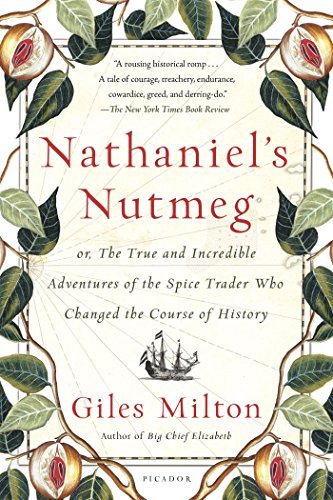
You should be aware of a couple of things before reading “Nathaniel’s Nutmeg: Or, The True and Incredible Adventures of the Spice Trader Who Changed the Course of History.” First, despite the title, this book has little to do with Nathaniel Courthope and his reputed adventures. In fact, Courthope doesn’t even appear in the narrative until page 202 in chapter 7, and then only as a peripheral character. Chapter 10 concentrates on his four-year ordeal from December 1616 to October 1620 fending off Dutch attempts to physically wrest control of the tiny but valuable nutmeg-producing island Run from the British. Second, Courthope’s purported role in changing the course of history is rather circuitous and certainly debatable. In short, in 1667, the British and Dutch signed the Treaty of Breda, “one of the most significant documents in history,” according to author Giles Milton, which swapped British claims upon Run for the future rights to Manhattan. “In exchanging a tiny island in the East Indies for a much larger one on America’s eastern seaboard, England and Holland had sealed the destiny of New York.”
Perhaps a more accurate title for this book would be “Tough Nuts: The East India Companies and the Anglo-Dutch Rivalry for Control of the Spice Trade.” It is difficult to exaggerate the value and influence of the spice trade to Western Europe in the early seventeenth century. Clove, mace and especially nutmeg are finicky plants. They grow naturally in only a few places on earth. Four hundred years ago nutmeg was only found on a few tiny islands between present-day Indonesia and Australia, an archipelago so minuscule that they don’t appear on large modern maps of the region. The most bountiful natural forest of nutmeg plants grew on Run, an island just two-miles long and half-a-mile wide. It was once, yard-for-yard, the most valuable piece of real estate in the world. “Run was the most talked about island in the world,” according to Miles, “a place of such fabulous wealth that Eldorado’s gilded riches seemed tawdry by comparison.”
Why? Because all sorts of fabulous (and clearly fraudulent) attributes had been ascribed to the nut, including the ability to ward off the dreaded plague. “Nutmeg … was the most coveted luxury in seventeenth-century Europe, a spice held to have such powerful medicinal properties that men would risk their lives to acquire it.” Indeed, in the early 1600s nutmegs were rarer and more valuable than gold or diamonds. A spirited and violent contest erupted between the Dutch and the British for access to – and ultimately unabridged control over – the islands that produced this invaluable commodity.
Milton tells the story of this rivalry almost exclusively from the British perspective. Both nations chartered an “East India Company” (London in 1600, Amsterdam in 1602) possessing the exclusive right to trade with the Spice Islands. Each regarded the claims of the other as invalid. Swashbuckling merchant captains – British and Dutch alike – raided native villages, burned down rival warehouses, bribed local chieftains, plundered spice-laden cargo ships, and unilaterally claimed sovereignty over nutmeg-producing islands. It was all quite a messy business, to say the least. Trade missions to the East Indies were known for their squalor and mortal danger. It was fully expected that half of the crew would be killed during the expedition, while the other half could expect to return barely clinging to life. But for many, it was all worth the risk. The riches to be had in the event of a successful trip were incredible. The markup on nutmeg prices between Run and London could be over 60,000%. An illiterate sailor could return with a small pouch of nuts and literally retire on the proceeds.
The war for control over the Spice Islands raged for decades, with the Dutch emerging more-or-less victorious. From their regional headquarters at Bantam, a port city 50 miles west of modern-day Jakarta, the Dutch East India Company dominated the major plantations in the region, including the nutmeg-producing Banda Islands, having ambushed and killed the heroic Nathaniel Courthope to take control of Run in 1620.
The aggressiveness of the Dutch would prove to be, in the end, a little too aggressive. In 1623, on the clove-producing island of Amboyna, the Dutch commander reacted violently to a rumor (false, as it turned out) that the small cadre of English traders on the island were plotting to seize the local stronghold of the Dutch East India Company, Fort Victoria. All eighteen Englishmen on the island were arrested, tortured and eventually executed, some by having their arms and legs blown off with gunpowder. Understandably, this caused an uproar in England. “There was only one possible way for the Dutch to atone for the Amboyna Massacre,” Milton writes, “and that was to hand back the tiny island of Run.” (It seems to me there were many other ways for the Dutch to atone for the incident!)
The British and Dutch East India Companies eventually learned to “play nice” with one another. By the end of the seventeenth century, the Spice Islands had lost much of their value after the British had successfully developed spice farms on Sri Lanka and Singapore. The wooded island at New York would prove to be a much better long-term investment than Run.
 What's Tim Reading Now?
Leave a comment