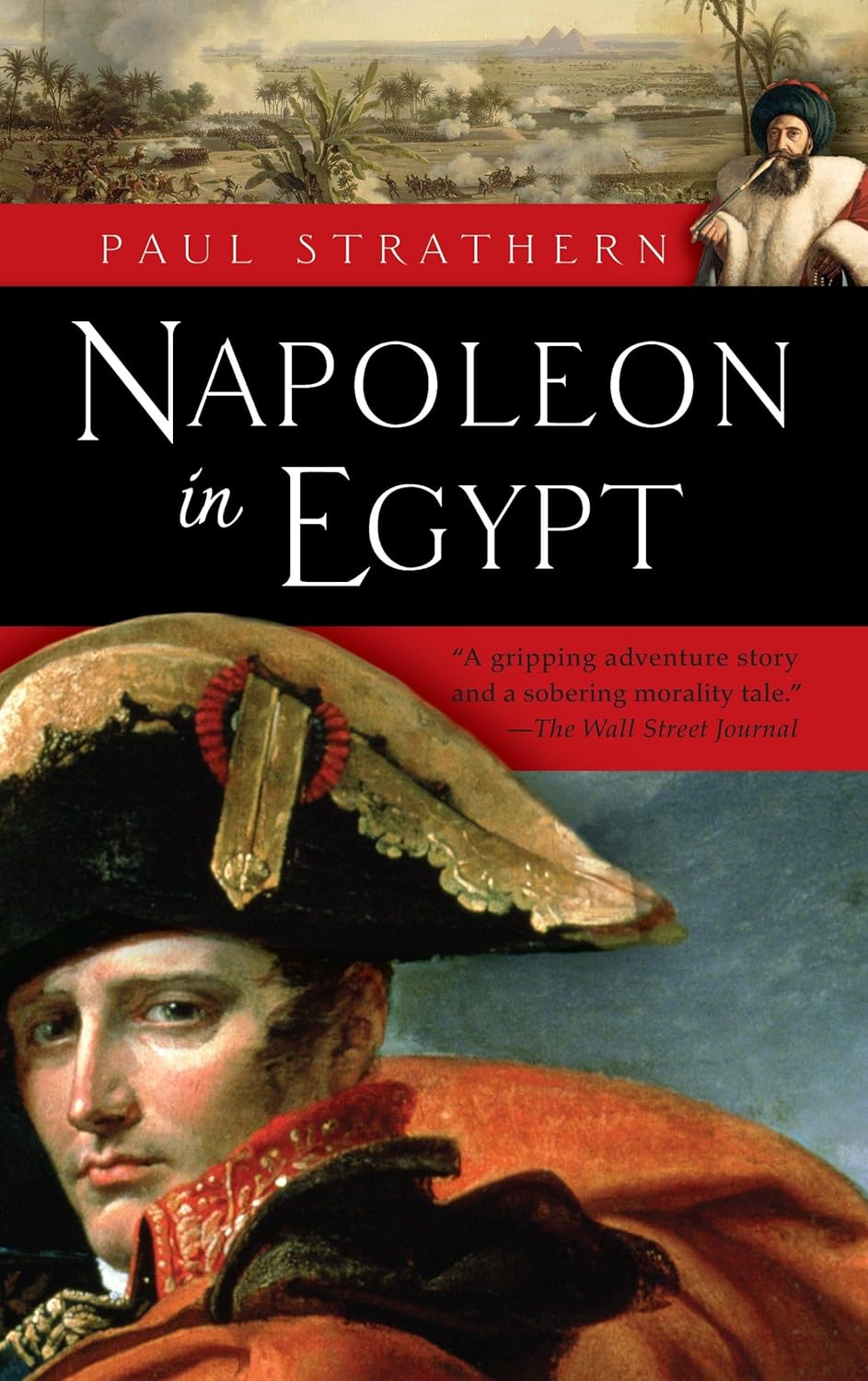
“Europe is a molehill,” Napoleon is said to have exclaimed, “We must set off for the Orient; that is where all the greatest glory is to be achieved.” The French invasion of Egypt in 1798 was one of the most audacious military and political undertakings of all time. With a fleet of 335 ships and 40,000 soldiers (not to mention 167 hand-picked savants) – an expeditionary force larger than that sent by the British to quash the American rebellion in 1776 – a 28-year-old Napoleon Bonaparte, emulating his hero Alexander the Great, set out to conquer an empire in the east. “Napoleon in Egypt” by the acclaimed novelist Paul Strathern tells this incredible adventure tale – and tells it incredibly well.
There are many surprising aspects to the French conquest of Egypt and broader operations across the Middle East in the late 1790s. First is the flimsy pretext upon which the entire invasion was based: the “liberation” of the Egyptian people from their Mameluke overlords and the protection of French merchantmen operating in Alexandria. (Never mind that Egypt was technically Ottoman territory and the Sublime Porte was ostensibly an ally of the French; Talleyrand would be counted upon to sort all that out.) The real impetus for the expedition was less altruistic. In short, the ambitious young Napoleon dreamed of conquests in the east culminating in the overland invasion of British India. “His primary aim in coming to Egypt was to found an empire – one that would extend to encompass Asia, but would also include Africa,” Strathern says. Meanwhile, Napoleon’s political superiors – the unstable Directory in Paris led by his mentor Paul Barras – were eager to see the hero of the recent Italian campaigns safely out of France and let him go. He said he’d be gone only six months.
Much like the US-led invasion of Iraq two centuries later, Napoleon fashioned himself as a triumphant liberator, a true friend of Islam and a proponent of progressive reforms in popular government. After a decisive victory over the Mamelukes under Murad Bey at the Battle of the Pyramids on 21 July 1798, a victorious Napoleon marched into Cairo, a city with a population greater than that of Paris, and proceeded to implement sweeping reforms, everything from establishing half a dozen new hospitals and poisoning the city’s swarms of wild dogs, to setting up locally-led political councils to enforce policing and conduct the general administration of the city. “Although this was hardly democracy,” Strathern writes, “any more than it represented a truly liberated Egypt, it is worth noting that it was the nearest thing to popular rule the country had experienced throughout its five millennia of history.”
Nevertheless, Napoleon’s efforts at mollifying the locals with his enlightened generosity and cultural sensitivity were (as with the Americans in Iraq) disappointing. Hatred seethed just beneath the surface; French soldiers could not travel outside of the city without being attacked by the locals. And then, on the first of August, Horatio Nelson and the British squadron that had failed to intercept the French flotilla sailing to Egypt launched a surprise attack on the French warships at anchor in Aboukir Bay and annihilated them. Napoleon’s Army of the Orient was trapped.
To make matters worse for the French, they soon found themselves isolated not only physically but diplomatically, too. By September, the Ottoman Sultan Selim III issued a “firman” calling for a Holy War against the infidel invaders and entered into an alliance with the British and the Porte’s traditional rival, Russia, in what has been called “one of the most improbable alliances in the history of international relations.” On 21 October the city of Cairo rose up in a revolt that Napoleon was just barely able to put down. Meanwhile, the remnants of Murad Bey’s Mameluke army lurked menacingly to the south. Catastrophe appeared inevitable.
Yet, against all odds, Napoleon held firm and began to successfully pacify the Delta. He dispatched one of his most able commanders, General Louis-Charles Desaix, with 3,000 men to chase Murad Bey up the Nile and out of Egypt, a 600-mile operation that Strathern calls “one of the most brilliantly conducted military campaigns of its times, [Desaix’s] generalship second only to that of his young commander-in-chief.”
Meanwhile, in early 1799 Napoleon himself led a massive expedition into the Levant aimed at defeating Ottoman forces under the notorious Ahmad Pasha “The Butcher” Djezzar at the ancient citadel of Acre. It would prove to be perhaps the most pivotal operation of the entire campaign. Napoleon’s well-disciplined army of 13,000 marched up the coast taking enemy-held cities as they went. At Jaffa, the French slaughtered some 4,000 Turkish prisoners-of-war because Napoleon simply had no means to support them. According to Strathern, it was “the most cold-blooded atrocity he would ever commit.” And then, after sixty-two days besieging Acre, which was being supported by a British fleet, Napoleon gave up on his effort to take the city. “This was the first setback, the first hint of defeat, that Napoleon had suffered on the field of battle,” Strathern says. His dreams of a sprawling empire in the east, the capture of Constantinople and marching on India, triumphantly following in the footsteps of Alexander, were over. “If only Acre had fallen,” Napoleon wrote in his memoirs, “I would have changed the face of the world.” His decimated, plague-ravaged army limped back to Cairo where he tried to save face by claiming victory in his Syrian campaign.
After aggressively repulsing a sizable Turkish invasion at the Battle of Aboukir on 25 July 1799, Napoleon learned of the rapidly deteriorating situation back in France. He decided immediately to return home and take over the government. “I will arrive in Paris,” he boasted. “I will chase out that bunch of lawyers [i.e. The Directory] who are making a mockery of us and who are incapable of governing the Republic. I will install myself at the head of the government, and I will rally all parties to my support.” He was not far off the mark. Napoleon absconded from Cairo and after 47 days at sea landed in France on 9 October; he returned, Strathern says, “with visions of a personal future such as no other sane man would have dared to contemplate.” The 31-year-old general successfully launched his coup establishing himself as First Consul on 9-10 November (18-19 Brumaire).
The French would remain in Egypt for another two years, finally evacuating in October 1801 after reaching a peace agreement with the British and Turks.
“What had begun with such high hopes just over three years previously had ended in barely concealed humiliation and farce,” Strathern concludes. All told, some 10,000 to 15,000 Frenchmen were probably killed or died of disease during the occupation of Egypt.
In closing, “Napoleon in Egypt” is popular history at its finest – engaging, informative and wonderfully written. Strathern leans heavily on primary source materials in crafting his superb narrative, quoting liberally from memoirs, soldiers’ correspondence and the observations of the eyewitness Arab historian, El-Djabarti. If you are a Napoleon nut or simply enjoy history told on a grand scale, this book is not to be missed.
 What's Tim Reading Now?
Leave a comment