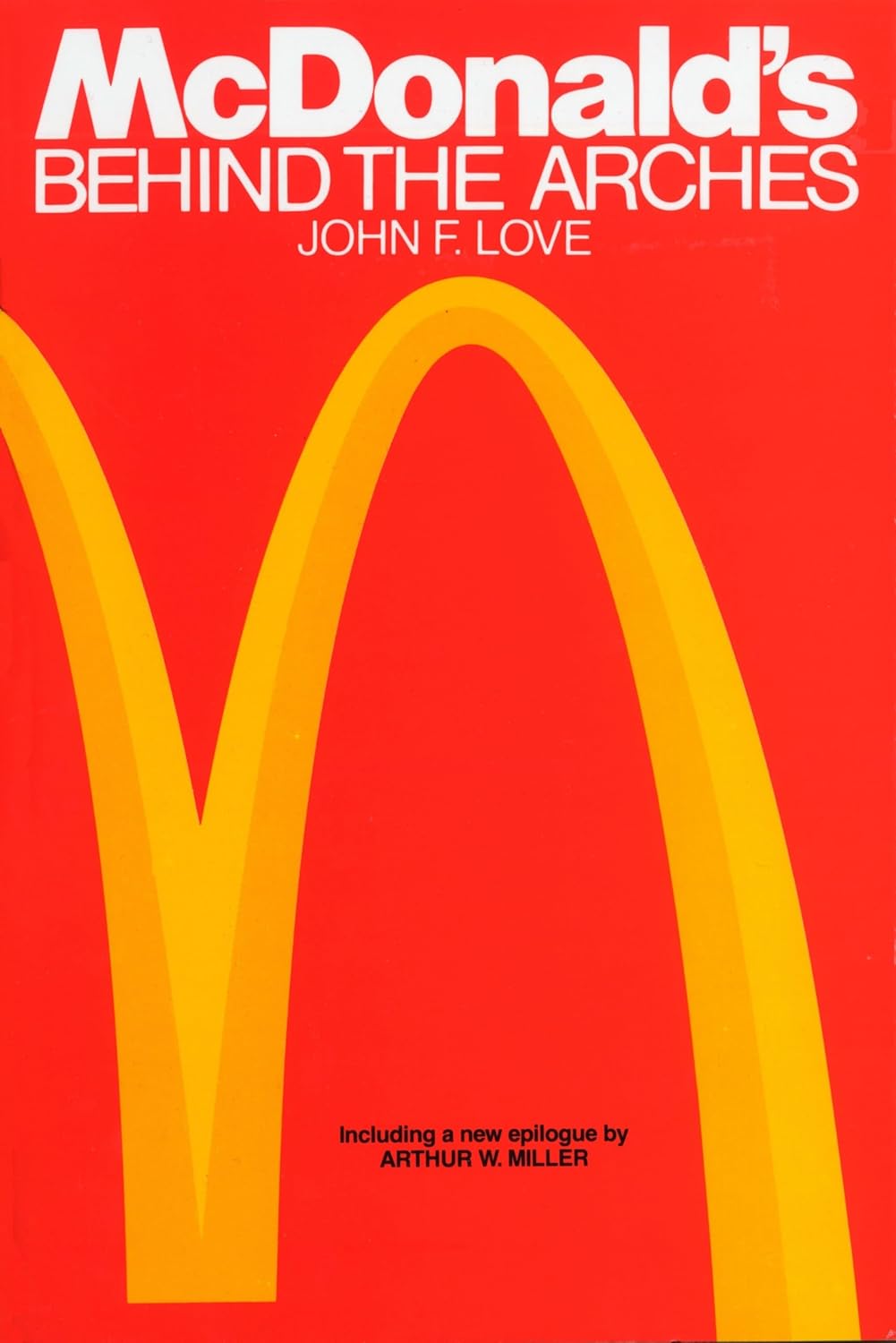
McDonald’s will always have a special place in my heart, even though I rarely eat there these days. A happy meal was a treasured treat when I was a kid and my first real job was working the drive-in window at a local McDonald’s.
“McDonald’s: Behind the Arches” by John Love is an absorbing and highly flattering corporate biography that tells the story of how a modest little drive-in in San Bernardino, California became one of the largest companies and most recognized brands in the world. It is important to note that this book, first published in 1986, is really “Volume I” in the McDonald’s story. If Love were to publish a follow up account of McDonald’s from 1990 to 2015, suffice it to say it would not be the “all unclouded glory” of the first 50 years, as told by the author.
I would argue that there is one principle theme in this book: how Ray Kroc’s unique owner/operator partner model to franchising is what has made McDonald’s so dominant in the fast food industry. And one gaping hole: the almost total absence of any discussion of the nutritional impact of fast food on community health.
In many ways, “Behind the Arches” is the story of successful franchising. The first franchised food service was A&W Root Beer in 1924 (the first commercial franchise system in the US was Singer Sewing Machines after the Civil War), although Howard Johnson’s is usually credited with developing the first year-around franchising operation in 1934. But it was the astonishing growth of Dairy Queen in 1944 that “triggered a revolution in the restaurant trade,” Love says. Selling franchise rights was suddenly seen as a quick way to make a fortune, mainly through the sale of large territory exclusives that carried with them a huge upfront licensing fee and then attaching a lucrative margin on all products sold and equipment purchased by the franchisee.
When Ray Kroc first visited the McDonald’s brothers drive-in in San Bernardino in 1954 he had “had never run a restaurant, never served a hamburger, and never sold a milk shake…” but he had an almost visceral understanding of the potential for a new fast food industry. “[He] had not invented a 15-cent-hamburger, or a self-service drive-in or a fast-food preparation system. What Kroc was inventing was a unique franchising system…[one that] treated his franchisees as equal partners.” It would be built on quality and as much central control as possible. At the heart of his concept was that the relationship between franchisor and franchisee needed to be a mutually beneficial partnership, not an exploitative one. Love claims “Kroc’s notion of a fair and balanced franchise partnership is without question his greatest legacy.”
Kroc’s system was simple, but not necessarily easy, and certainly not a “get rich quick” scheme. After being burned by selling the franchises to his wealthy country club buddies, Kroc learned the value of recruiting modest men with ambition to be entrepreneurs, owner-operators who had as much to lose (and gain) as the company. No large territory rights were sold. There was little in the way of required equipment to be purchased from the corporate office. And the opening price for a franchise was just $950. McDonald’s only source of income was a relatively modest 1.9% charge on topline revenue (of which 0.5% went straight back to the McDonald’s brothers for the rights to use their name). For nearly the first decade, Kroc’s McDonald’s outpaced the expansion of the competition (Kentucky Fried Chicken, Burger King, Taco Bell, and Burger Chef had all been founded in the early 1950s, too, so McDonald’s had no first mover advantage), but the company was barely staying afloat. The franchising model that Kroc developed, which resulted in astounding quality and cleanliness of stores, was an economic clunker. Or as the author states: “Kroc’s concept for building McDonald’s was financially bankrupt…Through 1960, the chain’s restaurants had sold an impressive $75 million worth of hamburgers, fries, and milkshakes, but had managed to earn a mere $159,000 in accumulated profits during its first six years.”
The real magic in the McDonald’s franchising system came from a man nearly forgotten in the corporate story, or more accurately purged: Harry Sonneborn, the company’s first chief financial officer (CFO) and later its CEO when the company went public in 1965. He was the man responsible for McDonald’s innovative and ingenious move into real estate. The humble owner/operator that Kroc wanted to run his franchises lacked capital and couldn’t hope to buy the land and build a McDonald’s on their own. Sonneborn’s solution was to collect a down payment from the franchisee, which McDonald’s would then use as a down payment on the land and take out the mortgage to build the single purpose restaurant. The franchisee would then pay 8.5% of total sales revenue back to McDonald’s in rent. Thus, McDonald’s would pay a low fixed cost on the land and mortgage and increase income as the store’s sales grew. Moreover, the company owned an appreciating asset and now had tremendous leverage over their franchisees. If the store failed to meet Kroc’s tough Quality, Value, Service standards the company had the right to pull the lease. Thus, Sonneborn had figured out a way to make the franchise model incredibly lucrative, financially low risk, and with a powerful means for the company to maintain centralized control over operations and standards. It really is something to marvel at.
The big challenge for McDonald’s early on was securing the capital to finance their aggressive expansion while adhering to their owner/operator franchisee model and not selling large territorial rights. The company ultimately came within a whisker of bankruptcy. In 1960, Sonneborn obtained a $1.5 million loan from a Boston-based insurance company in exchange for 20% in McDonald’s equity. It may have been the most expensive loan in history, although the author claims it gave the company the balance sheet credibility to get other loans as needed.
Just as important as capital for growth was the need to get out of the original contract Kroc signed with the McDonald brothers. Kroc may have come to them in 1954 begging to get involved in their business, but by 1960 “he hated their guts,” according to Love. The original franchising rights agreement that Kroc signed with the brothers was a legal disaster. It only allowed him to sign new franchisees. All of his operational improvements and strict oversight system were clear violations of the original contract, and the McDonald’s brothers absolutely refused to give more latitude by amending the contract. It was clear the brothers needed to be bought out, but their price appeared almost insurmountable: they each wanted $1 million post tax dollars ($2.7 million total). Again, Sonneborn came to the rescue. He managed to raise the capital from an East Coast money manager (almost half of the money came from Princeton University’s endowment), offering to pay 0.5% of revenues (the same amount they were paying to the McDonald’s brothers already) for 16 years. It was estimated that the loan would be paid back in full in about half that time. As it turned out, the loan was repaid in about 5 years and the total return was a whopping $14 million. It is estimated that the McDonald’s brothers lost at least $1 billion in future royalty payments by signing the deal. The first thing Kroc did was to open a new McDonald’s across the street from the original in San Bernardino, promptly putting the brothers’ still operating hamburger stand out of business.
Finally, the author also stresses how dynamic and innovative the local franchisees have been over the years. Many of the classic symbols and products of McDonald’s – including Ronald McDonald, the Filet-O-Fish sandwich, Big Mac, Playlands, the Egg McMuffin, Drive Thru windows, Happy Meals, and the Ronald McDonald House – were all created locally by franchisees, not the corporate office, which had dedicated teams to new product development (Quarter-Pounder and Chicken McNuggets are the only two notable successes) and innovation. Indeed, Kroc’s fundamental belief that a true partnership with local owner/operators proved magical in more ways than one.
The updated version “Behind the Arches” ends in the early 1990s. McDonald’s growth has continued to be phenomenal. When this book was published there were 14,000 McDonald’s in 79 countries driving $8 billion in annual revenue. By 2015, those numbers had ballooned to 35,000 stores in 181 countries and territories accounting for $27 billion. The company owns about 45% of the land and 70% of the buildings at their 36,000+ locations (the rest is leased). Perhaps most impressive of all, McDonald’s Corporation market capitalization has swelled from $17 billion in 1992 (roughly $30 billion in today’s dollars) to $115 billion in early 2016, a whooping 280% real return on investment. However, the past couple of decades have been rocky. The first half century of McDonald’s saw only three CEOs: Kroc, Sonneborn and Fred Turner, Kroc’s protégé. There have been at least seven in the last 20 years with an average tenure of less than four years. Meanwhile, the fast food industry that McDonald’s personifies has become the target of withering public criticism, most notably the stinging indictments of books like “Fast Food Nation” that chronicle the deleterious health impacts of processed food. While I was reading this book in February 2016, McDonald’s announced that Happy Meals would start coming with children’s books rather than the classic plastic toy. In his nightly monologue, Jimmy Kimmel joked that the book was “D is for Diabetes.” Strangely, almost inexplicably, Love completely ignores the issue. The single reference to the poor nutritional quality of McDonald’s food comes in the epilogue on page 456. It is no exaggeration to claim that fast food is emerging as the 21st century public health equivalent of cigarettes.
In closing, I really enjoyed this book, although it does tell only a part of the story. Love claims that “Behind the Arches” is not an official history of McDonald’s, but it sure reads that way (i.e. the only thing more brilliant than McDonald’s success has been their brilliant response to failures). In any event, you’ll never look at a Big Mac or Egg McMuffin the same.
 What's Tim Reading Now?
Leave a comment