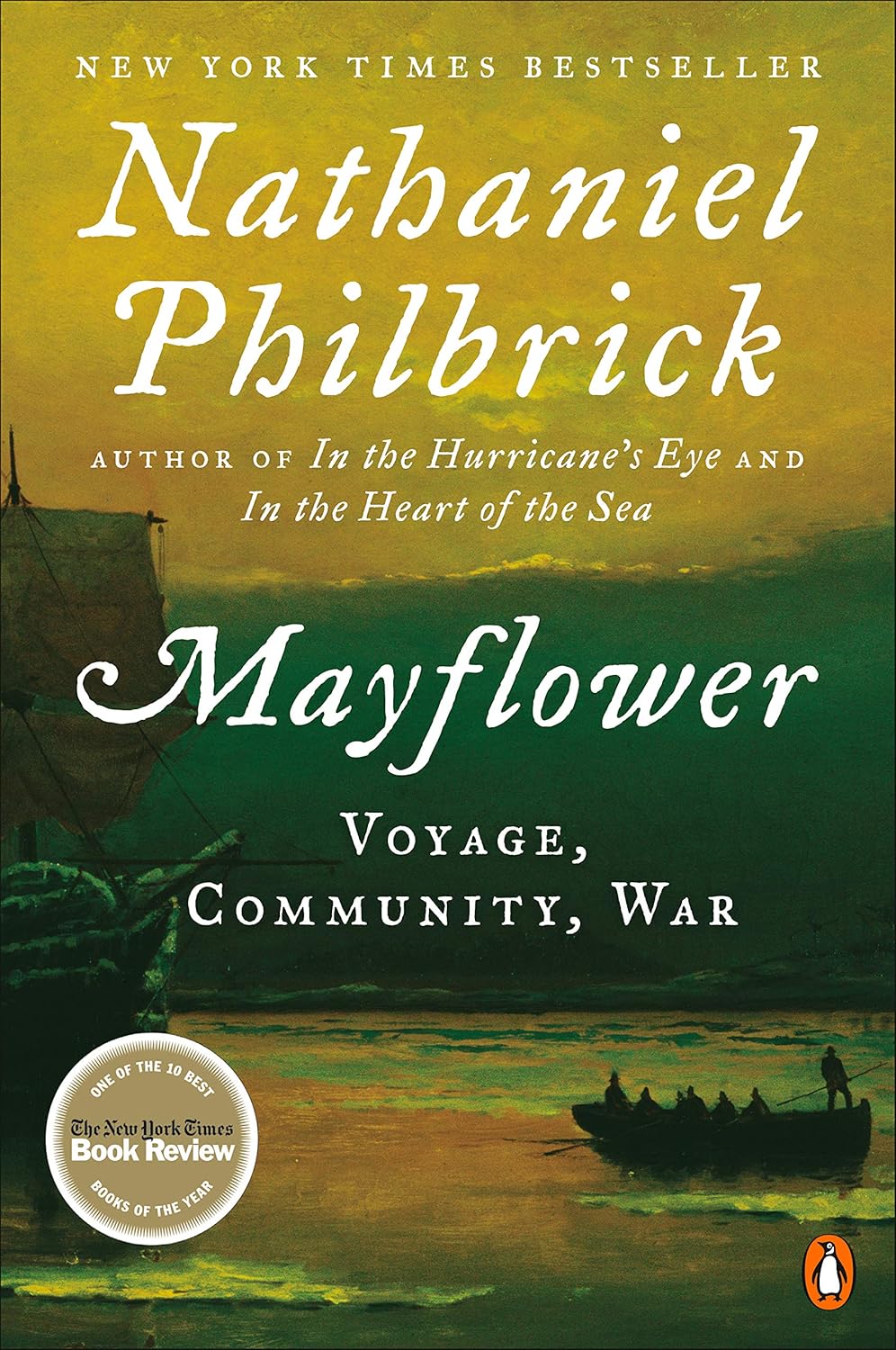
There has long been a great lacuna in American history – the 150 years between the landing of the Pilgrims in 1620 and the American Revolution of the 1770s. Nathaniel Philbrick turns his talented pen to this obscure period in the 2006 bestseller “Mayflower: A Story of Courage, Community and War.”
Philbrick’s narrative essentially covers the first two generations of Puritans in New England. The first part, when the Pilgrims first established themselves in the New World, reads like a political science case study in balance of power theory. The Pilgrims landed in modern day New England during a period of great upheaval among the native population. The plague had decimated the region from 1616 to 1619. Many communities were literally exterminated by the disease. The tenuous balance of power between competing Native American tribes was shattered by the arrival of the Pilgrims in 1620.
Massasoit, the great sachem of the local Pokanohet tribe, exploited his new relationship with the Europeans to the fullest. Caught between the powerful Narragansett and Massachusetts tribes, Massasoit looked to an alliance with the Pilgrims – small in number but possessing frightful European firepower and valuable trade items – to secure his position in the Native American power dynamic. Squanto, his devious, Talleyrand-like interpreter, ably guided his diplomatic machinations.
It is remarkable to read how sparsely populated New England was in the 1600s. Units of 50 warriors were considered a sizable Indian force. A couple dozen malnourished Pilgrims armed with flintlock muskets were enough to determine the fate of broad swaths of territory.
Philbrick says very little about the Pilgrim’s religious beliefs or how it influenced their daily routine. The settlers may have been pious, but there were by no mean pacifist. In 1623, the Pilgrims preempted an Indian attack by ambushing the native leader Wituwamat at the village of Wessagussett. Pilgrim military leader Miles Standish beheaded the Indian warrior and posted his head atop the fortress at Plymouth as a warning to other tribes. (Not exactly a Christian act.) The bloody performance succeeded in maintaining an uneasy peace for years. “Seven years after the Mayflower had sailed,” Philbrick writes, “Plymouth Plantation was still an armed fortress where each male communicant worshipped with a gun at his side.”
One of the remarkable things about the story is the longevity of some of the major players. Half of the Pilgrim population perished during the first winter in Plymouth, but Governor William Bradford and military leader Standish survived for decades, living well into the 1650s, as did Massosoit. Thus, the first generation of principal actors lived long enough to see the tremendous upheaval caused by the Great Migration of Europeans to the New World during the mid-seventeenth century.
Thousands of Europeans poured into New England, while the original Puritan families averaged seven or eight children. Puritans quickly outnumbered the native population. Beavers and other prized fur animals disappeared from the forests. Access to arable land became a contentious issue. By the 1670s, native tribes, especially the Pakanohets, had sold off most of their valuable land to the Puritans. Massasoit’s sons, Alexander and Philip, watched in horror as their homeland was systematically dismantled. By 1675, King Philip had decided that enough was enough and began plotting an Indian revolt against the Puritans. When some of his warriors were convicted for a murder and executed at Plymouth, Philip decided to act. All of New England erupted in brutal fighting between various native tribes and Puritan settlers. From the Connecticut River valley all the way to Maine isolated European settlements were attacked, its residents slaughtered. The Puritans responded by wiping out entire communities of Indians.
“In the end,” Philbrick writes, “the winner of the conflict was determined not by military prowess but by one side’s ability to outlast the other … After more than a year of unrelenting hardship, Philip’s people were exhausted, starving, and dispirited.” Benjamin Church, who Philbrick calls “America’s first Indian fighter,” finally captured and executed Philip. His head, like that of Wituwamat in 1623, was prominently displayed on the palisade wall of Plymouth Plantation. “Philip’s head would remain a fixture in Plymouth for more than two decades,” Philbrick writes, “becoming the town’s most famous attraction long before anyone took notice of the hunk of granite known as Plymouth Rock.”
The fourteen month long King Philip’s War of June 1675 to August 1676 was, according to Philbrick, “one of the most horrendous wars fought in North America.” The casualty list was staggering. Philbrick estimates that 8% of the adult male Puritan population perished. The devastation to the Native American’s of southern New England was far worse. Perhaps 60% to 80% of the population was lost to war, disease, starvation, and shipment into slavery in the West Indies. “Fifty-six years after the sailing of the Mayflower, the Pilgrim’s children had not only defeated the Pokanokets in a devastating war, they had taken conscious, methodical measures to purge the land of its people.”
Much of American history isn’t pretty. Philbrick demonstrates that seventeenth century New England is no exception.
 What's Tim Reading Now?
Leave a comment