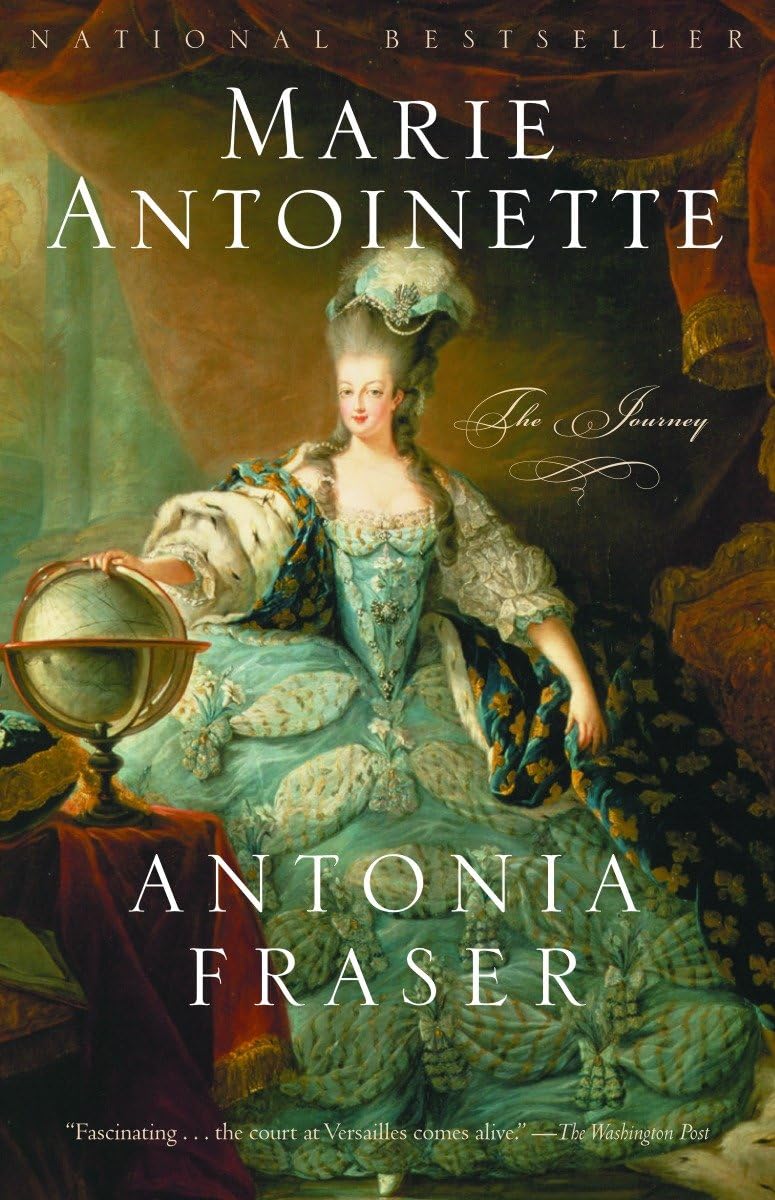
Marie Antoinette may have never said, “Let them eat cake!” Then again, much of what she had been accused of wasn’t true either, according to Antonia Fraser in this well researched, sympathetic biography of France’s most famous queen.
The fifteenth child and youngest daughter of the august Maria Teresa, Empress of the Holy Roman Empire, Marie Antoinette was a pawn on the imperial chessboard of eighteenth century Europe. Betrothed at age 13, the semi-literate duchess was thrust into a political role as a Habsburg “sleeper agent” and wife to the future king of France for which she was totally unprepared. Her dynastic marriage remained unconsummated for over seven years, much to everyone’s consternation, except perhaps the equally young and ill-prepared Dauphin, Louis Auguste. The Dauphine, meanwhile, wiled away her time while not procreating with all-night gambling and non-stop shopping, running up outrageous debts the monarchy was increasingly unable to support. She would eventually earn the sobriquet “Madame Deficit,” although Fraser points out that Court expenses accounted for only a small percentage of the ballooning French budget (40% went just to servicing the national debt). By 1781, eleven and a half years after arriving in France, Marie Antoinette had finally fulfilled her duty and delivered a baby boy, an heir to the throne – half Bourbon, half Habsburg. He would die of tuberculosis during the opening stages of the French Revolution.
The story of Marie Antoinette is surely a tragic and depressing one. A frivolous woman with little formal education to speak of, she failed to fulfill her role as diplomatic advocate for her native Austria. First with her mother, Maria Teresa, then with her brothers, the Emperors Joseph II and Leopold II, and finally with her nephew, Francis II, Marie Antoinette in theory served as a bridge to the Habsburg court in Vienna. In practice, her influence was negligible. The young Queen was, according to Fraser, a “light-hearted, unintellectual, pleasure-loving young woman,” hardly cut out for the role of international statesman. She was also the target of relentless, scabrous libels, many of them baselessly accusing her of lesbian acts with her ladies-in-waiting.
Although popular at the outset, there was no doubt that Marie Antoinette was the most hated woman in France by the time the Revolution got underway. Indeed, by the mid-1780’s she was widely – and, Fraser stresses, unfairly – reviled. According to the author, the French public believed that “She was worse than Cleopatra, prouder than Agrippina, more lubricious than Messalina, more cruel than Catherine de’ Medici…” She deserved almost none of it. Widely purported to be a lascivious, profligate drunkard, Fraser writes that the queen was, in fact, a teetotaler and hardly licentious. Why such wild claims against her stuck the author never quite explains. The Queen did carry on a dalliance, since 1783, with the dashing and devoted Swedish officer aristocrat, Count Alex Fersen, but that was tame compared to the wild bacchanalia she was regularly accused of by a hostile satirical press, which, it seems, somehow never suspected any illicit relationship with Fersen.
Fraser describes in arresting detail some of the most dramatic and sanguinary events of the French Revolution, such as the women’s march on Versailles on 5 October 1789, the mob assault on the Tuileries Palace on 10 August 1792 and the public execution and dismemberment of Princess Lambelle. What makes these scenes so terrifying and piteous is that you witness them primarily from the perspective of a tortured Queen, a undeniably loving mother and wife, who understood little of what was going on around her and feared mainly for her two surviving children, an adolescent daughter and the young Dauphin, Louis Charles, not yet 10. The reader will find themself almost rooting for the royal family, hoping somehow that the Prussians will manage to save their lives.
Marie Antoinette’s end was as pathetic as most of her life was tragic. Accused at trial of incest with her young son (among other sexually deviant charges) she refused to even acknowledge the accusation. In the end, she was convicted on a series of trumped charges of which she was completely innocent: “her secret agreements with foreign powers, including her brothers, emigre Princes and treacherous generals; her shipping of money abroad to help them; and lastly her conspiring with these powers against the security of the French state, both at home and abroad.” She stoically went to her death on 16 October 1793. “Every account, every eyewitness, agreed on the unassailable composure with which Marie Antoinette went to her death,” Fraser writes, “…her composure was so sublime as to be interpreted as contempt by her enemies.”
Fraser delivers here an admirable contribution to the study and analysis of the French Revolution. I have read a great many books on the subject, but had never perceived events from the perspective of Marie Antoinette. It’s a sad tale, to be sure. “Ill-luck dogged her from her first moment in France,” Fraser concludes, “the unwanted and inadequate ambassadress from a great power, the rejected girl-wife, until the end, when she was the scapegoat for the monarchy’s failure.” But a tale wonderfully told.
 What's Tim Reading Now?
Leave a comment