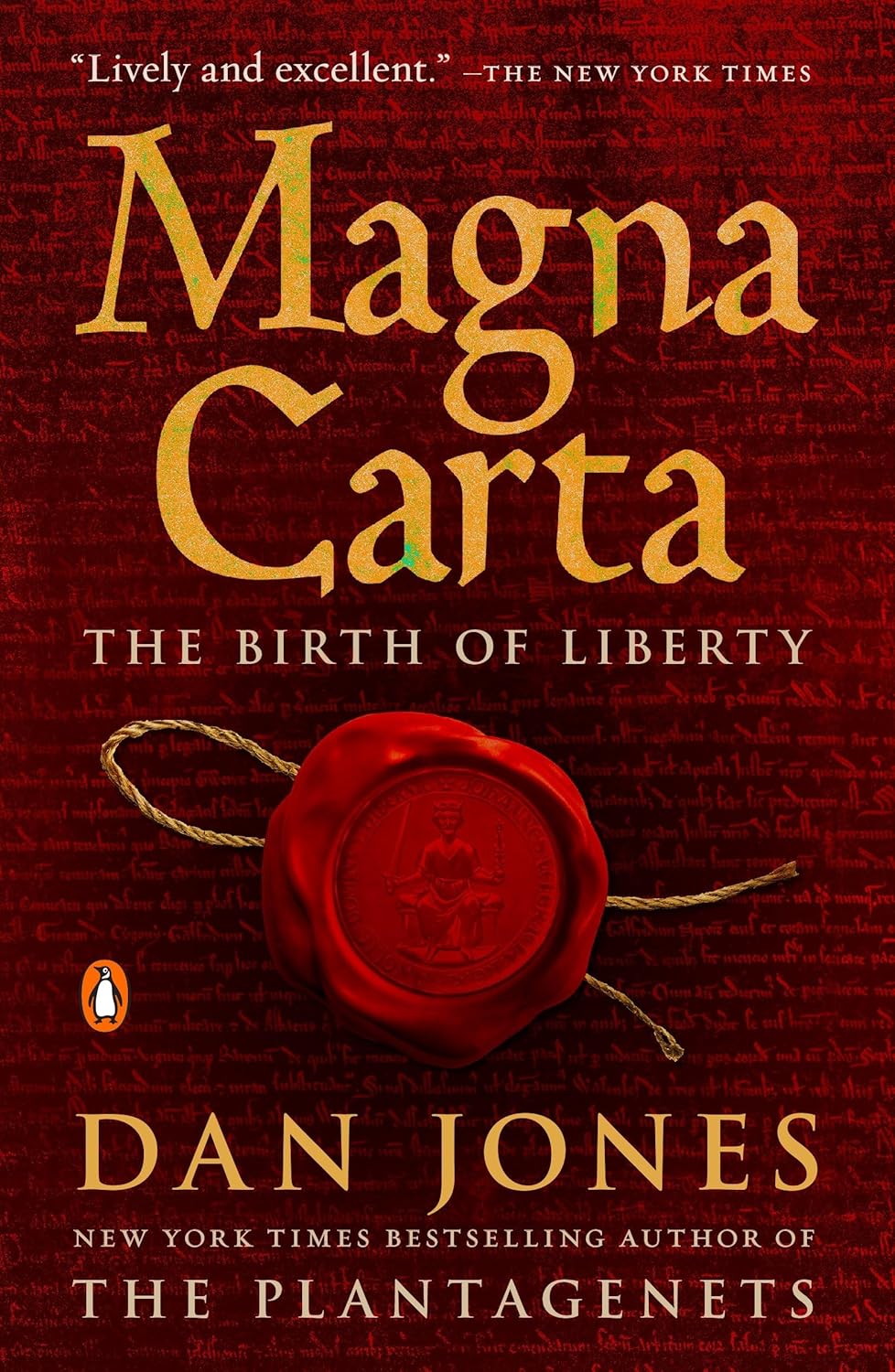
The Magna Carta. It’s one of those things that everyone knows, but few truly know anything about. Hip Hop mega star Jay-Z (for reasons known only to him) titled his 2013 album “Magna Carta Holy Grail.” In 2014, British Prime Minister David Cameron, who one would presume would know a thing or two about it, suggested that every schoolchild in the United Kingdom study the Magna Carta as its principles “paved the way for the democracy, the equality, the respect and the laws that make Britain.” Never mind that the Magna Carta of 1215 had nothing whatsoever to do with either democracy or equality.
So just what was the Magna Carta? How and why did it come about? If you’ve ever asked yourself these questions, Dan Jones’ “Magna Carta: The Birth of Liberty,” published in 2015, the 800th anniversary of the celebrated document, is the book for you. But be warned: this is very much a book about the Magna Carta of 1215 England, not really what the charter came to signify later in western and eventually global history. That important subject is covered cursorily in the final chapter (just 10 pages) of the book.
The story of the Magna Carta is intertwined with that of the early Plantagenet dynasty. The first Plantagenet king, Henry II, set the stage by leading a sweeping centralization of English royal government in the latter half of the twelfth century that aimed mainly at extending the power of the crown to raise desperately needed tax resources in the ongoing struggle with France. It was an initiative carried forward by his highly capable son and heir, Richard the Lionheart, who ruled briefly (1189-1199) but brilliantly, reconquering Acre from Saladin in the Third Crusade and consolidating the Plantagenet’s hold on a wide swath of what is now western France. Richard’s younger brother and successor, John I, however, was no fighter (he was known derisively as “John Softsword”) and by 1205 the dynasty’s territory in Europe, including even Normandy, was taken by the French under the daring leadership of King Philip Augustus.
To make matters worse, King John clashed with the indomitable Pope Innocent III – “perhaps the greatest of all medieval popes,” according to Jones – over the naming of the next archbishop of Canterbury. When the King refused to accept the Vatican’s pick, the cerebral theologian Stephen Langton, the Pope excommunicated John and, even worse, leveled an Interdict against England (essentially a strike by the Church whereby all masses, baptisms, wedding, etc. were halted indefinitely, a move that most of his subjects found terrifying as it put the eternal souls of every man, woman and child of the realm in jeopardy). But King John knew how to make the best of a bad situation. He was desperate to retake the lost territory across the Channel and used the opportunity of the Interdict to confiscate the Church’s English property and generous revenue. Virtually overnight he became the richest English monarch ever – and used the wealth to fund an army to battle Philip Augustus.
Unfortunately for John, the denouement of this strategic gamble was the crushing defeat of his largely mercenary army at the Battle of Bouvines on July 27, 1214. The whole affair was a political, military and economic catastrophe of the first order. The King slunk back to England, the barons of his realm in almost open revolt.
Backed into a corner, John turned to his erstwhile enemy, Pope Innocent III, looking for a way out. In 1213 he had accepted Stephen Langton as archbishop and even handed over England and Ireland as fiefs of the papacy, all in an attempt to win the Church’s support in his forthcoming invasion of France. In 1215, he went a step further and offered to finance a Fifth Crusade, a subject near-and-dear to the Pope who was still smarting from the debacle of the Fourth Crusade, which resulted in nothing but the sack of Constantinople, a Christian city, in 1204. The upshot for John was that an obligation to take up the cross came with a three-year grace period from secular obligations, meaning that he could put off an unsavory terms he had to concede to in 1215.
When John refused to meet with the insurgent barons over Easter, 1215, as he had earlier promised, they went into open revolt, taking over the city of London after a failed attempt to sack a royal castle at Northampton. The King had been building up his forces domestically for months and held numerous military advantages, but the symbolic control of London by the rebels along with their very real control of the money in the Tower of London made immediate negotiations advisable. He called for a meeting at a small meadow equidistant from London and Windsor called Runnymede.
The document that emerged on June 15, 1215 after the weeks of back-and-forth negotiations was a four thousand word, 65 clause laundry list of 13th century baronial grievances and their remediation, such as reforms to the current use of scutage (a tax to pay for military knights), expanded access to royal forests, the ability of widowed baronesses to re-marry of their own free will, the proper rate of inheritance tax, the standardization of weights and measures, and so on. Indeed, for all intents and purposes, this Magna Carta “ought to be dead, defunct, and of interest only to serious scholars of the thirteenth century,” according to the author.
But there were some clauses – and they would turn out to be the least politically successful at the time – that spoke to more general matters of liberty and were aimed squarely at protecting the wealthy elite from an “overbearing, extortionate, and cruel” monarch. Most importantly, clauses 39 and 40 foreshadow the basic principles of trial by jury, the right of habeas corpus, and the idea that justice should always restrain the power of government. Simply put, it argues for the rule of law: “no free man is to be arrested, or imprisoned, or disseized [real estate confiscated], or outlawed, or exiled, or in any other way ruined, nor will go or send against him, except by the legal judgment of his peers or by the law of the land” and that “to no one will we sell, to no one will we deny or delay, right or justice.” It is these two clauses that serve as the cornerstones of liberty in the western tradition, “the foundation of principles and systems of government of which neither King John nor his nobles dreamed,” according to none other than Winston Churchill. Indeed, the disgruntled nobles’ “insistence on freedom from harassment and annoyance by the state and the hatred of excessive taxation” echoes down through the ages.
In sum, the Magna Carta of history and the Magna Carta of today are two very different things. Or as Jones writes, “the myth and the symbolism of the Magna Carta have become almost wholly divorced from its original history,” which was essentially a list of specific demands – an ultimatum, really – from wealthy English barons to their capricious and malicious king. That Magna Carta was a failure, and almost instantly so; the Magna Carta of myth is iconic and enduring, “a historical palimpsest onto which almost any dream can be written.” It’s a great story and Jones tells it well.
 What's Tim Reading Now?
Leave a comment