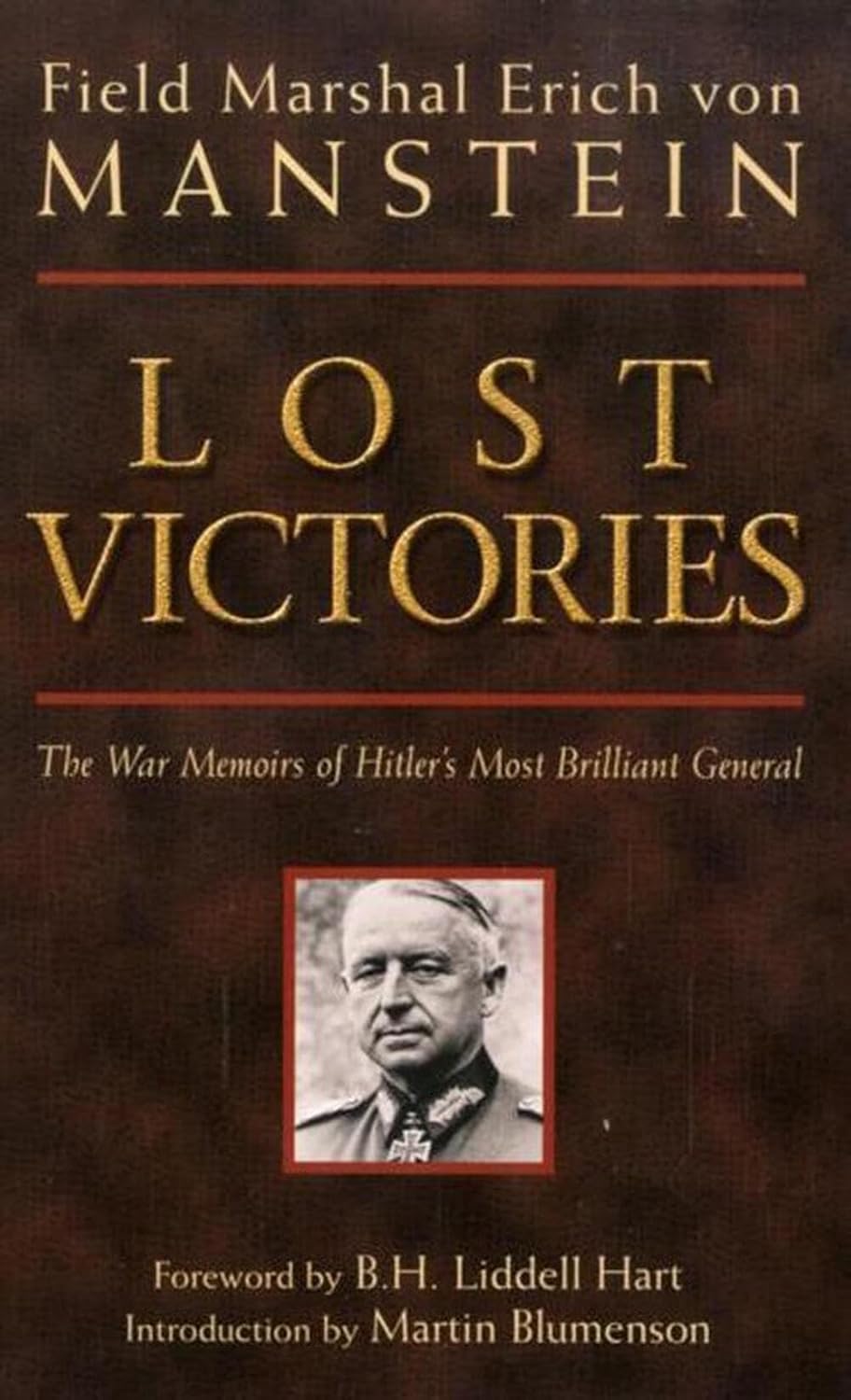
Erich von Manstein was considered by his peers as the most talented general officer in the German army. His celebrated Second World War memoir, “Lost Victories,” chronicles his exploits, frustrations, victories and defeats as a chief of staff in Poland in 1939, commander of 38th Corps in France in 1940, 56th Panzer Corps during the invasion of Russia in 1941, 11th Army in Crimea in 1942, and Army Groups Don & South in southern Russia in 1943 and 1944.
More than anything else, it was Manstein’s leading role in re-crafting the German war plans for the invasion of France in early 1940 that cemented his legacy as a brilliant military strategist. He was serving as chief of staff to Army Group A under Field Marshal Gerd von Rundstedt. From the very beginning, Manstein opposed the original war plan, which called for a massive invasion of northern France through the Netherlands and Belgium. Despite its superficial resemblance to the First World War’s Schlieffen Plan, Manstein believed it lacked two critical strategic objectives that had been central to the original: strategic surprise aiming for decisive victory. Manstein complained to his superiors – and anyone else who would listen – that the telegraphed frontal assault “would bring partial victory, nothing more.” Rather, he argued, the German plan needed to be more decisive in scope and imaginative in execution. He proposed a surprise attack through the Ardennes forest that would trap the British and French forces to the north and against the Channel coast, and then eliminate them. Manstein, along with Rundstedt, importuned the O.K.H. (Oberkommando des Heeres / High Command of the German Army) to change the plan for months, all to no avail. Luckily (for the Germans), poor weather postponed the launch of the offensive from late autumn to early spring. A private meeting between Hitler and Manstein on February 17, 1940, proved momentous. Three days after lobbying the Fuhrer in person, O.K.H. adopted Manstein’s radically different operational approach. Germany would conquer France in six weeks, a tactical victory as great as Hannibal’s at Cannae or Frederick the Great’s at Leuthen.
“Lost Victories” is a fascinating war memoir, primarily because it provides a fascinating perspective: that of a defeated Field Marshal who had won some of the greatest battlefield victories in history. “Lost Victories” certainly isn’t like “With the Old Breed,” Eugene Sledge’s classic Second World War memoir depicting frontline combat in the Pacific as terrifying, messy, ugly, and, above all, an absolute “waste.” Warfare in “Lost Victories,” by contrast, is noble, cerebral, even romantic. Manstein writes about his bloody campaigns with the same sort of cool detachment one might expect from a General Staff officer reporting back about a staff ride at war college. For instance, when reminiscing about his final assault on the Crimean Peninsula bastion of Sevastopol in early 1942, Manstein gushes: “It was indeed a fantastic setting for such a gigantic spectacle!” The winter campaign in southern Russia in 1942-43, in which tens of thousands of Russians and Germans were slaughtered or frozen to death, was, in Manstein’s opinion, “one of the most exciting of the war.”
A leitmotif of “Lost Victories” is the superior professionalism and courage of the German Army. It’s a professionalism that manifested itself in several ways during the war. First, Manstein stresses that the Germans always respected private property in the lands the Wehrmacht conquered. German generals were, first and foremost, he suggests, men of honor and integrity, chivalric twentieth-century knights. They might raze an entire village to secure a river crossing, but they wouldn’t dare pilfer an attractive pair of gold cufflinks from a home they had commandeered as a field headquarters. “It goes without saying,” he wrote of the German experience in Nazi-occupied France in 1940, “as in all other quarters we occupied, the owner’s property was respected and treated with the most scrupulous care … In contrast to what happened later in Germany, it did not occur to us to act as lords and masters who could do as they pleased with enemy property.”
Second, the Germans were simply better warriors than their enemies – and their allies, as he is often quick to point out (e.g. “Any illusions about the Italians’ fighting capacities, of course, were inexcusable from the start.”). Much of the advantage, according to Manstein, was owed to the cult of initiative inculcated by the General Staff. “Individual leadership was fostered on a scale unrivaled in any other army,” he writes, “right down to the most junior N.C.O. or infantryman, and in this lay the secret of our success.”
Such diffused initiative also happened to be a major point of friction for the commander-in-chief, Adolf Hitler. Civil-military relations, at least so far as there was such a thing in Nazi Germany, forms another major theme of “Lost Victories.” Manstein writes that the Germany Army lived by a code: “Always conduct operations elastically and resourcefully; give every possible scope to the initiative and self-sufficiency of commanders at all levels.” Unfortunately, Manstein points out, “both principles…were greatly at variance with Hitler’s own way of thinking.” The Fuhrer saw himself as a man-of-destiny. His remarkable success in rising from obscurity to leader of the Third Reich, along with his shocking diplomatic coups before the war, convinced him that anything was possible if only the German people had the will and faith to carry out his visions. Manstein writes: “For the art of war [Hitler] substituted a brute force which, as he saw it, was guaranteed by the will-power behind it.” Thus, any German defeat, no matter how overwhelming the odds, could only be ascribed to a lack of will and faith. In the end, Manstein argues, Hitler’s fabled intuition was ultimately his greatest weakness. “What he lacked, broadly speaking, was simply military ability based on experience – something for which his ‘intuition’ was no substitute.”
And that brings us to Manstein’s main gripe about the German national command authority in the Second World War, a topic he returns to again and again. His grievance is plain and understandable: “next to the Head of State who made the political decisions, there was no parallel military authority empowered to take responsibility for … overall strategy.” That’s because, in the author’s estimation, Hitler “wanted to be another Napoleon,” and jealously guarded his prerogative to make final decisions on the most strategic, as well as the most mundane, of issues. Manstein writes with disgust and despair about how O.K.H. was emasculated after the successful invasion of Poland in 1939. “The Commander-in-Chief of the Army had been demoted from the status of military adviser to the Head of State to that of a subordinate commander pledged to unquestioning obedience.” It was a state-of-affairs that Manstein repeatedly and unsuccessfully tried to redress throughout the war.
In closing, “Lost Victories” is a true classic and ought to be on the bookshelf of anyone with a keen interest in the Second World War or military leadership. Although parts of the memoir bog down in tactical details (for example, large swaths of certain chapters read like this: “In order to reinforce Fourth Panzer Army still further, the Army Group moved over two extra armoured divisions [3 and 10], two panzer grenadier divisions [20 and the SS ‘Reich’ Division] and the 198 Infantry Division of the Eighth Army.”), the lengthy treatment of strategy and operations more than makes up for it.
 What's Tim Reading Now?
Leave a comment