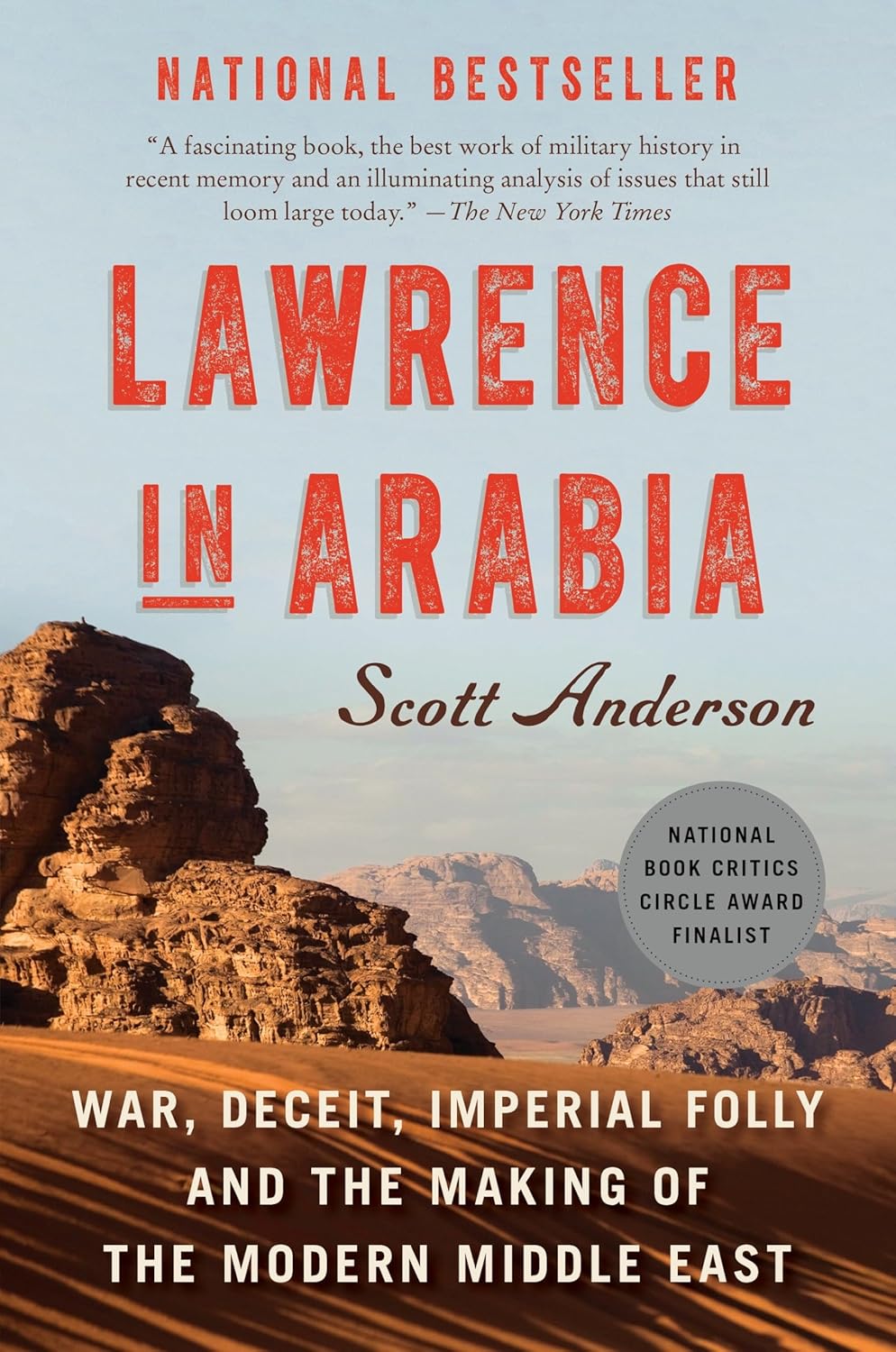
The story of T.E. Lawrence and the Sykes-Picot agreement has been told many times before. Nowhere perhaps better than David Fromkin’s award-winning “A Peace to End All Peace.” Scott Anderson tackles the topic from an interesting angle. He tells the story in narrative form following four inter-related characters: T.E. Lawrence; the Jewish spy-leader, Aaron Aaronsohn; the German diplomat and spy, Curt Prufer; and the American oil-man William Yale.
Each character is not given equal treatment and when their storylines do pop back up it can often be confusing to the reader. The bulk of the narrative follows the exploits of T.E. Lawrence, an Oxford-educated archaeologist attached to the British military mission in Egypt as an intelligence analyst. Anderson describes Lawrence as brilliant, quick-witted and irreverent, utterly dismissive of military protocol and procedure. How he escaped court-martialing is something of a mystery. By a mix of luck and gumption, Lawrence escaped his desk-bound job in Cairo for a liaison position in the field with the Arab rebels operating in the Hejaz and southern Syria. Anderson claims that Lawrence’s academic mastery of fourteenth century warfare prepared him best for the role of guerilla leader in the sands of modern-day Saudi Arabia. He viscerally understood the importance of keeping together fragile tribal alliances and the way the land and water sources ultimately determined tactics and strategy. Anderson maintains that Lawrence’s lack of contemporary military training was a blessing given the conditions of the Arab revolt.
“Most wars were wars of contact,” Lawrence himself wrote, “both forces striving into touch to avoid tactical surprise. Ours should be a war of detachment. We were to contain the enemy by the silent threat of a vast unknown desert, not disclosing ourselves till we attacked.” A military force “drifting about like a gas.”
The stories of the other three main characters are far more disjointed. They pop back into the main storyline at different times and for different lengths, but their adventures – interesting as they are – add little to the core narrative of Lawrence and the Arab revolt. It also seems as though alternate characters may have been chosen. For instance, Anderson writes “it’s hard to think of any figure who, with no true malice intended and neither a nation nor an army at his disposal, was to wreak more havoc on the twentieth century than the personable and brilliant young aristocrat from Yorkshire,” Sir Mark Sykes.
For those looking to better understand the exploits of T.E. Lawrence and the political machinations that led to the creation of the modern Middle East, “Lawrence in Arabia” is an able and easily digestible narrative. This reviewer would still recommend Fromkin’s “A Peace to End All Peace” as the best of the genre, but “Lawrence in Arabia” is credible second choice.
 What's Tim Reading Now?
Leave a comment