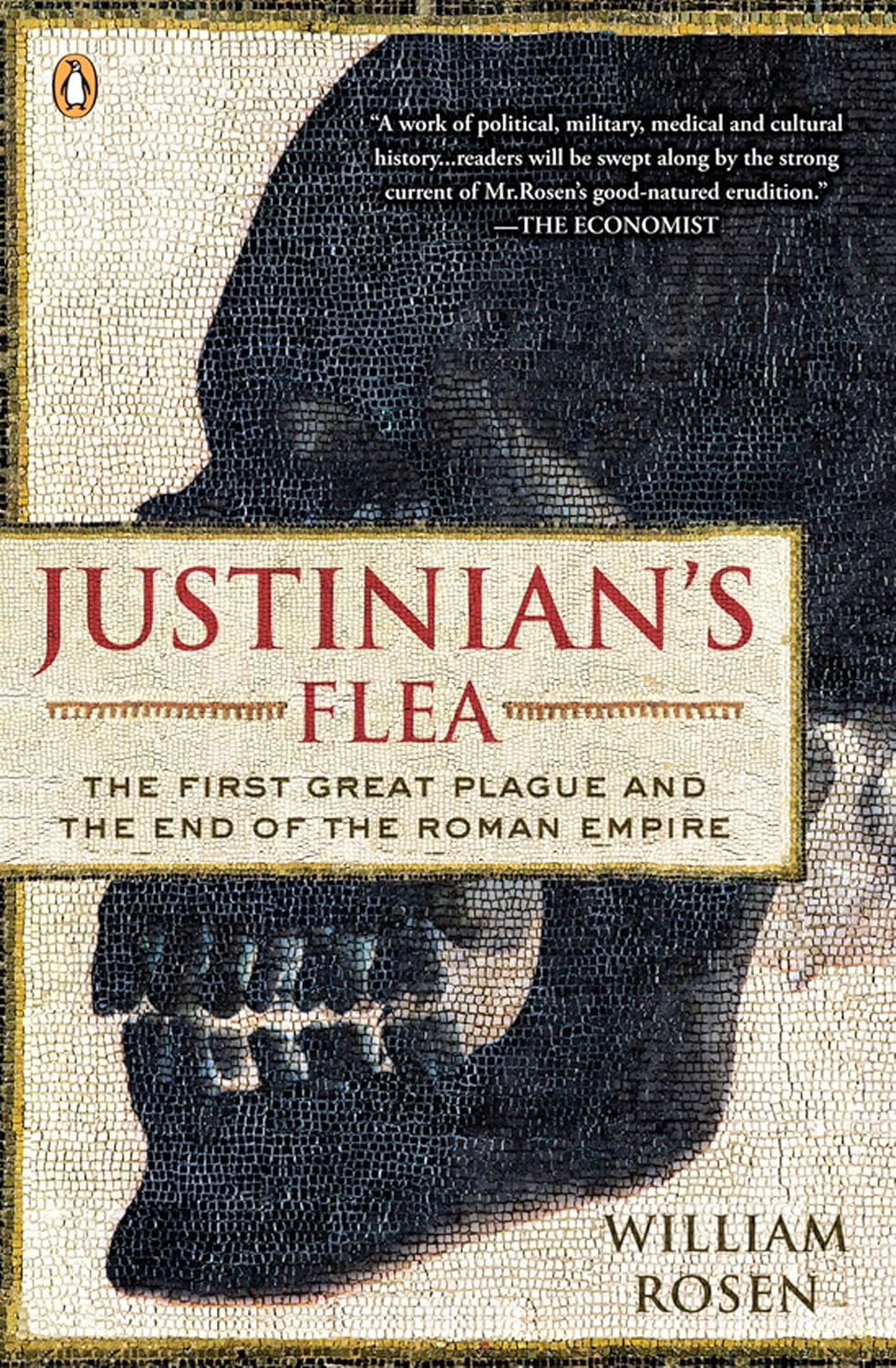
“Caveat Reador” — Let the Reader Beware! You need to know a few things before picking up “Justinian’s Flea: The First Great Plague and The End of the Roman Empire” by William Rosen.
First, this book is filled with details, many of them extraneous, yet the narrative has surprisingly little specific to say about the bubonic plague that struck Constantinople in 542 AD and how that pandemic ultimately destroyed the Roman empire of Justinian and his successors. Rather, Rosen writes about the consequences in sweeping generalities. For instance, “War is hard on an economy; pandemic disease is even worse.” Besides the obvious decimation of the population, which he puts at 1,000 deaths a day in the year the plague struck, he provides little detail as to how the plague otherwise undermined Justinian’s economy and military. What were the second and third order consequences of the disease and how did they cripple the machinery of empire for generations to come?
On the one hand, Rosen argues that the plague, which he likes to call “the demon,” was the “midwife of Europe.” “As the demon washed across the lands once ruled by Rome,” he writes, “it left behind tidal pools: the distinctive regions in which protonations like the Franks, Lombards, Saxons, Slavs, and Goths could coalesce and combine into polities called France, Spain, and England.” On the other hand, he maintains that the population loss caused by the plague also generated critical innovations. Or as he succinctly puts it: “No pandemic, no labor shortage; no labor shortage, no agricultural revolution; and, therefore, no victory to Europe in the race for population dominance.”
Second, what the narrative lacks in detail on the plague it more than makes up for in a variety of other tangential topics. For instance, section one, titled “Emperor,” chronicles two hundred years of eastern Roman history from 286 to 470 AD. Rosen tells how the Huns pushed the Goths across the Danube in 376 and how the Roman attempt to check them at Adrianople in 378 led to the most complete Roman military disaster since Cannae and ultimately led to the sack of Rome by Alaric in 410. What does all of this have to do with the plague that struck Constantinople a century-and-a-half later? Not much more than providing a complete backstory for those with limited understanding of late Roman history, I guess.
Section two, “Glory,” provides a rather complete thematic overview of the crowning achievements of Justinian leading up to the outbreak of plague. “Justinian was neither a great orator nor a skilled warrior, nor even a brilliant theologian,” Rosen writes. “He was not physically brave or personally charismatic. He was, however, one of the greatest statesmen who ever lived, combining a grand vision for the empire he ruled with the ability of seeing a dozen moves ahead of his opponents.” Rosen tells the story of the improbable rise to power of Justinian and his powerful wife, Theodora, “the most successful marriage in the history of statecraft,” according to the author. Rosen also chronicles the building of the magnificent Hagia Sophia by the great architects Anthemius and Isidore after the Nika revolt of 532; the establishment of the Justianic Code by the lawgiver Tribonian; and the conquest of the Vandals in Libya and the Ostrogroths in Italy by Justinian’s general of genius, Belisarius. “No general since Mark Antony cut a more dashing figure” than Belisarius, Rosen writes, and he “may have been the greatest Roman general since Julius Caesar.” High praise, indeed.
Section three, “Bacterium,” is a fifty-page crash course in molecular biology and disease theory. If you can read and digest it all, you’re better than me.
The final section, “Pandemic,” is ostensibly what the entire book is supposed to be about (i.e. “The First Great Plague and the End of the Roman Empire”). Yet, that is now how it reads. Instead, the reader is treated to more detailed history of the times, particularly Justinian’s relationship with the Persian leader Khusro, “Philosopher-king, builder, warrior, prince, patron to physicians and astronomers.” I kept reading and expecting the story of the pandemic to unfold in dramatic detail, but it never came. Instead, all I got was grandiloquent pronouncements about the gravity of the plague and what never would have happened had it not come. “No Holy Roman Empire. No Crusades. No Hundred Years’ War. No Inquisition. No European colonies. No Charlemagne, Napoleon or Hitler.” After slogging through 300 pages of material only cursorily related to the main theme, I was highly disappointed, to say the least.
 What's Tim Reading Now?
Leave a comment