At the turn of the century, the cost of naval warship production was spiraling out of control. New technologies and sophistication had doubled the cost of battleships and first class cruisers. Moreover, the ships were growing in size, requiring more crew and substantial upgrades to port facilities. Navy estimates of 22 million pounds in 1898 had rocketed to 38 million in 1905, an increase of 72%. Jackie Fisher was brought into the Admiralty as First Lord and tasked with finding efficiencies while maintaining the fighting effectiveness of the fleet.
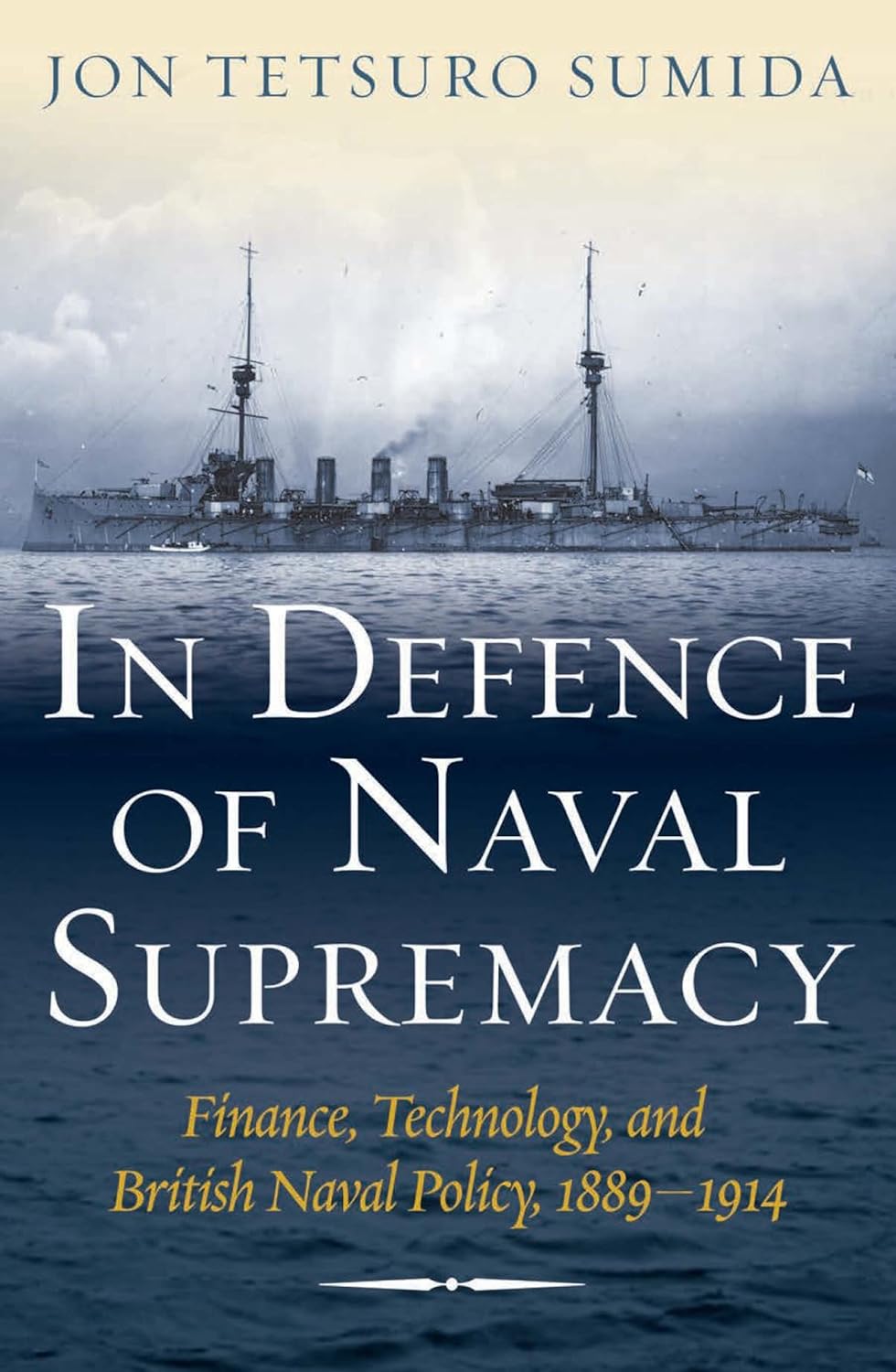
In Defense of Naval Supremacy (IDNS) seeks to answer three related questions associated with Fisher’s reforms: 1) what prompted the Admiralty to resort to a policy of radical technical innovation in capital ship design in 1905; 2) what factors affected the development of this policy; and 3) to what extent did the policy fail or succeed? Rather than answering these questions clearly and convincingly, Jon Sumida delivers a turgid, highly detailed account of fire control experimentation in the Royal Navy. Even the most committed and experienced student will find it hard to digest everything contained in IDNS. In short, this book is a slog.
So, why did the Admiralty resort to radical technical innovation in capital ship design in 1905? According to Sumida, there were several reasons. Among them was the development of the submarine and the torpedo. Fisher feared that the battleship was becoming obsolete. What was needed was a fast capital ship that could run down enemy cruisers, chase down a retreating fleet, maintain distances that avoided the threat of torpedoes, and control the distance at which the fleets engaged. The resulting fast battle cruiser was not a battleship, but was close enough that distinguishing the two types of ships was becoming like determining “when a kitten became a cat,” to use Fisher’s wonderful metaphor.
However, the innovative battle cruiser design could only achieve its mission if it possessed effective fire control that accounted for the roll, pitch and yaw of a warship in heavy seas firing at a moving target while steaming at 25 knots. Given the technological limits of the times, this was a nearly impossible task, but one that Arthur Pollen believed he had conquered. Sumida writes about the development and sea trials of the Pollen fire control system in painstaking detail. Indeed, it is difficult for the reader to retain the forest for the trees in Sumida’s complicated, blow-by-blow narrative. The upshot was Pollen’s brilliantly innovative system (according to Sumida) was rejected by the conservative Royal Navy as too complicated and untrustworthy, but above all prohibitively expensive.
What factors affected this policy? The development of effective long-range fire control deeply affected this policy, according to Sumida. A fast, heavily armored battle cruiser would only be effective if it could accurately engage the enemy at distances of greater than 10,000 yards. The entire premise upon which the battle cruiser was built was the ability to hit without being hit back.
To what extent did the policy fail or succeed? The failure to develop an effective fire control system led to the development of “a seriously flawed weapon system” (i.e. the battle cruiser). Sumida criticizes Fisher’s leadership at the Admiralty for not being forceful enough in demanding the adoption of the Pollen system, which in theory would have mitigated the shortcomings in the battle cruiser design.
In closing, this was a challenging book to read. I wish Sumida had done a better job articulating his arguments and summarizing his conclusions – including in his “Conclusions” chapter. I’m sure there is a fascinating story somewhere in IDNS, I just wasn’t able to find it.
 What's Tim Reading Now?
Leave a comment