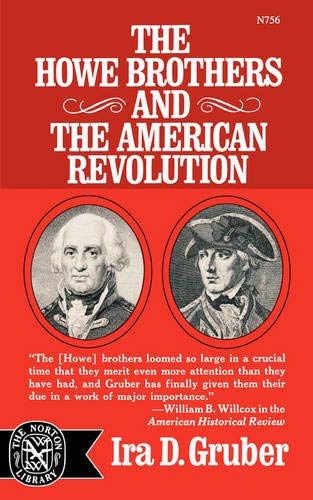
At the beginning of 1776, the British government was spoiling for a fight. Ira Gruber’s “The Howe Brothers and the American Revolution” tells the story of the opening chapter in the war when British success in smashing the rebellion seemed all but foreordained. “Why, indeed,” Gruber asks, “did [the Howe brothers] have no more success at the beginning of the war, at a time when the Continental army was half-trained, when many Americans were uncertain about the rebellion, and when foreign aid was as yet covert and tentative?” Gruber examines the Howes’ failure within the context of their relationship with the British ministry in London.
King George III was determined to make the colonists acknowledge the omnipotence of the British legislature. Gruber says he actually welcomed signs of open rebellion and the opportunity it presented to oppose force with force. The king, along with his new secretary for the colonies, the uber bellicose Lord Germain, “had come to believe that parliamentary supremacy more important than peace.” The conventional wisdom at the time was that the Americans would never stand and fight against British regulars and that the whole rebellion was led by a small group of demagogues without broad public support. The events of Lexington and Bunker Hill did little to alter opinions of easy success, the author says.
The Howe brothers – Admiral Richard Lord Howe and Major General William Howe – were both exceptionally well qualified professionally in their respective spheres and, perhaps just as importantly, politically well connected at court. However, neither shared the strident Parliamentary supremacy views of the king, his more bellicose ministers, and the vast majority of Parliament. Rather, the brothers were warm friends of America and staunch supporters of reconciliation, although like many English leaders they gravely underestimated the depth and breadth of American resentment. According to Gruber, “[Admiral Howe] feared that demanding abject submission of the colonies would lead to desperate resistance, that desperate resistance would force Britain to conquer the colonies, and that conquest would leave America sullen, difficult to govern, and of little value to Britain.” Lord Howe only agreed to accept command of the North American squadron if he were also given the role of peace commissioner, which he was granted, albeit with extreme limitations. In short, until the rebels surrendered unconditionally to British authority, acknowledging Parliament’s right to tax the colonists and to pass laws binding them in all cases whatsoever, he could do no more than offer pardons to those who would take an oath of allegiance.
The British ministry’s plans for 1776 were aggressive and unambiguous: “As commanders in chief the Howes would subdue the rebellion, destroying the Continental army, sweeping American ships from the sea, and strangling New England; as peace commissioners they would dictate Britain’s terms of surrender.” To accomplish these sweeping objectives the Howes were granted a substantial military and naval force, an army of over 30,000 soldiers and a fleet of 73 warships, 43% of all the ships on active service in the world’s most powerful navy.
Almost immediately, Gruber says, the Howe brothers mediated their strategy in the hopes of preserving the opportunity for reconciliation. In August 1776, rather than trapping and destroying Washington’s army in New York City and snuffing out the rebellion, they sought merely to capture territory. “A steady advance, creating the impression of British invincibility without causing widespread loss of lives and property,” Gruber writes, “probably seemed to [General Howe] the only way of persuading the colonists to negotiate on Britain’s terms.” Thus, the British missed perhaps their best chance of securing victory in 1776. Never again would Washington leave his army as vulnerable as it had been in New York City.
Nevertheless, the rout of the Continental army in New York generated generous appeals of reconciliation from Lord Howe. On November 30th he issued a proclamation that commanded the Continental army to disperse, ordered Congress to renounce its powers, and, most provocatively, offered a pardon to anyone, including rebel leaders, who within sixty days would swear allegiance to the crown. The ministry back in London, as well as many British officers serving in America, were shocked by its leniency.
Gruber makes much of the pivotal American victory at Trenton in December 1776. He claims that it utterly undermined the effectiveness of Howe’s November 30th proclamation and virtually destroyed the image of British invincibility that was so critical to his strategy for victory. In Gruber’s estimation, the victory at Trenton, a minor engagement in the grand scheme of things, likely saved the entire revolution. Moreover, it had a profound impact on General Howe’s plans for 1777. While the ministry was importuning him to coordinate with Burgoyne in Canada while prodding his brother to ramp up the blockade of the colonies, General Howe became maniacally focused on Philadelphia and what he believed was a large population of Pennsylvania loyalists. In Gruber’s words, Howe “was passionately – even irrationally – attached to his plan for tapping the great reservoir of loyalist sympathy in the Delaware Valley” that would prove he was not wrong in garrisoning the outpost at Trenton.
The ministry (and Gruber) criticized General Howe for getting off to such a disturbingly slow start in 1777. His New York-based army didn’t begin to move until July and would not land in the Chesapeake for an assault on Philadelphia until early September. Any hope of connecting with Burgoyne at Albany was irrecoverably lost. Moreover, the much-anticipated loyalist uprising never materialized. “The campaign of 1777 was disastrous for the British,” Gruber writes, “primarily because Sir William Howe had been obsessed with recovering Pennsylvania and incapable of taking prompt or consistent action.” If Trenton had been a strategic disaster for the British in late 1776, Burgoyne’s surrender at Saratoga in October 1777 would prove much worse. It was a catastrophe that could have been prevented if only General Howe taken his direction from the ministry. Both brothers offered their resignations, General Howe relinquishing command of the army to Henry Clinton in May 1778 and Admiral Howe stepping down in September.
The brothers returned to London to face an inquiry into their performance in America. They defended themselves by arguing that campaigning in America was unusually difficult: “the colonists had been hostile, unwilling to give intelligence or serve in British units; and the terrain had been both a hindrance to the flow of supplies and a complement to American tactics. Under these conditions the Howes had done as well as anyone could expect. Sir William had never tolerated plundering; he had never allowed his desire for a reconciliation to interfere with the prosecution of the war; and he had ever sought a general action as the shortest way to victory.” Moreover, they cast blame on their two toughest critics in the ministry, Germain because he refused to provide requested reinforcements and Sandwich because he was unable to provide an adequate fleet to ensure an effective naval blockade.
In sum, Gruber argues that the Howes failed because they pursued an unenergetic and too conciliatory policy. “In pursuing unsuccessfully their own dreams of conciliation,” the author writes, “the Howes sacrificed the ministry’s best prospect for regaining the colonies … Competent commanders without an interest in conciliation might have destroyed the Continental army, taken Philadelphia, and broken the rebellion in 1776. Incompetent commanders without powerful friends might have been recalled before serious damage was done.”
All told, I found Gruber’s arguments less than convincing. By 1776, the British faced a well-established insurgency in the colonies. Overwhelming force is rarely a successful counter-insurgency policy regardless of time or place. It might be argued that the more nuanced and thoughtful approach of the Howe brothers in fact gave the British their best chance for success under the circumstances. In any event, “The Howe Brothers and the American Revolution” is an outstanding, if somewhat esoteric contribution to our understanding of the war.
 What's Tim Reading Now?
Leave a comment