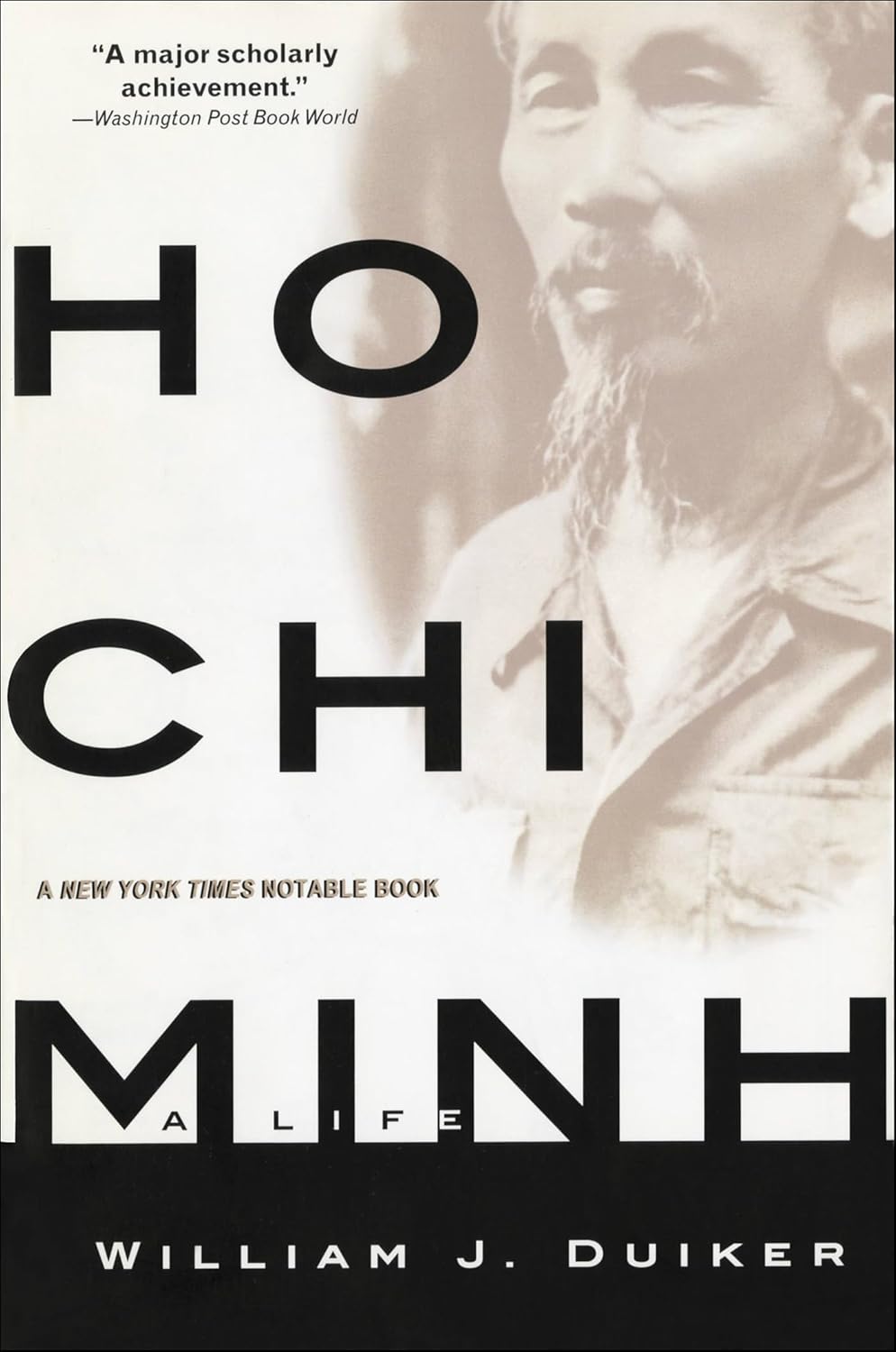
Ho Chi Minh was one of the most important political figures of the twentieth century. Yet much of his life has been shrouded in mystery. In this scholarly and highly detailed biography first published in 2000, the former Vietnam-based foreign service officer turned professor William Duiker seeks to pull back the veil of secrecy surrounding Ho’s life. In the process, he tells the story of the Vietnamese Communist Party and, indeed, modern Vietnam.
Duiker’s narrative is detailed, perhaps too detailed as it is easy for the reader to lose the forest for the trees. Here is my attempt to synthesize the story and Duiker’s main arguments and insights.
Ho Chi Minh was born Nguyen Sinh Cung in a small village in central Vietnam in 1890. His father held the equivalent of a doctorate and was a respected Confucian scholar; his mother died when he was eleven. From his father, young Ho would learn about Vietnam’s rich history and develop a patriotic yearning for independence. An energetic and promising student, he was carried away by anti-French protests in 1908 and was kicked out of school. By 1911, Ho had left Vietnam for the west in an effort to learn how his country might modernize. He would spend the next decade traveling the world over, working odd jobs to support himself, including short stints working in New York City and Boston. “Exposure to the world outside Vietnam had a major impact on his thinking and attitude toward life,” Duiker says. Yet, by the time he reached his 30s, “[Ho’s] worldly experience was limited to teaching, cooking, and a few menial jobs.”
All that changed in June 1919 when Ho, now operating under the new pseudonym, Nguyen Ai Quoc, penned a petition to the Versailles peace treaty congress calling for the self-determination of colonial peoples. It marked his official entry into the world of radical leftist politics. For the next five years he would write for radical journals and agitate within the French Communist Party for greater focus on the colonial issue. “Within a few years,” Duiker writes, “[Ho] had emerged from obscurity to become a leading force within the radical movement in France and the most prominent member of the Vietnamese exile community.” In the summer of 1923 he fled France, where he was under constant police surveillance, and traveled to Soviet Russia at the invitation of the Comintern. Ho had abandoned the path of political reform and had set out as a radical revolutionary, a path he would pursue for the rest of his natural life.
Ho’s stay in Moscow was short (just over a year) but eventful. He attended the “Stalin School” for international revolutionaries and was an outspoken advocate of addressing colonial exploitation and the importance of the peasantry in bringing about world revolution. By the time he left the Soviet Union in 1924, Duiker writes, “[Ho] was now the recognized spokesman for the Eastern question and for increased attention to the problems of the peasantry.”
There is a debate among scholars about the nature of Ho’s revolutionary mindset. Was he a devoted Marxist-Leninist? Or was he a devoted Vietnamese nationalist who used communist ideology as a convenient pretext? “There are valid reasons for the argument that [Ho] was above all a patriot,” Duiker says. “[Ho] often appeared to view the issue of national independence almost as an end in itself, with the Communist utopia a mere afterthought that could be postponed to the indefinite future.” Nevertheless, when the Vietnamese Communist Party was first cobbled together in March 1930 from competing radical leftist organizations operating in Indochina, Hong Kong-based Ho would be one of its founding fathers and its vital link to the USSR via his work as an agent for the Comintern. He would be arrested by the British in 1931 and held until 1934. Ho would spend the mid-1930s back in Moscow, a period Duiker calls his wilderness years, writing articles on the situation in southeast Asia, studying at various communist institutes, and just trying to stay relevant. The Comintern finally sent him back to Asia in 1938 to report on the situation in China. Thus, Ho would be on the ground in region when the Second World War opened up avenues to national liberation in Vietnam.
The French cracked down hard on communist agitators in the early years of the war, arresting most of the cadres operating in Vietnam and executing many of its leaders. Ho had long been held in high regard among his communist compatriots, but now he had the added benefit of being one of the few senior leaders left alive. He would lead a new united front for national independence, the Vietminh, and would do so under a new nom de guerre: Ho Chi Minh (He who enlightens).
Duiker stresses that Ho was above all a pragmatist and was willing to work with various parties, including the French, in order to achieve national independence. He continued to preach a need for “patience, calmness, and vigilance.” When peace came in August 1945, Ho triumphantly declared Vietnam’s independence and led a coalition provisional government in Hanoi. He downplayed his history of communist agitation and sought to lead a united front consisting of various nationalist elements. The French, meanwhile, had no intention of granting independence to a unified Vietnam.
At this point in the story, Ho Chi Minh recedes into the background as Duiker constructs a richly textured narrative of the Vietnamese struggle for independence. It is easy to forget that you’re reading a biography of Ho Chi Minh and not a general history on the subject.
Despite the long odds against the Vietminh in the mid-1940s, Ho Chi Minh retained his buoyant confidence, arguing that the coming struggle would be like a fight between a tiger and an elephant. The Vietminh tiger would come out at night to attack the French elephant and slowly bleed it to death. It was an apt metaphor and one that proved largely correct, although Duiker stresses that Vietminh success would have been unlikely without increasingly robust logistical and political support from the recently victorious Chinese Communist Party. The Soviet Union, meanwhile, remained lukewarm in support of Ho, many in Moscow doubting his ideological purity. After eight long years of war, the Vietminh secured victory in the North, a victory officially recognized by the Geneva Accords of 1954.
Duiker stresses that Ho was a moderating political influence in the North after the armistice. He counseled for a go-slow approach to developing a socialist society, including land redistribution, and abhorred the violence committed by party cadres in the countryside. The image Duiker constructs of Ho is that of a genuinely kind and humane avuncular figure, one committed to national unification and anti-feudal reforms, but willing to work with various parties to implement his desired changes slowly, peacefully and pragmatically. He was constantly fighting against the more aggressive actions of his party underlings and his Chinese advisors and urged caution instead.
Already by the late 1950s, Ho was losing his influence over the direction of events. “The process may have begun with the rise of Chinese influence over the movement in the early 1950s,” Duiker writes, “and it accelerated after Geneva [in 1954], when many of his colleagues grew restive at the failures to achieve the peaceful reunification of the country. With the emergence of Le Duan as the most important figure on the political scene [in 1957],” it was to decrease even further. By 1958, Duiker continues, “Ho Chi Minh’s role was increasingly limited to that of a senior diplomat and foreign policy adviser, as well as to fulfilling his growing image as the spiritual father of all the Vietnamese people and the soul of the Vietnamese revolution.” When the Central Committee passed Resolution 15 in January 1959 committing the North to a strategy of revolutionary war in the South, Le Duan had already eclipsed Ho in day-to-day authority over the Vietnamese Workers Party.
Ho’s diplomatic portfolio was challenging, to say the least. He tried to keep Vietnam neutral in the growing Sino-Soviet split. The one thing that Moscow and Beijing seemed to agree upon, however, was that Hanoi shouldn’t pursue an aggressive policy in the South that might disrupt the peaceful global balance with the capitalist west. Ho continued to express a preference for a war of stratagem in the South over one of direct confrontation, which put him at odds with Le Duan. According to the author, by the early 1960s, as the war in the South intensified, Le Duan and his hard-liner allies in the Politburo “clearly harbored a condescending and even contemptuous attitude toward the president, who, in their view, had in recent years lost his acute grasp of politics and was now increasingly muddled in his thinking.”
Ho’s health steadily deteriorated throughout the 1960s as he was shunted aside politically, playing only a ceremonial role as “Uncle Ho” to his people as the war raged in the South and American bombs dropped on the North. He died on September 2, 1969, the 24th anniversary of his Vietnamese declaration of independence.
In the end, Duiker argues that Ho Chi Minh was the indispensable man of the Vietnamese revolution. “Not only was Ho the founder of his party and later president of the country,” he writes, “but he was its chief strategist and its most inspiring symbol … part Lenin and part Gandhi, with perhaps a dash of Confucius.” His desire for national independence and the quest for economic and social justice were a message that resonated far beyond the borders of Vietnam and are, in Duiker’s view, his most enduring legacy.
 What's Tim Reading Now?
Leave a comment