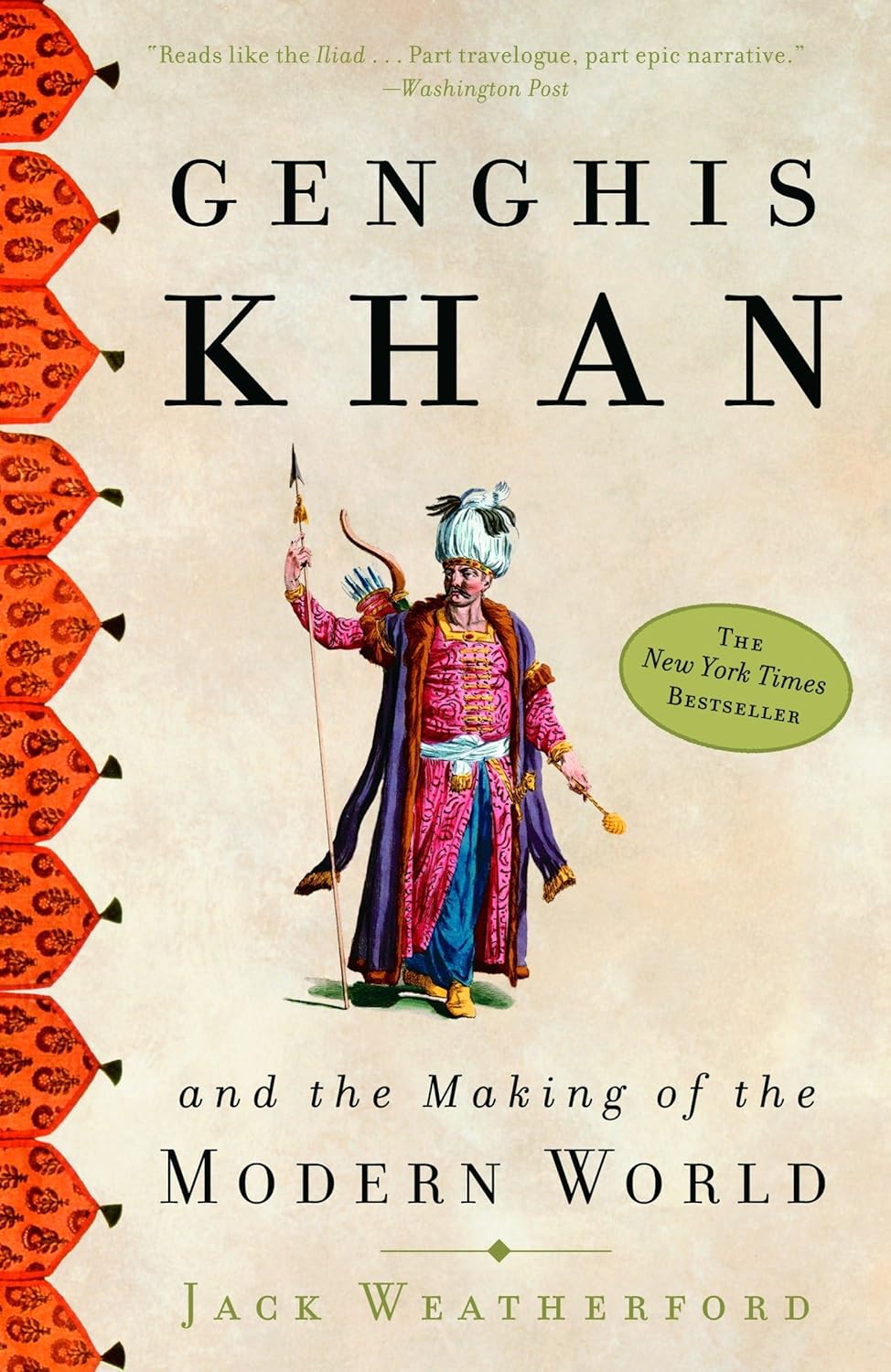
The early 1990s marked the first time that Genghis Khan and his empire – defunct since at least the mid-fourteenth century – could be studied in-depth. “The Secret History of the Mongols,” re-discovered in the early nineteenth century, had finally been translated, and the collapse of the Soviet Union had opened up the so-called Ikh Krorig, the Closed Zone, hundreds of square miles of unspoiled nature in Inner Mongolia where the Great Khan was born, raised and buried.
The speed and sweep of the Mongol conquests in the thirteenth century was breathtaking, even with 800 years of perspective. “In twenty-five years,” writes author/anthropologist Jack Weatherford, “the Mongol army subjugated more lands and people than the Romans had conquered in four hundred years,” an empire of some 12 million contiguous square miles, an area as large as the African continent. In the Middle East, the Mongols “accomplished in a mere two years what the European Crusaders from the West and the Seljuk Turks from the East had failed to do in two centuries of sustained effort”: the total subjugation of the Arab Muslim world.
Genghis Khan was born in 1162 in the far northeastern corner of what today is Mongolia. His childhood was difficult even by the standards of 12th century steppe society, dominated by challenge and hardship, abandonment and murder. He was a lower class orphan from a minor tribe, the Mongols, which Weatherford writes had “no ancient and glorious history among the steppe tribes.”
Temujin (Genghis Khan’s birth name) emerged as a formidable steppe leader in his late teens. Not only was he brave and fierce; his leadership philosophy included a revolutionary social dimension. Growing up a non-aristocratic “black bone” and without a father, he was keen to make his management style more egalitarian, an approach that endeared him to many, but also alienated the traditional leadership class, the so-called “white bones,” who saw Temujin as a “common upstart” and flocked to his erstwhile best friend from childhood, and eventual chief rival, Jamuka. Under Temujin, no longer would steppe warriors receive any special privilege because of their lineage. It was a shocking policy decision, and one he would carry to across his future empire.
Weatherford writes that Temujin instituted several innovations that sent shockwaves through long established steppe culture: 1) all looting of a defeated rival would happen after the battle, not during it, so that the distribution could be more organized and centrally controlled; 2) the widows and orphans of slain Mongol warriors would receive a share of loot, a sort of insurance policy that engendered loyalty among his troops; 3) the rank-and-file of the defeated tribes would be absorbed into the Mongols not as slaves, as was tradition, but as equals (tribal leaders, however, would be executed wholesale); and 4) he organized his new army into a sophisticated decimal system structure, with ten men, usually from mixed tribes, making up an “arban,” ten “arbans” making up a hundred man unit called a “zagun,” 10 “zaguns” creating a thousand-man “mingan,” and 10 “mingans” forming a ten thousand-man “tumen,” the main operational unit in future Mongol conquests. No man could change or desert his “arban” under pain of death. It was Temujin’s way of ensuring that the historically fragmented and quarrelsome tribes of the steppe were melded into a single cohesive army.
Temujin consolidated his leadership position by 1206 when he was in his mid-forties. Elected “Genghis Khan” by a khuriltai (intertribal election), he was the supreme ruler over a stretch of territory the size of Western Europe, but with perhaps only 1 million people and some 20 million animals. “He had neutralized the power of his own relatives, killed the lineages of aristocrats and all the rival khans, abolished the old tribes, redistributed the people and, finally, allowed the most powerful shaman on the steppe [Teb Tengeri] to be killed.”
Never before had the tribes been so united. Rather than resting on his laurels he sought to create a new nation. He proclaimed an epoch-shaping “Great Law of Genghis Khan” that focused on alleviating the ageless steppe raids that made the territory so violent and ungovernable. The Great Law forbid the kidnapping of women, adultery, animal rustling, and hunting between March and October; complete religious freedom was declared (a first in world history, according to the author); and even the Great Khan himself would be held accountable under the Law, a declaration of the rule of law made a few years before the Magna Carta itself. The depth and breadth of these reforms are truly breathtaking, especially given the time and place from which they emerged.
In 1210, at the age of 48, Genghis Khan would be drawn into an affair that would ultimately alter world history. A new Golden Khan was put on the throne of the Jurched empire in modern day China. The Jurched, with 50 million subjects, demanded that Genghis Khan and his nascent Mongol nation submit as a vassal. He refused. Weatherford stresses that Mongol martial success was never about new or better weapons, but rather their “cohesion and discipline, bred over millennia as nomads working in small groups, and from their steadfast loyalty to their remarkable leader.”
The author also notes that Genghis Khan carefully husbanded his soldiers. He was no “meat grinder” general. “The Mongols did not find honor in fighting; they found honor in winning,” he writes. In 1211, for instance, as the Mongol horde descended on the Jurched, they turned their enemy’s manpower advantage into a liability, avoiding battle and burning fields and villages, channeling tens of thousands of refugees into the empire’s cities, overwhelming their supplies and forcing a quick and relatively bloodless surrender.
The unanticipated and unwanted threat from the Jurched had resulted in almost unimaginable quantities of loot, acquired quickly and at little cost. These riches quickly changed the fabric of Mongol society, Weatherford says. “Novelties became necessities, and each caravan of cargo stimulated a craving for more. The more [Genghis Khan] conquered, the more he had to conquer…what began as a quick raid on cities south of the Gobi for silks and baubles had turned into three decades of the most extensive war in world history.”
In 1219, the Sultan Muhammed II of the Khwarizm Empire, which stretched from modern day Central Asia to the Levant, attacked a large Mongol caravan and mutilated the faces of Genghis Khan’s emissaries. In response to these rash and foolish acts, the Mongols “laid waste a whole world,” according to the Persian writer, Juvaini. The Mongol invastion of Khwarizm was unprecedented. “Nothing could slow, much less stop the Mongol juggernaut,” Weatherford writes. Looting was conducted on an epic scale and with medical precision. Meanwhile, the Mongols slaughtered the rich and powerful from every city and every society. “By killing the aristocrats, the Mongols essentially decapitated the social system of their enemies and minimized future resistance.” But the Mongols were not sadistic, according to the author. Genghis Khan and his army “did not torture, mutilate, or maim.” In fact, Weatherford writes that the Mongols went to great lengths to use propaganda and word-of-mouth to encourage cities to surrender without a fight. “The Mongols did not inspire fear by the ferocity or cruelty of their acts so much as by the speed and efficiency with which they conquered and their seemingly total disdain for the lives of the rich and powerful.” Later historians’ claims that the Mongols killed 15 million people (and that’s the low end estimation) does not stand up to critical analysis, according to Weatherford. Such numbers would mean that every individual Mongol horseman killed hundreds of people each. (But what if you include the millions starved in Mongol sieges?) Weatherford says that “Genghis Khan would be more accurately described as a destroyer of cities than a slayer of people.”
By 1226, when Genghis Khan died, his Mongol homeland was an odd blend of traditional, austere steppe culture and the finest luxuries the world had to offer. Humble felt tents of ordinary families were stuffed with Chinese silks, Persian rugs, exotic spices and perfumes, and jewelry of gold, silver and jade. Imagine some shabby Kentucky trailer park where every family had Jacuzzis and big screen HD TVs in their double-wides, Rolexes and Berkin bags on their person, with Bentleys and Ferraris parked out front. It was something like that.
The succession was marred from the start. “Without Genghis Khan to moderate the celebration, his heirs now ruled the empire, drunk with riches they had not earned and with the alcohol that they had come to love.” He had four sons. The oldest, Jochi, had a questionable lineage and was likely Borte’s son from her time in captivity with the Merkid. The second son, Chaghatai, vehemently opposed his older (and likely half-) brother. Thus, the family compromised on Ogodei, the Khan’s “mellow, good-natured, hard-drinking” third son. Weatherford calls the “khuriltai” that decided the succession as eventful to world history as the Congress of Vienna, Versailles or Yalta; much of the Eurasian landmass was carved up by a few men, all of them related.
One of Ogodei’s first decisions – “the first of several bad mistakes” according to the author – was the creation of a new permanent Mongol capital city, Karakorum. The sole function of the city was to collect tribute from across the empire. It was an enormous financial burden to maintain. The city of tribute and the love of luxuries “transformed the Mongols from a nation of mounted warriors to a sedentary court with all the trappings of civilized decadence that was so contrary to Genghis Khan’s legacy.”
The Mongol people grew no crops and manufactured no products. They lived on conquest. They required a steady diet of new people to pillage – and they were running out of attractive targets. Ogodei was rapidly depleting his massive inheritance and needed a new campaign to refresh the imperial coffers. In 1236 the Mongols undertook a 5-year campaign targeting Eastern Europe that “marked the zenith of Mongol military ability.” It was likely the largest and most sophisticated military operation until World War II, coordinated across a front hundreds of miles wide and 4,000 miles from their home base at Karakorum. The seemingly unstoppable Mongol juggernaut was eventually stopped by the “forests, rivers, and plowed fields with crops and ditches, hedges, and wooden fences” of Western Europe. The Mongols’ marked advantages of speed, mobility, and surprise were all undermined by geography, not any armed opponent. But victory was still theirs. “Walled cities and heavily armored knights were finished,” Weatherford writes, “the Mongol triumph portended the coming total destruction of European feudalism and the Middle Ages.”
If the unfamiliar geography halted the expansion of Mongol power, the bubonic plague of the mid-fourteenth century destroyed it. The Black Death was an epidemic of commerce that spread along the trade routes that the Mongols had created and maintained. Between 1340 and 1400 some 75 million people died. “The disease brought down urban dwellers more readily and thereby destroyed the educated class and the skilled craftsmen.” Commerce collapsed and the trade routes connecting the far-flung empire were severed. “With the onslaught of plague, the center could not hold, and the complex system collapsed,” Weatherford writes. In Persia (1335) and China (1368), respectively, the end came quickly. In China, where Khubilai Khan “consistently and systematically pursued a nearly two-decades long policy of winning the allegiance of a continental civilization,” the Mongols simply vanished, packing up and returning home to Inner Mongolia. In the Middle East, the Mongols converted to Islam in a last ditch attempt to retain allegiance.
In closing, I enjoyed reading this book and learned much; mainly, that the Mongols were far more sophisticated and progressive than I had ever imagined. I was surprised to learn that paper money, the primacy of the state over the church, freedom of religion, diplomatic immunity, and international law were all core principles of Mongol rule. Indeed, as Weatherford argues, “Whether in their policy of religious tolerance, devising a universal alphabet, maintaining relay stations, playing games, or printing almanacs, money, or astronomy charts, the rulers of the Mongol Empire displayed a persistent universalism.” It’s far from the conventional modern image of Genghis Khan and the Mongol hordes as bloodthirsty marauders.
 What's Tim Reading Now?
Leave a comment