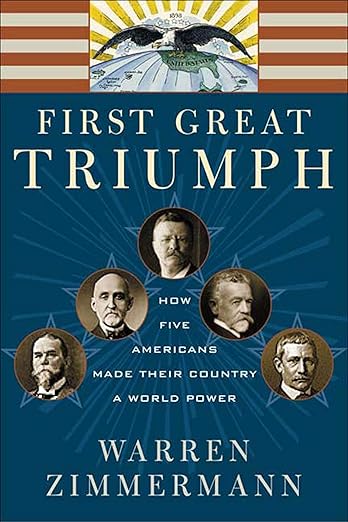
In 1986 Walter Isaacson published “The Wise Men: Six Friends and the World They Made” about how a group of East Coast foreign policy establishment leaders helped craft U.S. national security and foreign policy in the early Cold War era. Warren Zimmermann’s “First Great Triumph: How Five Americans Made Their Country a World Power,” first published in 2002, takes the same group biography approach and can be read as something of a prequel to Isaacson’s award-winning effort. They were “The Original Wise Men,” as it were.
To begin, a few words must be said about the author of “First Great Triumph.” Zimmermann is neither an historian nor an academic of any stripe. Rather, he is a retired Foreign Service officer, having completed his distinguished 33-year career as the last U.S. ambassador to Yugoslavia in the early 1990s. His writing is brilliant, his scholarship is excellent, and his insights are penetrating. I found it amazing that a relative amateur was able to write a book this good.
Zimmermann divides his narrative into two parts. The first is a collection of biographical vignettes of the principle characters in the story. Each would play a key role in the establishment of American imperialism in the wake of the lightning fast U.S. victory in the Spanish American war of 1898. Naval officer and strategist Alfred Thayer Mahan provided the historical case for a powerful navy and the necessity of overseas bases and coaling stations. His work would provide the blueprint and intellectual justification for overseas expansion when the opportunity arose. Henry Cabot Lodge would play the pivotal role of imperial leader in the United States Senate and promoter of the political career of Theodore Roosevelt. John Hay, a quiet man of much self-doubt and recurring bouts of depression, would steer American foreign policy as secretary of state for seven years after the conclusion of the Spanish American war, a period when the United States transitioned into a great power and empire. Elihu Root, a prominent New York corporate attorney with no previous foreign policy or national security experience, expertly managed the country’s recently acquired colonial domains from his perch as secretary of war and, after the death of Hay in 1905, as secretary of state. Finally, there is the incomparable Theodore Roosevelt, whose presidency from 1901 to 1909 was a watershed in American history. All five were longtime personal friends and shared a similar outlook on America’s destiny in global affairs.
Part Two tells the story of how the United States acquired an overseas empire in the wake of the Spanish American War. Zimmermann stresses that President William McKinley fervently sought to avoid war with the Spanish, who were bogged down fighting a rebel insurgency on Cuba. American interest in the conflict was keen. Amazingly, Cuba was the third largest trading partner with the U.S. after Britain and Germany. McKinley sought a peaceful resolution to the crisis by offering to purchase Cuba for the princely sum of $300 million, more than forty times what the United States had paid for Alaska. Madrid demurred. “Spanish pride,” Zimmermann writes, “would be better served by losing Cuba in war than by negotiating it away.” McKinley’s hands were increasingly tied. The Spanish were unwilling to negotiate. Americans were outraged by reports of Spanish brutality and were horrified by the sinking of the USS Maine in Havana Bay. Meanwhile, the yellow press in New York whipped up a war-frenzy. McKinley eventually capitulated. American intervention in Cuba was required, he wrote, “in the cause of humanity and to put an end to the barbarities, bloodshed, starvation, and horrible miseries now existing there, and which the parties to the conflict are either unable or unwilling to stop or mitigate.”
It would be, as John Hay, then serving as U.S. ambassador to Great Britain, famously put it, “a splendid little war.” After two decisive naval victories at Manila and Santiago, the Spanish surrendered. “It would be hard to imagine a more convincing proof of Mahan’s dictum that control of the sea was the key to military victory,” Zimmermann writes. From start (the Battle of Manila Bay) to finish (the Treaty of Paris), the conflict took just 8 months.
Zimmermann’s story really begins with the Treaty of Paris that concluded the war. “The country had entered the war against Spain with the limited aim of winning control of Cuba,” he writes, “but it emerged as a world power.” A fierce domestic debate quickly erupted over how to handle the new possessions. The imperialists, known as the jingoes, had a clear vision, which had largely been articulated by Mahan before the war. The U.S. needed to retain control over Cuba and Puerto Rico in the Caribbean to ensure the safety and security of a future canal through the Isthmus of Panama. The Philippines, Guam, and Hawaii (conveniently annexed in 1898) provided a foothold in the Pacific, allowing the United States to play a larger economic and political role in Asia.
A strident and diverse set of anti-imperialists, known as “goo-goos,” emerged to block these aspirations. Among them included the writer Mark Twain, probably the most famous American alive at the time, industrialist Andrew Carnegie, former U.S. Civil War general Carl Schurz, Harvard intellectuals Charles Eliot Norton and William James, journalist E.L. Godkin, and U.S. senator George Frisbie Hoar of Massachusetts. Their primary objection to the imperial cause was their belief that it betrayed fundamental American principles and ideals. Moreover, the acquisition of overseas territories, they argued, were illegal and could not be justified by anything written in the Constitution or Declaration of Independence. In the words of Senator Hoar: “You have no right at the cannon’s mouth to impose on an unwilling people your Declaration of Independence and your Constitution and your notions of freedom and notions of what is good.”
Not all of their arguments against imperialism were noble, however. Social Darwinism – the belief in the innate superiority of the Anglo-Saxon race – also figured prominently in their arguments. Many goo-goos wanted no part in welcoming brown people to the growing American family. “There was more than a little racism among social Darwinist opponents of imperialism,” Zimmermann writes, “just as there was among its defenders.” In the end, the goo-goos failed in all of their major objectives. Zimmermann says, first of all, that their political base was too narrow. Second, the anti-imperialists’ fear of foreign contamination dislodged them from the moral high ground that was so important to their appeal. Finally, Zimmermann says, the anti-imperialists were backward looking and seemed out of touch. Many of their leading members were in their late sixties and seventies and held a worldview perceived by many to be conservative and reactive.
By 1901, with Roosevelt in the White House, Hay at State, Root at War, and Lodge at the Senate Foreign Relations committee (Mahan played a limited role in events); the jingoes were firmly in control. “It was Roosevelt and his friends who defined the future with the most clarity and exuberance,” Zimmermann says, “who laid claim to its riches, and who set America squarely in the center of it.”
Overall, and somewhat surprisingly, Zimmerman is glowing in his assessment of the U.S. performance in colonial administration. Secretary of War Root, who oversaw colonial administration and the war in the Philippines, is labeled “a colonial strategist of genius.” Howard Taft, who served four years as governor of the Philippines, was in Zimmermann’s estimation, “an extraordinary proconsul.” Leonard Wood, Governor General in Cuba, comes in for similarly high praise.
What legacy did Mahan, Hay, Lodge, Root, and Roosevelt, who Zimmermann calls the “founding fathers of American imperialism,” leave on American foreign policy? Zimmermann cites five enduring principles. First, they created a more benevolent form of imperialism, far from perfect but immeasurably better than that of their European predecessors. As Roosevelt put it, “Our chief usefulness to humanity rests on our combining power with high purpose.” Zimmermann largely agrees. He asks: “Would things have been better for Hawaiians, Cubans, Puerto Ricans, and Filipinos if they had never been under American rule?” He says, “The answer is certainly no for Hawaiians and probably no for the others.” Indeed, it is noteworthy that “Americans are not particularly unpopular among peoples they have ruled.”
Second, the five founders laid the groundwork for the United States to become a great power. The United States entered the world of the great powers through its territorial conquests, but those conquests in themselves did not make it one. Rather it was an empire generated by principle and authority.
Third, they developed the first clear and comprehensive articulation of U.S. security interests abroad. Primary among those assertions was that American security depended on effective hegemony in the western hemisphere, a principle first articulated in the Monroe Doctrine and expanded at the turn of the century by the Roosevelt Corollary. The acquisition of Hawaii and the Philippines extended the American security commitment to Asia, a fact that proved difficult to defend. In Zimmermann’s estimation, “In the Philippine case the founders of American imperialism may have made a costly mistake.”
Fourth, the founders created the twin enduring foundations of American foreign policy: human rights and stability. American involvement in the First and Second World Wars and then its leadership against global communism is a testament to those enduring principles.
Finally, the birth of American imperialism ushered in an era of enhanced executive authority. Zimmermann argues that Roosevelt was the first strong American president since Lincoln. The twentieth century would be filled with them (Wilson, Roosevelt, Truman, Johnson, Nixon, Reagan). The five understood that legislatures could never make effective foreign policy; only strong executives can.
In closing, “First Great Triumph” is a fabulously entertaining and informative read. For anyone interested in the history of American foreign policy or just curious about America in the early Progressive Era Zimmermann’s book is not to be missed.
 What's Tim Reading Now?
Leave a comment