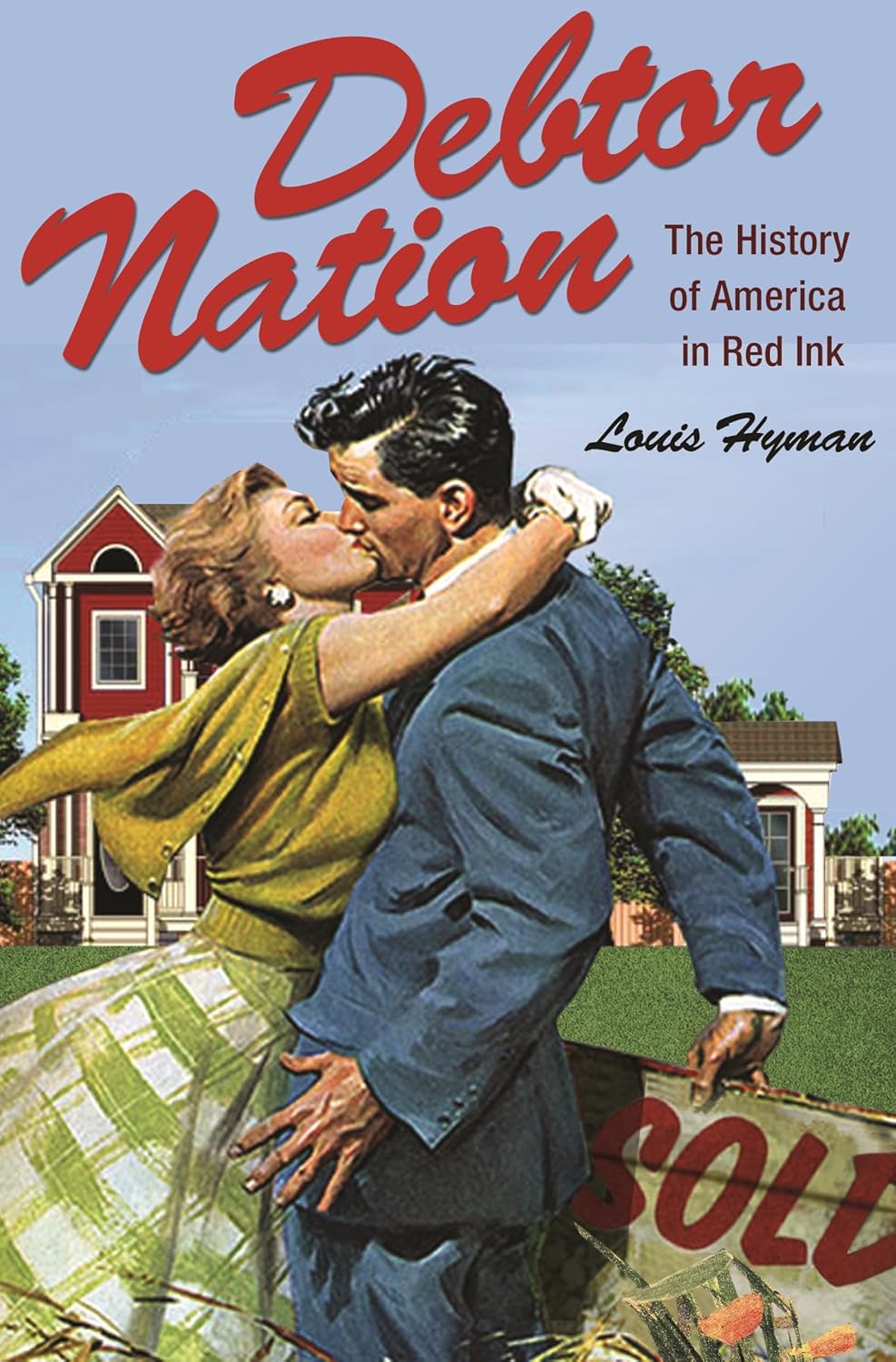
Never mind the cheesy harlequin romance novel cover, this is a serious book. Perhaps the most amazing thing about Louis Hyman’s “Debtor Nation: The History of America in Red Ink,” the story of personal debt (namely, consumer loans, long term home mortgages, and credit cards) in twentieth century America, is that it hasn’t been written before. Moreover, it was written as a PhD dissertation, and in American history, not economics (Hyman was awarded the prize for best dissertation in history at Harvard and best dissertation in business history nationally for his effort). The end result is a surprisingly easy-to-read and highly informative, not to mention incredibly important, piece of historiography, although not without a few notable shortcomings.
There are a few core themes to Hyman’s thesis. First, consumer debt is relatively new thing and banks proved remarkably slow to recognize the huge profit potential it held. Second, it was the ability to securitize consumer loans, first home mortgages but eventually credit card debt, that powered the tremendous growth in lending. But no theme is more pronounced than the author’s argument that “Market solutions guided by public policy can work to transform the most basic aspects of our material lives.”
Hyman’s story starts with two key financial innovations, both of which took root after World War I: installment credit (financed by independent finance companies) and personal consumer loans. For centuries there was no legal market for personal loans because usury laws prohibited interest rates over 1.5% a month or 20% annually. At that rate of interest, personal loans were simply not profitable to the lender, he writes. The market void was filled by so-called “loan sharks,” such as John Mackey of Minneapolis, who charged interest of 10% a month or 185% annually on loans usually less than $50. A reform movement against loan sharking, led by the progressive Russell Sage Foundation, actually helped bring firms like Mackey’s into the mainstream, as usury laws were raised to 3% a month and 45% annualy in order to drive nefarious lenders out of business while making the more reputable ones rich. Mackey’s Housefield Finance Corporation not only survived, but thrived to become a leading subprime lender a century later.
Installment credit, on the other hand, grew out of the remarkably successful American auto industry. At first, there was an explosion of independent finance companies dedicated to auto finance. But as the market for new cars slowed and the major auto manufacturers launched their own finance divisions (GM’s GMAC and Ford’s Universal Credit) the smaller players moved quickly into household durable goods, like radios and refrigerators.
Prior to the depression, home loans were unamortized, short term (3-5 years) debt held by small, local lending institutions. Moreover, loan rates varied widely from city to city and state to state. With the depression the old form of home loans collapsed, and with it went the entire construction industry, the primary employer in the country. The New Deal launched two agencies to tackle the issue. First, the Public Works Administration (PWA), led by the liberal crusader Harold Ickes, aimed at building, at government expense, low income housing to improve urban areas. Second, and more important, according to the author, was the Federal Housing Authority (FHA), led by the businessman James Moffett, and aimed at “private planning, private funds, and private incentives to carry out federal policy.”
Mortgages that met the FHA criteria for housing quality had to be long term (e.g. 20 years), low interest (<5%), and amortized so that the owner was paying both interest and principal. In exchange, the US government would ensure up to 20% of the mortgage if it fell into default. The 20% insurance was enough to encourage private lending without promoting reckless lending. Moreover, standardization of the loans allowed them to be packaged and resold as a commodity in a market created by the government. This allowed major capital centers, like insurance providers, to invest in the housing market.
The FHA offered two types of loans: Title I for home modernization, such as electrification (which, in turn, would boost retail sales in radios and refrigerators); and Title II home loans, mainly targeted at suburban areas. Unlike the PWA, the objective of the FHA was “to escape the cities, not save them.” The key shift was that government language “reframed mortgages not as a heavy debt, but as a responsible long-term investment for the borrower.” It also introduced banks to consumer lending — and it ended up saving many of them during the Depression when commercial lending collapsed. “The great lesson of the Depression for banks,” Lyman writes ‘was that there were alternatives to investing in business – investing in personal debt could be profitable as well.”
Hyman disputes the commonly held narrative of the birth of the credit card: when Diner’s Club founder, Frank McNamara, left his wallet in a different pair of pants and was unable to pay for dinner on a business trip in 1950. Rather, the author argues that the modern notion of a credit card – a revolving credit account that can be paid off over any amount of time the consumer chooses – was mainly the creation of the market’s use of new technology during WWII to avoid Regulation W, federal legislation enacted under the Trading with the Enemy Act to control wartime inflation by regulating how much consumers could borrow and under what terms. Regulation W was in many ways the economic “brakes” to the FHA Title I “gas pedal,” as federal policy suddenly switched from promoting demand to dampening it. The regulation generally limited installment programs to a maximum of 18 months and minimum down payment of 15-33%, even though the different products that leveraged the installment program had vastly different terms. Because revolving charge accounts were not covered by Regulation W, “all a retailer needed to do was to invent a new kind of credit outside the regulations, to give customers what they wanted – more borrowing power.”
The booming postwar economy was aided by innovations in consumer credit, specifically department store credit programs. Lyman writes that “debt made the good life possible” in the postwar years as “the debt economy of the post-war suburb erased many class differences in consumption.” The leitmotif is that department store credit programs taught shoppers about borrowing. Store managers, meanwhile, learned that default rates were less than 1% and that the finance program could be more than just a means to promote greater sales at the store, which they were designed to do and most certainly did, but could also be meaningful profit centers in their own right. It was Federated Department Stores, “always the innovators,” according to Lyman, that developed the option account, which for the first time removed credit limits on the customer. Gone were the days of the merchant manager determining the appropriate debt load for customers, while wielding the humiliating stick of repossession. Now the customer determined how much to borrow and when to pay it back, all without fear of repossession (which had become costly and unnecessary). “By the early 1960s,” Lyman writes, “credit was not seen as a customer courtesy but as a customer necessity.” Thus, it was the American consumer’s experience with highly flexible and permissive credit at their local department store that paved the way for the credit card; “Businessmen did not matter nearly as much as suburban housewives in the creation of the credit card.”
Interestingly, poor access to credit and high prices were closely tied to the race riots of the 1960s. Black ghettos generally had neighborhood stores that sold mainly on installment plans with high interest, making consumer goods dramatically more expensive for the poorest families. These stores had default rates of 6.7% versus suburban default rates of a measly 0.3%. Moreover, the purchases were still subject to repossession. Somewhat surprisingly, many black activists believed that “credit cards would liberate the black consumer” by giving them a choice in where to shop, allowing them to escape the exploitive credit practices of ghetto merchants. At the same time, the women’s liberation movement was protesting the difficulty of married and divorced women to establish credit on their own merits.
The Fair Credit Reporting Act (FCRA) was passed in 1970 and amended in 1973. Hyman stresses that by “fair” they really meant “accurate.” For some reason, the author glances over the fact that Congress debated and then defeated the idea of a government run national credit bureau, presumably over the optics of Big Brother watching over citizens. Indeed, the classic credit bureau of the early 20th century was essentially a local gossip report. Information came from local paid volunteers and included hearsay information about individual’s drinking habits and the perceived state of their marriage and household tidiness, as well as other highly personal and subjective moral topics. As late as 1973 the industry group Associated Credit Bureaus had 2,100 members. Only a handful, led by Credit Data Corporation (today’s Experian), used computers and objective analytical insights. The new age of credit bureaus moved the industry “away from hearsay, moralizing, and discrimination toward a more impartial and financial basis for its judgments.” Today’s world of three major credit bureaus and a common credit score rating of 350 to 850 is a creation of the past couple of decades.
By the 1980s credit cards had become twice as profitable as conventional bank loans. The challenge for issuers quickly became the ability to raise capital to fund their cards, not finding qualified borrowers. The transition came with the securitization of credit card debt, much like that of home mortgages. And, again, according to the author, it was federal policy and regulations, not the free market, that provided the financial innovation to make it happen. The Housing Act of 1968 created the mortgage backed security. Moreover, a short term program called Section 235 subsidized interest payments in a hope to quell urban unrest via home ownership.
There were a few topics I would have liked to hear more about though. First, there is little focus on the the macroeconomic impact of loose consumer credit, which essentially created trillions of dollars that didn’t exist (even though he touches on it with the inflation-containing Regulation W of World War II and Korea). Second, there is scant attention paid to the history and competency of credit bureaus. Lyman clearly understands the incredible power these companies wield (“Three corporation [assign] every American a credit rating. Their opinions [govern] consumers’ ability to rent and to buy housing, to afford an education, to shop for clothes and food, to commute to work, and even to receive medical care — that is, the basic materials of daily life.”) but he limits the topics to several pages in the final chapter of the book. Finally, he fails to address the housing crisis of 2008 even though this book was published well after the fact, although he does note “World War II did not get us out of the depression, having the ability to invest profitably in suburbia, aerospace, and electronics did…[the 2008] financial crisis occurred not because capitalism failed, but because it succeeded in doing what it does best: profits and inequality.”
All in all, this is a fabulous and informative book and should appeal to both academics and the thoughtful general reader.
 What's Tim Reading Now?
Leave a comment