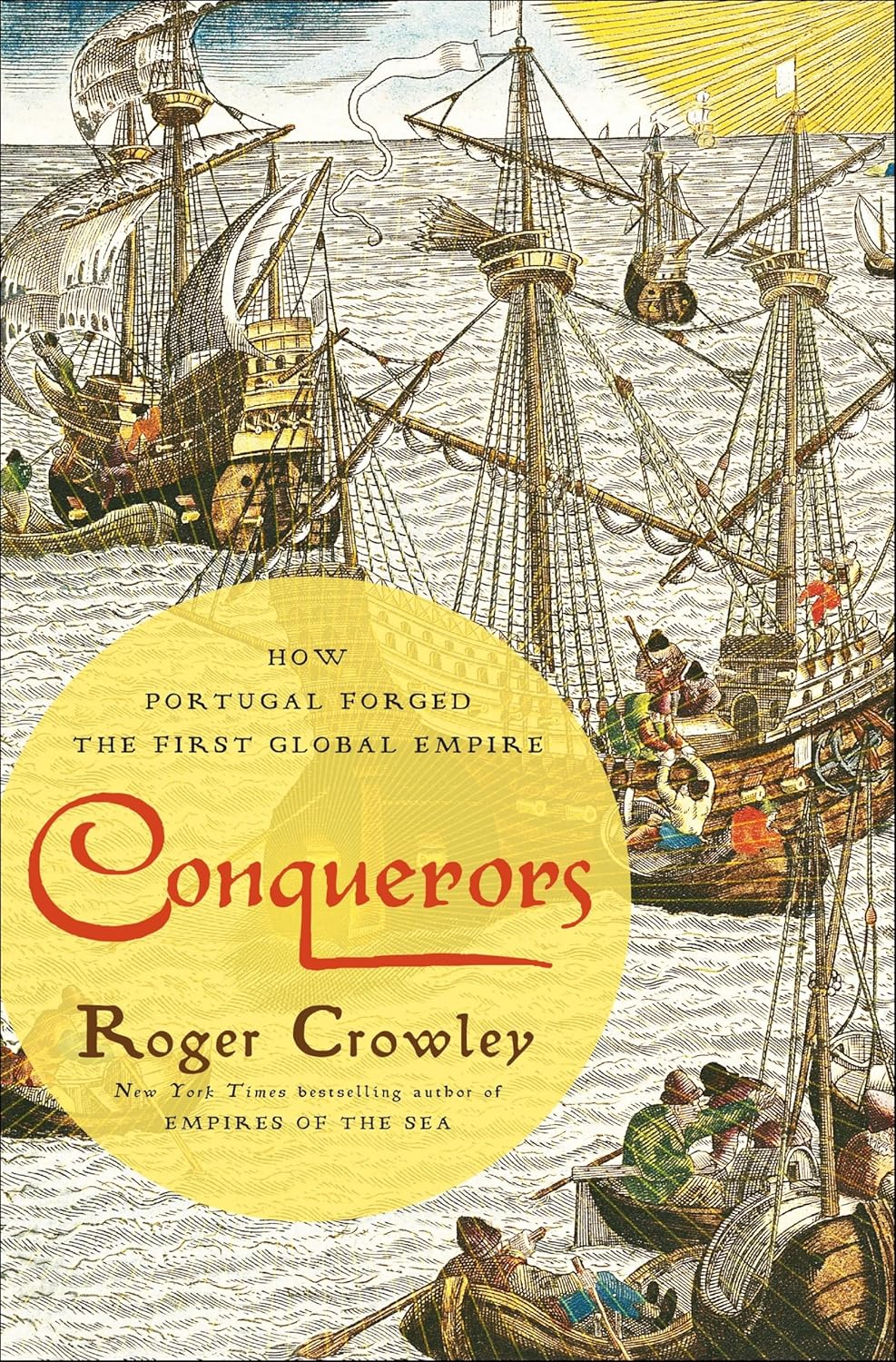
Everyone knows that in 1492 Columbus sailed the ocean blue. Less well known, but dramatically more important in the near term, Vasco da Gama sailed around Africa and into the Indian Ocean in 1498. It was a triumph of seafaring and endurance that had the effect of a hydrogen bomb being dropped on the vibrant East Indian economy.
By the end of the fifteenth century, the Portuguese, led by their ambitious king Dom Manuel, were propelled by “a high-octane mixture of prickly pride, reckless courage and a desire for glory, linked to crusading fever.” Portuguese vessels probed the coast of Africa looking for an inland river passage to the Indies and searching for the mythical Christian king, Prester John, all in a hope of attacking the Muslim world from the rear. “The idea of outflanking Islam’s grip on Europe was both economical and political,” Crowley writes. The Portuguese were indefatigable in their endurance and their willingness to push themselves over the edge of the known world and spread the Christian faith.
Columbus’s voyage took just one month; Gama’s took seven and consumed nearly two thirds of his crew. This first voyage of just four ships was for reconnaissance purposes only, both economic and religious. Gama was startled to find that “it was Europe that was ignorant and isolated,” Crowley says, not the East Indians. Unlike Columbus, Gama had stumbled into a highly sophisticated and high functioning society; a poly-ethnic free trades zone that operating openly and efficiently. The Hindu leaders and Muslim traders of the Indian Malabar coast turned up their noses at the trifles Gama had brought as trade items. He tried to assure them that his was only an exploratory expedition; the Portuguese would be back with more ships and more goods. It was a promise the locals should have taken as a dire warning.
A mere six months after Gama returned home to Lisbon another Portuguese fleet, this time of 13 ships brimming with valuable trade goods, set sail for the Indian Ocean. It was an expedition “aimed at winning material advantages and the crusading admiration of the Catholic world.” The Portuguese were not returning with the goal of mixing harmoniously with the current ebb and flow of the established spice trade. They were coming to dominate the region, shutting down the long established trade route through the Red Sea that supplied Venice and Genoa with her goods. They weren’t going to rely on any superior trade route to win; they were going to rely on superior European firepower. They weren’t coming to outcompete the Muslim traders; they were coming to destroy them. “They came with intemperate demands for spices and for the expulsion of the deep-rooted Muslim community,” Crowley says, “they flouted the taboo of Hindu culture and backed up their threats with traumatic acts of violence beyond the acceptable rules of war.”
The existing network of trading centers on both the Swahili east coast of Africa and the southern Malabar Coast of India didn’t know what hit them. “Metronomically, year after year, fleets were despatched and returned.” The Portuguese came to trade. The Portuguese came to kill. The innovations they brought from Europe weren’t commercial; they were military, especially bronze cannon and the Swiss pike infantry formation. Like in the New World, a small handful of men were able to conquer as if they were an invading horde. “Santiago!” was their battle cry.
The Portuguese were merciless. A Muslim ship loaded with men, women and children returning from the Hajj was butchered in 1502. The trading port of Chaul was razed in 1508. A Muslim fleet sent out by the Mamluks of Cairo to confront the Portuguese was annihilated in 1509. A few hundred well-trained and fanatical “soldier-merchants” captured the cosmopolitan eastern trading hub of Malacca in 1511. By 1513, the Portuguese had brazenly entered the Red Sea putting Mecca and Cairo in a panic. “A trading system that had endured for centuries was being bombed into submission,” Crowley writes. Portuguese firepower and a crusading religious zeal proved an irresistible combination. However, it almost seems as though domination of the spice trade was of secondary importance to the wholesale destruction of Islam’s presence in the Indian Ocean.
Meanwhile, Lisbon was awash in money – lots of money. Exotic animals of the east, such as a white elephant and a rhinoceros, were paraded through the streets to gawking onlookers. King Dom Manuel embarked on an ambitious building program. Tiny, sleepy Lisbon, just a generation ago a third-rate city on the fringes of Europe, was muscling out Venice as the premier trade hub of the entire Mediterranean world. “The city was a swirl of colour,” Crowley writes, “a febrile gold rush of floating populations of many races and colours.”
Crowley does an excellent job telling the story in a tightly constructed chronological narrative. He excels at developing characters and putting human faces to dramatic human events. No man looms larger in Crowley’s story than Alfonso de Albuquerque, the governor of Portuguese India from 1506 to 1515, the so-called Lion of the Sea. “[I]ntelligent, fearless, incorruptible and strategically brilliant … Albuquerque oversaw everything, ruled everything, worked tirelessly,” Crowley gushes. He hails Albuquerque for developing a revolutionary concept of empire. Relying on a powerful, flexible fleet and a network of defensible coastal fortifications, Albuquerque was able to forge, with never more than a few thousand men, the first European empire in Asia since Alexander the Great. “With his long white beard and his frightening demeanor,” Crowley writes, “he was regarded across the Indian Ocean with superstitious awe.”
In sum, “The Conquerors” is another gem in Crowley’s crown of popular histories about the medieval Mediterranean world. If you enjoyed “1453” or “City of Fortune” you won’t be disappointed here.
 What's Tim Reading Now?
Leave a comment