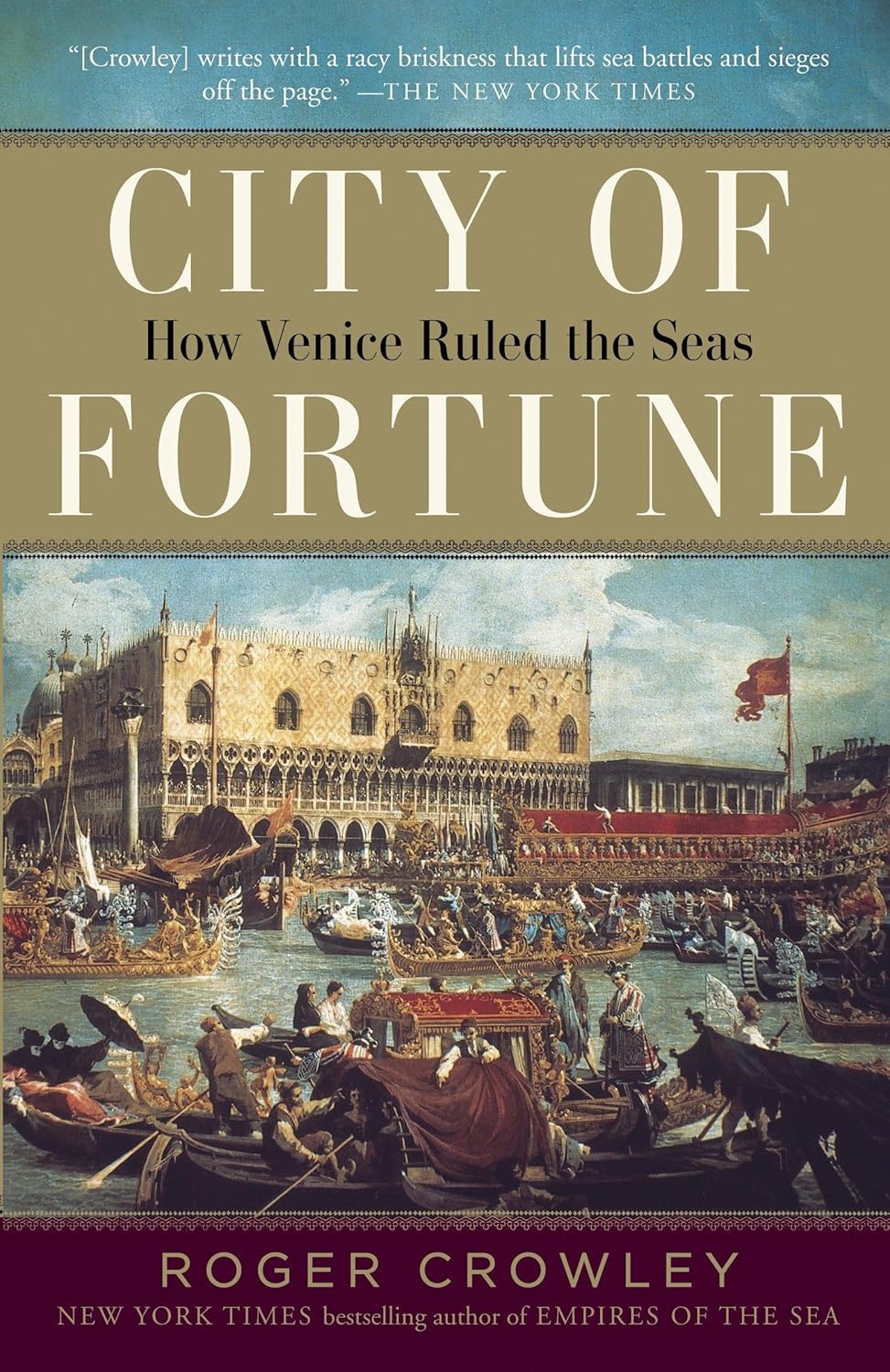
Roger Crowley has carved out a rather respectable niche for himself as a popular historian of the Mediterranean in the late Middle Ages. His scholarship is first-rate, his prose is crisp and colorful, his narratives are clear and accessible. His latest effort, “City of Fortune: How Venice Ruled the Seas,” is no exception. Crowley charts the course of Venice from 1000 to 1500, although the meat of the story occurs between 1200 and 1500 and can be broken up into three uneven parts.
The first part deals with the unusual birth of the Venetian empire. In 1198, Enrico Dandolo, the blind, nonagenarian doge of Venice, took an enormous gamble. He signed the Treaty of Venice committing his tiny, island republic in full support of the Fourth Crusade. It was, Crowley writes, “the largest commercial contract in medieval Europe,” which led directly to “the most controversial event in medieval Christendom.” In short, Dandolo agreed to deliver 450 ships to “transport and maintain an army of 33,500 men 1,400 miles across the eastern Mediterranean and maintain it for a year,” in exchange for the princely sum of 95,000 marks, roughly the GDP of France at the time, the largest kingdom in Europe. All independent commercial activity in Venice ceased for over a year. Every resource was devoted to meeting the June 24, 1202 deadline for the start of the Crusade.
However, only a fraction of the anticipated knights eventually showed up and only half of the contract was paid. The initial target of Cairo was abandoned. Dandolo and the Venetians took over control of the Crusade with the aim of recouping their losses. They set their sights on the Orthodox Christian city of Constantinople. The vastly outnumbered Crusader army defeated the forces of Constantinople largely thanks to the aggressiveness of the Venetian galleys, led and inspired by Dandolo. In what Crowley describes as “…probably the single most significant action in the whole long maritime history of the Republic,” the aged doge placed himself at the prow of his flagship and ordered it sailed ashore to storm the walls of the great city. It was an image that “would send shivers of martial patriotism down the spines of the Venetian people for hundreds of years.” The Byzantine emperor capitulated.
“The sack of Constantinople burned a hole in Christian history; it was the scandal of the age, and Venice was held to be deeply complicit in the act.” Yet, the “scandal” paid enormous dividends. Dandolo’s audacious gamble had paid off. Venice reaped a reward of some 250,000 marks, over twice the value of the original contract, and acquired a treasure trove of priceless art and religious relics, such as the Holy Shroud, hair of the Virgin Mary, fragments of the supposed crown of thorns, and the literal head of St. James. Furthermore, by the terms of the peace treaty of October 1204, “Venice became overnight the inheritor of a maritime empire,” including control of 3/8 of the city of Constantinople.
The second part of “City of Fortune” explores the Venetian Empire in its prime, the 250 years between the fall of Constantinople to the Venetians in 1204 to the fall of Constantinople to the Ottoman sultan Mehmet in 1453. The empire of Venice “was the creation of a city of merchants and its rationale was exclusively commercial.” The Venetian coat of arms declared “For the Honor and Profit of Venice,” but Crowley claims “the emphasis was always on the profit.”
During this period, the rivalry between Venice and Genoa was intense and longstanding, “driven by profit but sustained by patriotic fervor and visceral hate.” The Venetian monopoly on trade through Constantinople lasted just 50 years. In 1261, Genoa regained access to the city’s trade via the Treaty of Nymphaion. Moreover, the Genoese also gained access to trade in the Black Sea, a right theretofore withheld from Italian traders, and a privilege that became invaluable after the fall of Acre in 1291 when the pope forbade all trade with the Islamic Levant. The Black Sea suddenly became the entry port for all goods from the East destined for Europe. The Genoese established a port on the Crimean peninsula at Kaffa, while the Venetians established their port even further east, at Tana on the northeastern shore of the Sea of Azov.
The fourteenth century was a trying time for the Stato de Mar, as the Venetian empire was called. Commercial and military conflict with Genoa seemed interminable, “a chaotic, wide-ranging, and visceral maritime brawl involving hit-and-run tactics, piracy, raids on bases and islands, and pitched sea battles.” The plague stuck with stunning lethality in 1348. Papal bans on trade stressed Venetian traders to the limit. In 1363, Crete, “the nerve center of the Venetian empire,” revolted. In 1380, the Genoese besieged Venice itself and came within a whisker of victory; a defeat Venice avoided, Crowley claims, “less through military supremacy than through the durability of her institutions, the social cohesion of her people, and their patriotic adherence to the flag of St. Mark.”
Yet, through all of the challenges and setbacks, Venice more than survived; she thrived. “By patience, bargaining, intimidation, and outright force, Venice extended the Stato de Mar.” At one time or another, Venice controlled every Aegean island and 100 sites in continental Greece. “The empire represented Europe’s first full-blown colonial experiment,” Crowley writes. Closely managed by the lagoon, imperial records filled 45-miles of shelf-space by the time it ended. Nobles were sent involuntarily as imperial administrators. Graft, corruption, and nepotism were punished mercilessly. Food, manpower, and natural resources were exploited systematically. “The Republic was a centrist empire; everything was ruled, dictated, and regulated from the lagoon and precisioned in an endless stream of edicts.”
Crowley stresses that the Venetian empire was held together by commercial and diplomatic skill. The city ran regularly scheduled trade routes throughout the Mediterranean that provided regularity and stability to the entire regional economy. Trading with the Moslem East was always risky and unreliable, but Crowley notes that Venetian patience and flexibility and solidarity regularly triumphed over the more belligerent and individualistic Genoese. Indeed, “Venice was a joint stock company in which everything was organized for fiscal ends.”
The final part of the story chronicles the relatively swift decline and fall of the Venetian empire from 1450 to 1500. The Stato de Mar was ultimately laid flat by a devastating one-two punch. First, the Ottoman Empire, welded together by religious fealty and led ruthless by Mehmet II, represented a rival the Venetians simply couldn’t match. “Europe was too nationalistic, too divided, too materialistic, too secular” to unite against the threat. Venice was too small and too commercially oriented to resist.
The Ottomans conquered Constantinople in 1453 and took the strategic Venetian island colony of Negroponte (known to the ancients as Euboea) in 1469. By the turn of the century, they were threatening to seize control of access to the Adriatic. In 1499, at the Battle of Zonchio, in what Crowley calls “a foretaste of Trafalgar,” the Ottomans annihilated the Venetians in a naval battle in the Gulf of Corinth. According to Domenico Malipiero, a Venetian galley captain at Zonchio, “Everything arose from a lack of love of Christianity and our country, a lack of courage, a lack of discipline, a lack of pride.” The martial inspiration of Doge Enrico Dandolo and commitment to the flag of St. Mark had evidently run out.
Then, in 1500, news arrived that Vasco de Gama had discovered a direct route to the East Indies. “The whole business model of the Venetian state appeared, at a stroke, obsolete.” The Portuguese (and eventually the Spanish, English, and Dutch) could cut out all of the middlemen and bring the luxuries of the East directly to Europe at a fraction of the cost. The Stato de Mar was doomed.
“Venice was perhaps the first virtual economy,” Crowley writes, and its history is no doubt fascinating. “City of Fortune” is a satisfying and quick read. I’d recommend it to anyone with an interest in history or before traveling to Venice on summer holiday.
 What's Tim Reading Now?
Leave a comment