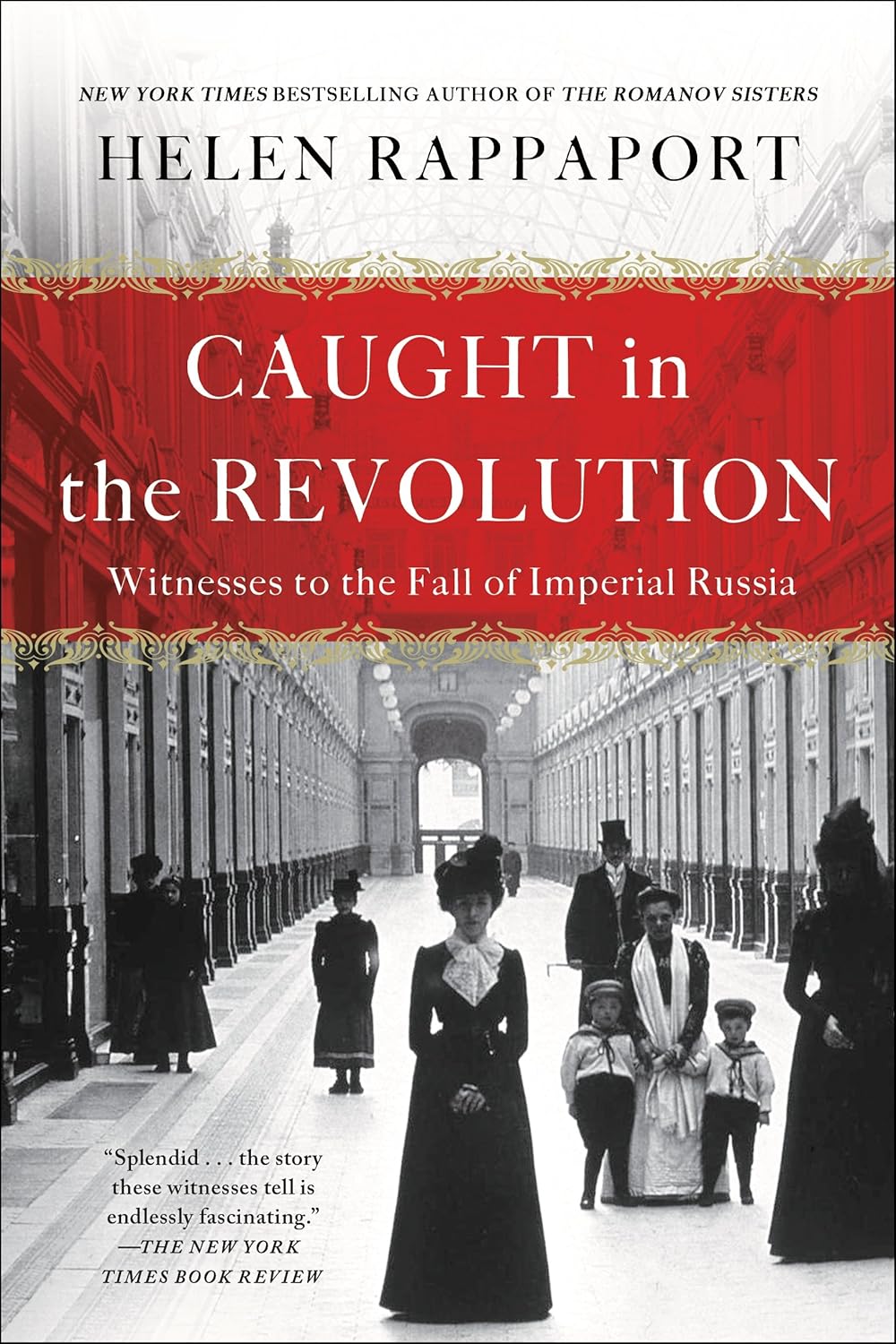
I’ve read several scholarly accounts of the Russian Revolution, but nowhere have the events of 1917 in Petrograd come alive quite like they do in Helen Rappaport’s masterful “Caught in the Revolution: Witnesses to the Fall of Imperial Russia.”
Rappaport breaks her quick flowing narrative down into thirds. Part I, The February Revolution, chronicles the tumultuous events of February to May 1917. Many in the west may have been shocked by the revolutionary turn of events in Petrograd that winter, but it was no surprise to the many western diplomats, journalists and businessmen residing in the city. Petrograd was a tinderbox in February 1917; the air was “thick with talk of catastrophe”; everyone was braced for revolt. On 27 February the city exploded in a spasm of uncontrolled violence against the Imperial regime. “It was like watching some savage beast that had broken out of its cage,” recalled one western eyewitness.
Many horrified foreign onlookers noted the acephalous nature of the revolt. It had been “a revolution carried out by chance,” according to another eyewitness, “no organization, no particular leader, just a city full of hungry people who have stood enough and are ready to die if necessary before they will put up with any more Tsarism.” Rappaport describes in arresting detail the brutality of the revolution, as policemen were literally torn limb from limb on the streets while others were tied up and thrown alive into raging bonfires. It is estimated that as many as 4,000 people died during three days of revolutionary upheaval, although such figures are open to wide debate.
The pace of events was breathtaking. “The Czar of all the Russias has been dethroned as easily as a recalcitrant school-boy is made to stay in after school,” quipped one female observer. The impact of the revolution was immediate and electric. Red flags and buntings flew all over the city. Everywhere laborers and ordinary household staff were gripped by a certain “unbridled, self-righteous sense of equality,” Rappaport says, insouciantly demanding an eight-hour workday and a doubling of wages. For many in the diplomatic community, however, the outcome of the February Revolution was no brave new world, but rather one of “dilapidation, of demoralization and decay,” according to the doyen of the Petrograd foreign consular establishment, British ambassador George Buchanan.
In early April the unstable political situation in the capital became even more unstable still with the return of Vladimir Lenin, a radical extremist who returned to the city after decades in exile. His harangues whipped the sullen, leaderless multitude on the streets of Petrograd into a revolutionary lather against the inchoate Provisional Government of Alexander Kerensky. The Bolshevik revolutionary had “brought with him the one thing that until [then] the revolution had lacked: he had ‘provided violence with a doctrine.’” Lenin was one of many rabble-rousers on the streets of Petrograd in April 1917, but the foreign community quickly realized that he was something different. In the words of French ambassador Maurice Peleologue, Lenin was some combination of “utopian dreamer and fanatic, prophet and metaphysician, blind to any idea of the impossible or absurd, a stranger to all feelings of justice or mercy, violent, Machiavellian and crazy with vanity.” He would push the revolution inexorably to the left.
Part Two, The July Days, covers the hot, steamy summer of 1917 as the Provisional Government sought to establish control ad mist utter chaos, much of the instability fomented by Lenin and his Bolshevik supporters. Another one thousand people were killed in the streets during the first days of July. “The violence was confused and elemental,” the author says, “with those among the disorganized mobs who were armed running around firing, often out of sheer fright, and then beating a retreat at the slightest retaliation.”
Here Rappaport tells many interesting vignettes, such as the story of Maria Bochkareva, perhaps the most famous woman in Russia at the time, who established the Women’s Death Battalion, an all-female unit dedicated to defending the Fatherland at the front (she would be shot by the Bolsheviks in 1920). It was an exercise of patriotism cheered on by Emmeline Pankhurst, the notorious British suffragist, who came to Petrograd in 1917 to stiffen Russian resolve for staying on the Allied side in the war.
Meanwhile, “Petrograd at the end of July 1917 remained a city in flux resembling an armed camp,” Rappaport writes. Riga had fallen to the Germans and then, at the end of August, General Kornilov had been thwarted in his attempt to establish martial law in Petrograd using troops from the front. Many of the embassy dependents and foreign businessmen evacuated the starving, volatile city at long last.
Part Three, The October Revolution, tells the story of the Bolshevik’s seizure of power. “As September turned to October,” Rappaport writes, “Petrograd life continued to be measured by the same, tedious factional infighting and sloganeering, by stultifying meetings, wildcat strikes, rumour and counter-rumour.” Just as in February, the city was on pins-and-needles waiting for the outbreak of violence as many anticipated the fall of the Provisional Government. British ambassador Buchanan saw the situation clearly: “The Bolsheviks,” he wrote, “who form a compact minority, have alone a definite political programme. They are more active and better organized than any other group, and until they and the ideas which they represent are finally squashed, the country will remain a prey to anarchy and disorder.”
Rappaport faults Kerensky for “prevaricating” in the face of the Bolshevik threat. He was weak, both politically and physically, she writes. When the expected Bolshevik coup finally came, it was not the heroic workers’ showdown of Soviet historiography, but rather “an exhausted capitulation of Kerensky’s moribund and virtually defenceless government.” The western diplomatic communities were powerless to help and increasingly targets of the proletarian mobs. American ambassador David Francis and his intrepid valet, the African-American Phil Jordan, did their best to keep the foreign colony together in the face of extreme privations and the persistent threat of revolutionary violence. The last of the remaining embassy staff and expatriates had headed for the exits by January 1918.
In closing, “Caught in the Revolution” is a fantastic read and presents a novel perspective on the events of 1917. It is highly recommended to students of the Russian Revolution or just those who like to read great non-fiction.
 What's Tim Reading Now?
Leave a comment