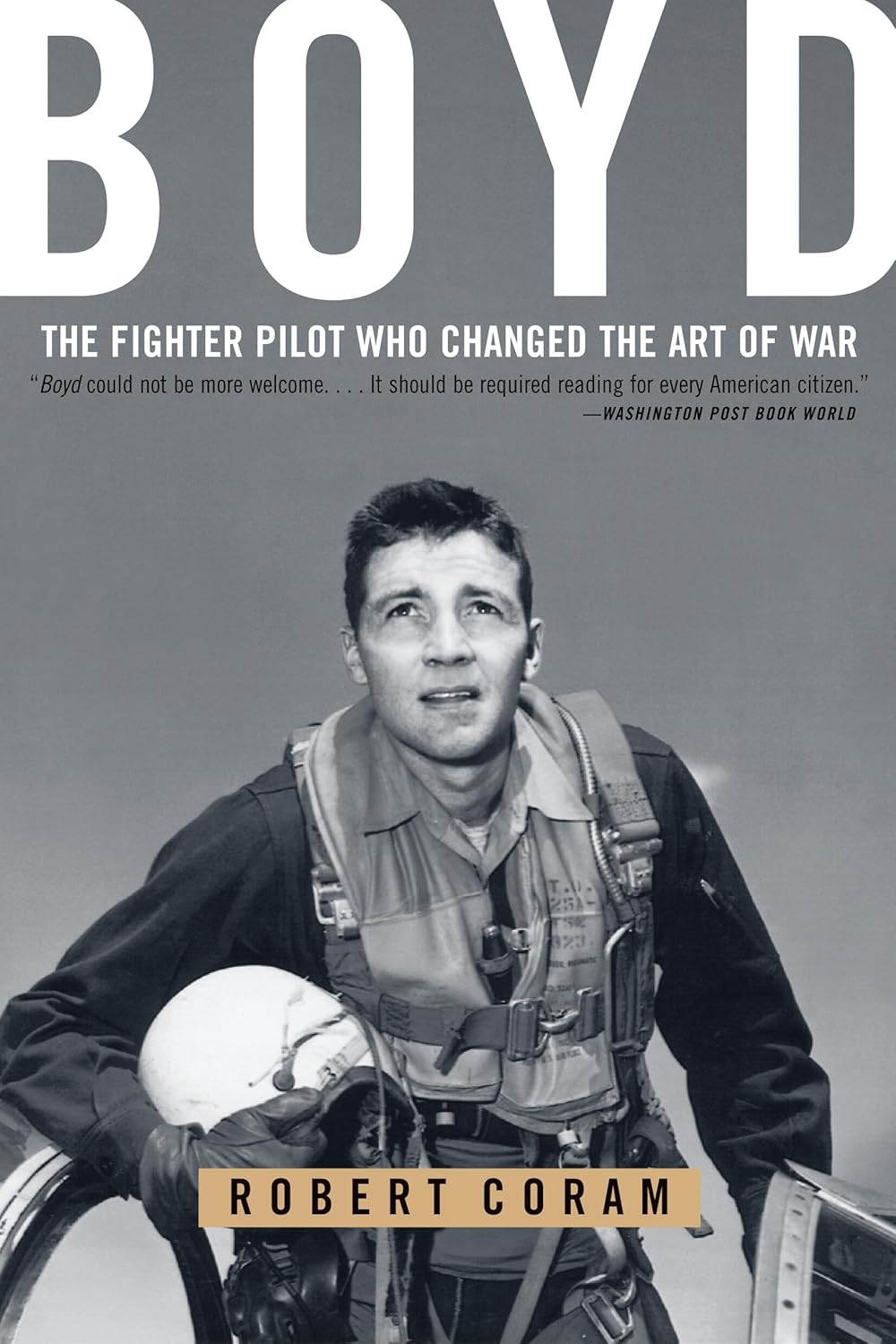
I came to this book with a completely open mind. For the past two decades I’ve lived and worked in Silicon Valley as a technology executive, but my educational background and early career experience was in national security and defense, including a stint at the Pentagon’s Office of Net Assessment, the defense department’s internal long-range planning shop. Yet, I was only vaguely familiar with John Boyd and his work. I decided to give this book, “Boyd: The Fighter Pilot Who Changed the Art of War” by Robert Coram, a shot, even though the grandiose subtitle struck me as a serious red flag. However, the 4.5 star Amazon reviewer rating on over 400 reviews trumped my initial suspicions.
Few books have left me as conflicted as “Boyd.” On the one hand, I really liked it, particularly Boyd’s admonition that one must decide whether you want be someone (i.e. advance far and high in a competitive bureaucracy) or do something (i.e. affect real and lasting organizational change). Having worked at large technology companies and served in the US Navy reserve, I am more than familiar with the “get-along-to-get-ahead” mentality that most large organizations foster and I’m especially sympathetic to Boyd’s evident willingness to “break glass” in order to get meaningful things done. On the other hand, “Boyd” is perhaps the worst biography I’ve ever read. Never in my life have I experienced writing so tendentious and one-sided. To call it a hagiography would be an insult to the Church.
Therefore, I have divided this review into two parts: 1) insights on Boyd’s impact and its relative limitations; and 2) why this is a terrible biography.
Coram clearly sees Boyd as the fighter-pilot-turned-military-theorist liked to see himself: “the man of principle battling superiors devoid of principles; the idealist fighting those of higher rank who have shirked their responsibilities; the man who puts it all on the line and, after receiving threat of dire consequences, prevails.” In short, a maverick. And I certainly believe John Boyd was a maverick and deserves to be remembered.
He grew up poor and fatherless in Erie, Pennsylvannia, attended the University of Iowa on a swimming scholarship, and then joined the US Air Force. By his early thirties he was one of the most gifted jet fighter pilots in the country and a lead instructor at the elite Fighter Weapons School at Nellis Air Base in southern Nevada. Coram swoons over Boyd’s legendary skill as an aerial dogfighter (he was nicknamed “40 second Boyd” because he could supposedly win any air-to-air engagement in less than 40 seconds). Never mind that Boyd served in the Air Force for a quarter century during three major conflicts (WWII, Korea, Vietnam), yet only served in air combat, and briefly at that, in Korea. What his thousands of hours in the air in simulated dogfights taught him was that maneuverability was far more important than other variables, such as speed, range or altitude. While studying for a second degree in engineering at Georgia Tech, he was inspired by Newton’s second law of thermodynamics and the concept of entropy, which he used to develop a radically new approach to measure the ability of an aircraft’s performance. Energy-Maneuverability Theory (E-M Theory), as he called it, assessed an aircraft design’s total kinetic and potential energies, allowing for the quantitative measurement and comparison of competing aircrafts – such as US fighters versus Soviet MiGs – across a range of performance envelopes. Boyd was able to mathematically demonstrate that American jets were, from a pure design perspective, vastly inferior to their Soviet counterparts, a finding that was demonstrated during Vietnam as the North Vietnamese Air Force produced 16 aces while the vaunted US Air Force claimed just one.
By the mid-1960s, Boyd had left the ego-driven world of fighter pilots behind and waded into the political minefield and bureaucratic morass that is the Pentagon weapons design and acquisition process. He quickly established himself as an officer willing to go against the grain, challenge conventional wisdom, and speak truth to power, usually without any of the usual decorum and deference expected of mid-level military officers. People like John Boyd – combining intelligence, pertinacity, and selflessness – are rare and, quite frankly, critically important to the long-term health of any large organization. The story of John Boyd – along with that of his improbable collection of mentees, who Coram calls the Acolytes – demonstrates that individuals can, with hard work and courage, take on institutions seemingly impervious to change, and eventually make a difference, albeit not without personal career consequences. Boyd’s EM Theory and his relentless pursuit of nimbleness and maneuverability over the Air Force’s never ending desire for “Bigger-Higher-Faster-Further” produced both the F-16 and F-18 fighters.
The “whistle-blower”-like performance of his Acolytes, such as Franklin “Chuck” Spinney’s work on irresponsible defense spending, James Burton’s efforts to ensure the proper testing of the Army Bradley fighting vehicle, Pierre Sprey’s development of the aircraft nobody wanted (the close-air-support A-10 fighter), and Mike Wyly’s pursuit of enshrining maneuver warfare into Marine doctrine, are all noteworthy as well. Boyd and his Acolytes, came to view the Pentagon as driven more by “Pride Power Greed” than “Duty Honor Country.” It’s a sad, but important story.
The story of Coram’s skills as a writer and biographer are sadder still. I have four specific gripes, some more damning than others. First, and of least consequence I suppose, is his purple and often juvenile prose. For instance, when explaining what it meant to be called a “Tiger” by a fellow fighter pilot, Corman says it meant “you had stainless-steel testicles that dragged the ground and struck sparks when you walked.” Personally, I have no problem with locker room language, I just feel like it degrades the legitimacy of the overall effort.
Second, the book is filled with essentially fabricated dialogue. At every turn, Coram is recreating some contentious event from Boyd’s past by quoting dialogue that is at best directionally accurate and at worst outright fabrications. Here’s one example from Boyd’s early days at Eglin Air Force Base in Florida:
“Goddammit, Christie, they f-cked up over there in the computer shop,” he yelled. “I’m going over there and kick that civilian’s ass.”
“Now, John,” said Christie in his soft, conciliatory voice. “Let me handle it.”
It’s as if Coram is turning the story of John Boyd and his fight against the military industrial complex into some sort of roman a clef novel. You can’t do that in a work of non-fiction and expect to be taken seriously. Again, for me, it just detracted from the book’s legitimacy.
Third, Coram’s descriptions of Boyd, his work, and his impact are so over-the-top it really beggar’s belief. With the one notable exception of his performance as a father and husband, Boyd, in Corman’s view, was a god amongst mortals. Think I’m overstating the point? Let’s review some direct quotes from “Boyd” and you decide…
When Boyd was as instructor at the Fighter Weapons School at Nellis Air Base the “pure and elegant beauty of [his tactical flying maneuvers] sank into [his students’] consciousness and they understood and sighed in awe.” And when he turned his formidable talents to creating a new Energy-Maneuverability (EM) Theory of aircraft performance and design he achieved what “is today as fundamental and as significant to aviation as Newton was to physics.” It’s “not only elegant, but it is simple, beautiful, and revolutionary.” And when it came time to present his findings to the Pentagon brass, “Boyd’s briefing charts were things of beauty, pieces of art, clean and elegant and simple; they had enough data to inform but not enough to overwhelm, and were creative in appearance but not so creative as to detract from the information being presented.”
But, wait! There’s more! After retiring from the Air Force, Boyd began to think deeply about military strategy and drafted a briefing he called “Patterns of Conflict,” a piece of work, while never actually written down (more on that later), that Corman believes makes Boyd “the greatest military theoretician since Sun Tzu.” (Seriously, I’m not making this up.) He even earned the respect and admiration of the Marines Corps, an organization not known for their love of Air Force pukes. But once “Boyd stood up and his eyes locked on the Marines and he took charge. His deep voice boomed out. The Plum began to weave his magic…[the students knew] they were witnessing the beginning of something new and powerful and wonderful.” Indeed, according to Corman, “Boyd changed the world.”
Finally, for some reason, Coram doesn’t provide for any real opposing viewpoints. Boyd had enemies and detractors – and evidently lots of them. But we don’t hear from them, at least not directly and certainly not with any specificity. The author confesses that Boyd had a tendency to “embroider reality,” but he doesn’t dig very deep trying to uncover just how elaborate and widespread that embroidery may have been. In the Epilogue, Corman writes that “[detractors] say Boyd was unprofessional, unreliable, and an embarrassment to the Air Force – a man who happened to have a flair for math, and that’s all.” Who said that, exactly? Why would they say that? What were their examples? General Bob Mathis, the Air Force vice chief of staff (and one of the very few Boyd detractors Corman calls out by name), supposedly referred to Boyd and his Acolytes as “dark and satanic forces.” Really? Wow! I would have loved to hear more about that. In many ways, “Boyd” reminds me of “Three Cups of Tea” and “Charlie Wilson’s War,” all ostensibly accurate and objective biographically-based stories that are, in fact, propaganda pieces where the lead actor is an inestimable hero, all of his supporters pure and true (which in Boyd’s case includes none other than Dick Cheney), and every detractor an incompetent, careerist, mendacious jerk. In my opinion, Corman does Boyd and his legacy a disservice by ignoring the perspectives and opinions of those who don’t see his subject through the same rose-colored glasses.
At the end of his life Corman claims that Boyd feared that “…people thought he was crazy and that his work was insignificant.” Well, the man the author describes, who regularly poked people in the chest with his finger, showered their ties with cigar ashes, and sprayed their face with spittle while delivering a profanity-laced lecture – certainly does sound nutty. And it’s hard to fully judge a man’s intellectual contributions when he essentially refused to write things down. His supposedly legendary “Patterns of Conflict” thesis (“an updating and affirmation of Sun Tzu and a repudiation of Clausewitz” according to Corman) was only available in a six-hour oral briefing (Boyd categorically refused to redact the content, no matter how important the potential recipient was) with supporting slides, which could only really be interpreted by Boyd himself. The guy literally had twenty years to collect and sharpen his thoughts, and then leave a lasting legacy in print the way Sun Tzu and Clausewitz did. If Boyd’s ideas are never fully grasped or implemented or are eventually forgotten entirely, he has no one to blame but himself. Frankly, after reading “Boyd” I think I know why he never committed his thesis to writing. He was afraid. So long as his theory was confined to personal, six-hour briefs, it couldn’t be challenged. Once he published a book or extensive white paper, it would become open to peer review and withering critiques. The kind of guy that Coram describes in “Boyd” — the loudmouth, know-it-all at the bar — rarely handles public criticism well.
In closing, “Boyd” is one of the most frustrating books I’ve read in a long time, but I’m glad I read it nevertheless.
 What's Tim Reading Now?
Leave a comment