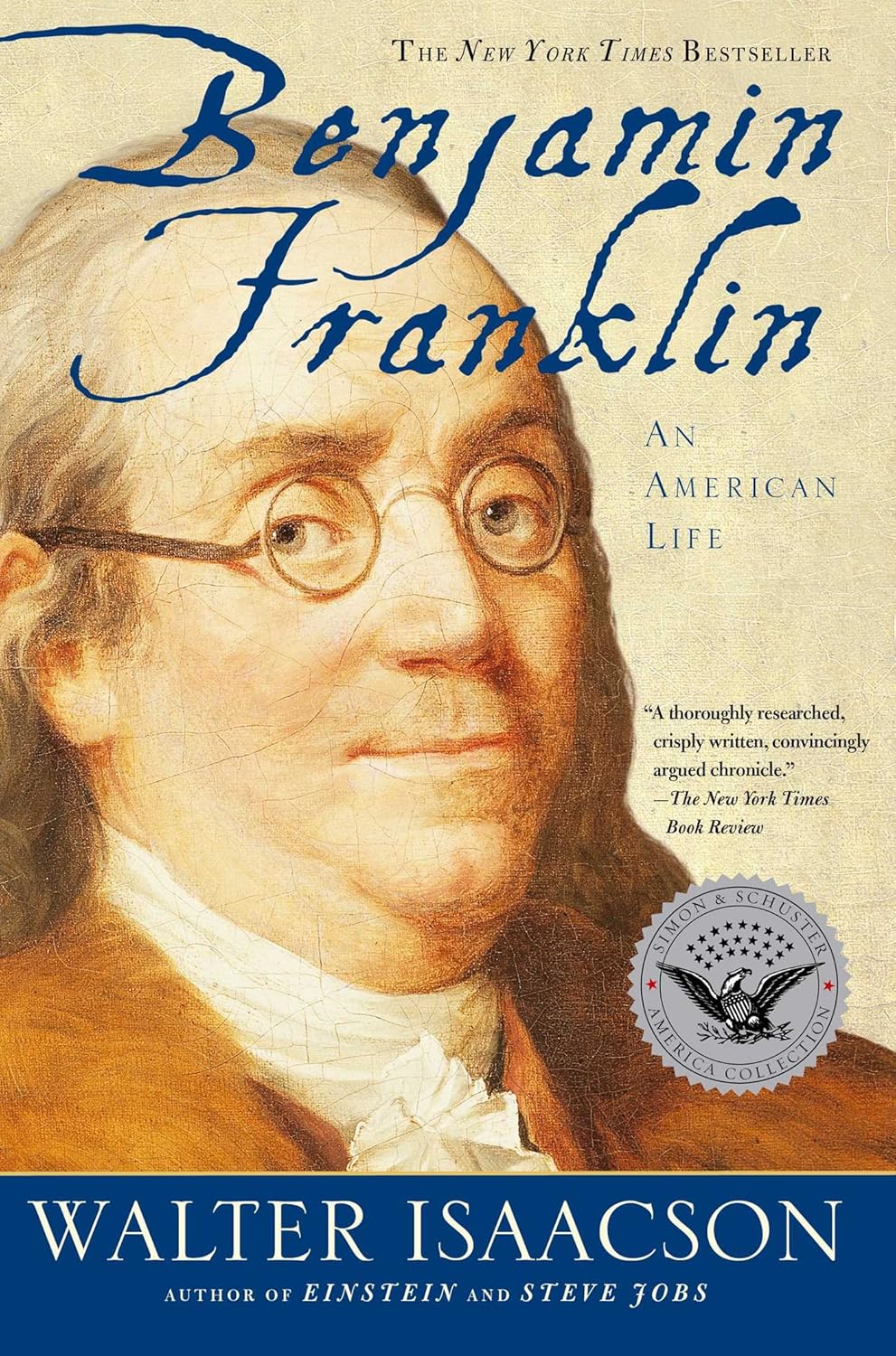
Many years back I endeavored to read a full-length biography on each of the Founding Fathers. For most, I had multiple options and several had undisputed “definitive” single volumes available, such as McCullough on Adams and Chernow on Hamilton. For Benjamin Franklin, Carl Van Doren’s 1939 Pulitzer Prize-winner was still considered the best, but I found it tedious and dry. Van Doren had somehow taken the most affable and relatable Founding Father and turned him into a moldy museum piece. The Washington Post was clearly taking an aim at Van Doren’s classic when, in a 2003 review of Isaacson’s “Benjamin Franklin,” they called it “the most readable full-length Franklin biography available.” I must wholeheartedly agree. Isaacson’s avuncular Franklin comes to life, bursting with humor and sagacity in equal measure.
Isaacson develops four themes in the life of Franklin; each is quintessentially American. First is an almost reflexive resistance to arbitrary authority. Beginning with the bucking of his printer apprenticeship to his older brother, James, in Boston in his teenage years and ending with his leadership in the American Revolution as an octogenarian, Franklin always bridled against heavy hands of authority. Almost from birth, Franklin retained what Isaacson calls an “inbred resistance to established authority.”
That is not to say that Franklin was a natural born revolutionary. Quite the contrary, according to Isaacson. To begin with, in addition to hostility to authority, Franklin also possessed an equally strong aversion to disorder and mob behavior. In the early 1760s, Franklin was “an enthusiastic and unabashed royalist,” Isaacson says, and prior to the 1770s remained “a proud and loyal Englishman, one who sought to strengthen his majesty’s empire rather than seek independence for the American colonies.” That loyalty was steadily eroded as the British tightened their grip on colonial life. It was, Isaacson writes, a steady collection of “personal slights, dashed hopes, betrayals, and the accretion of hostile British acts” that finally pushed Franklin into the rebel camp.
Second, Franklin maintained an unshakable belief in the value of merit, virtue, and hard work. He was his own best example of the good things that come to those who work hard and apply their talents to useful endeavors. The breadth of Franklin’s contribution is eye-popping. He developed significant improvements to such critical eighteenth-century devices as the heating stove and street lamps. He designed an entirely new musical instrument, the “armonica.” He organized the development of major institutions that still exist today, such as the University of Pennsylvania, the American Philosophical Society, and Pennsylvania Hospital. And, of course, as everyone knows he invented the lightning rod and bifocals. For all of his fame and myriad achievements in science, literature, and industry, Isaacson is quick to point out that Franklin’s ability was of a unique, yet almost quotidian variety. For instance, “Franklin would never develop into a rigorous, first-rank philosopher…he was more comfortable exploring practical thoughts and real-life situations.” Nor was he exactly a first-rate scientist. “Ingenious as he was,” Isaacson writes, “[Franklin] was no Galileo or Newton. He was a practical experimenter more than a systematic theorist.” Indeed, Isaacson concludes, “In science [Franklin] was more an Edison than a Newton, in literature more a Twain than a Shakespeare, in philosophy more a Dr. Johnson than a Bishop Berkeley, and in politics more a Burke than a Locke.”
Third, Franklin believed that one can best serve God by serving your fellow man. Thus, while he promoted “hard work, individual enterprise, frugality, and self-reliance” on the one hand, he also pushed for “civic cooperation, social compassion, and voluntary community improvement schemes,” on the other. Such “good works” were at the foundation of his spiritual life and self-identity. Raised in Puritan Boston and established in Quaker Philadelphia, Franklin nevertheless firmly believed “A virtuous heretic shall be saved before a wicked Christian.”
Finally, Franklin’s unique blend of intelligence, wit, compromise, and bonhomie made him, in Isaacson’s estimation, “the greatest American diplomat of all time.” He was “America’s first great image maker and public relations master.” No other American in the 1780s was more famous than Franklin and arguably no one understood all thirteen colonies better. Owing to his time in Boston and Philadelphia and his responsibilities as postmaster, Franklin was “one of the few to view America as a whole,” Isaacson writes. He was “the most traveled and least parochial of colonial leaders.” Likewise, he pursued a unique American foreign policy mixed realism and idealism, what Isaacson calls “the warp and woof of a resilient foreign policy.”
In closing, Franklin was – and in many ways still is – the personification of America: “Its cracker-barrel humor and wisdom; its technological ingenuity; its pluralistic tolerance; its ability to weave together individualism and community cooperation; its philosophical pragmatism; its celebration of meritocratic mobility; the idealistic streak ingrained in its foreign policy; and the Main Street virtues that serve as the foundation for its civic values.” Or as the great historian Frederick Jackson Turner put it in 1887: “[Franklin’s] life is the story of American common sense in its highest form applied to business, to politics, to science, to diplomacy, to religion, to philanthropy.”
It has been argued that Americans are either natural born haters or lovers of Franklin. I suspect that both Isaacson and I are the latter, and this is a biography for those in that happy camp.
 What's Tim Reading Now?
Leave a comment