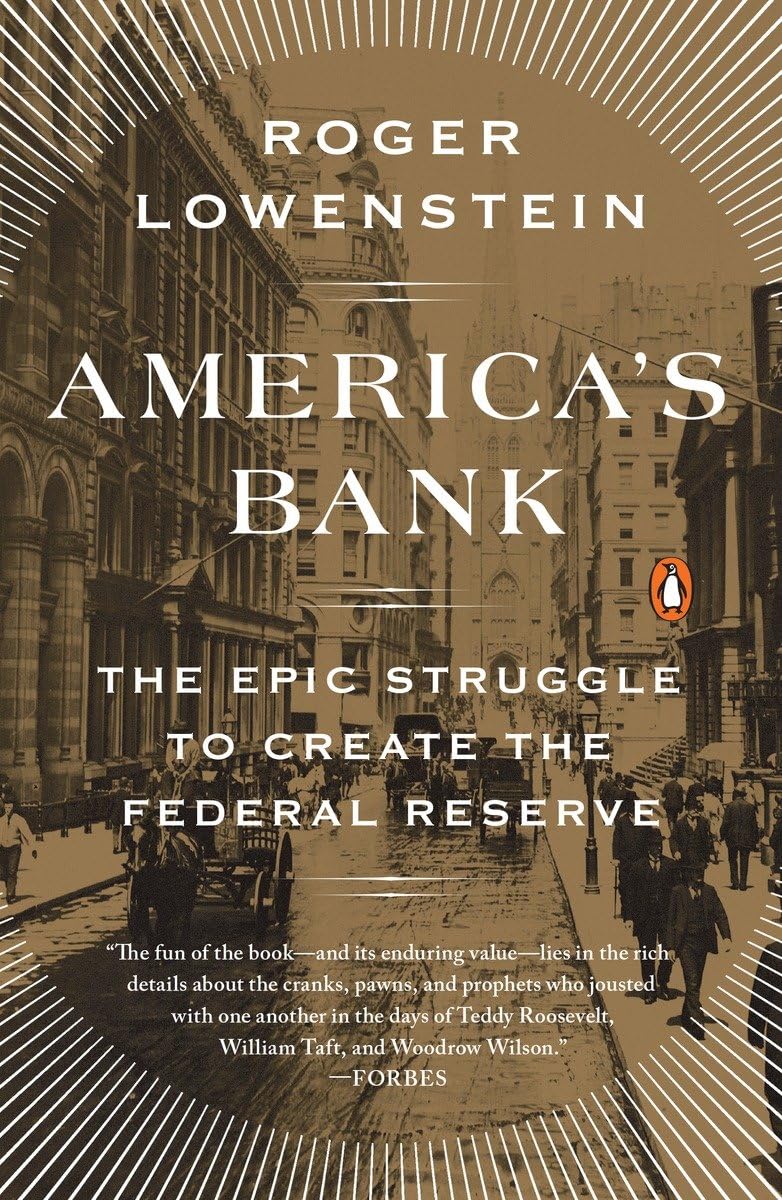
The Federal Reserve is one of the most controversial government organizations. Many fear its powers; fewer actually understand them. The topic of central banking in America has been addressed many times before, from the classic 1957 study “Banks and Politics in America” by Bray Hammond to William Greider’s 1987 bestseller “Secrets of the Temple.” What makes “America’s Bank: The Epic Struggle to Create the Federal Reserve” by Roger Lowenstein so compelling is its laser focus on one important part of the story, the years between the Panic of 1907 to the passing of the Federal Reserve Act in 1913.
Lowenstein breaks the story into two parts. The first, “The Road to Jekyl Island”, summarizes the antiquated nature of banking in early twentieth century America and emphasizes the central leadership role played by Paul Warburg and Senator Nelson Aldrich.
For much of American history the country was a “monetary Babel,” according to Lowenstein. During the Civil War, the Union alone had 1,395 banks with a total of 8,370 varieties and denominations of circulating paper currency. In response to the national emergency, Washington passed the National Banking Acts of 1863 and 1864 that created a new system of nationally chartered banks that were permitted to issue circulating paper money in the form of National Bank Notes. In order to issue the notes, however, the banks had to invest in government bonds and deposit them with the Treasury as collateral. The Acts served their primary purpose, finance the Union war effort, quite well. As a method of promoting economic growth and stability in the banking sector, however, it was a disaster, a “breeder of panics” as the system consistently failed to generate enough liquidity when needed.
A key theme of the first half of the book is that the American monetary system – both banking and money supply – were archaic and outmoded for an economy that, by 1900, was the world’s largest and most dynamic. The weaknesses were immediately clear to Warburg, the scion of one of Europe’s great banking families, who had moved to the US in 1902 when he married the daughter of the American banking power Kuhn Loeb. He began to lobby among the Wall Street banking elite for establishing a true central bank based on European models, an idea, no matter how obvious from an operational point of view, was simply politically impossible in a fin-de-siecle America that still clung tenaciously to the anti-bank prejudices of President Andrew Jackson and his Bank War of 1832.
The story of the Federal Reserve Act of 1913, as told by Lowenstein, is a decade-long march as a small group of thoughtful bankers gradually converted key political leaders to the cause. Their first victory was Aldrich, a Republican Senator from Rhode Island, “arguably the most influential figure in Congress at the turn of the century,” but also a staunch conservative and defender of the sacred financial trinity of high tariffs, the gold standard, and the outmoded National Banking Act, a sort of pre-globalization “Washington Consensus.” The motivation for reassessing these shibboleths was short in coming.
“In the fall of 1907, America suffered the worst breakdown in the history of the National Banking system,” the author writes. It would be the turning point in the movement toward creating a central banking system, although the journey would not be short, easy or direct. What made the Panic of 1907 so extraordinary, besides its extent, was that it occurred during a period of national prosperity. It was “chaos in the midst of plenty” as the nation’s aggregate banking capital was substantial, but dangerously dispersed across thousands of banks, each hoarding what little slice they possessed. Warburg likened the system to “a town without a fire department in which each family maintained a pail of water to quench blazes in its own house.” Suddenly, banking reform was a top priority for conservatives and progressives, alike, although they would each approach the problem quite differently.
In the summer of 1908, in the wake of the Panic, Aldrich led a mission to Europe to study the banking systems of England, France, and Germany, each of which had central banks, albeit with some notable differences between them, such as the level of reserves they maintained (France held more than England and Germany combined) and the nature of their ownership (France’s was controlled by the state while the Bank of England was “defiantly independent”). Over the course of 11-weeks and 58 meetings, however, the Aldrich mission learned about several important commonalities. Namely, that each bank held the nation’s reserve currency, it lent freely during a crisis, and the general confidence the system inspired obviated the need for American style regulation, such as setting reserve requirements for deposit institutions. Lowenstein writes that the transformation in thinking that the mission engendered in Aldrich was “nothing short of startling.” Indeed, he returned home harboring an ambition to become America’s Robert Peel, the British prime minister who, in 1844, presented the law that gave the Bank of England the exclusive right to issue notes. He had visions of a central bank as the crowning work of his decades long career in the Senate.
Unfortunately for Aldrich, his political influence was rapidly eroding. As a new progressive movement swept the nation, Aldrich was widely perceived as an aloof, elitist stooge of big business. In less than a decade, Aldrich had morphed from the GOP’s greatest leader on Capitol Hill to its greatest liability. The irony of the situation, Lowenstein writes, is that “when it came to banking, western so-called progressives were backward-looking and prone to conspiracy theories.” Thus, Aldrich’s leadership of the movement was doomed, but he would make an inestimable contribution before he faded from the scene.
In November 1910, a small group of “co-conspirators” snuck out of New York City and Washington for a secret meeting at a country club on Jekyl Island, Georgia. The group consisted of one US senator (Aldrich), his assistant (Arthur Sheldon), a senior Treasury official (Piatt Andrew, a former Harvard economics professor), and three bankers (Warburg from Kuhn Loeb, Frank Vanderlip from National City Bank, and Harry Davison from Morgan). Their work, known as the Aldrich Plan, was an “inventive and thoughtful plan, honestly wrought,” according to Lowenstein, and in its essentials represented a first draft of the eventual Federal Reserve Act. It steered clear of the “dreaded appellation” Central Bank, and instead described a Reserve Association controlled by bankers that would serve, rather than compete, with banks. The author writes that the bank reform movement rightfully belonged on the list of progressive causes, but because it was led by Aldrich – a potent symbol of arch conservatism – it was misinterpreted and misunderstood by the public and especially the resurgent Democratic Party.
The second half of the book, “The Legislative Arena,” describes how the work of the Aldrich Plan was crafted by competing Democrats into the Federal Reserve Act. By 1911, the Aldrich Plan had entered the public discourse and quickly found powerful interests were aligned to neuter or destroy it. The broader banking community, especially those from the West, who fought for looser rules on what could be used for collateral for currency and restricted government control, to the progressives in both parties, such as Wisconsin Republican Senator LaFollette and perennial Democratic presidential nominee William Jennings Bryan, who saw the Aldrich Plan as a conspiracy of Wall Street bankers to dupe the nation. After the presidential election of 1912 and the sweeping victories of the Democratic Party, leadership of banking reform passed to Virginia Democrat member of Congress Carter Glass and the president-elect, Woodrow Wilson.
Wilson had few fears of strong federal authority and he viewed the banking issue as a subset of the much wider spread monopoly issue. The upshot was that bank reform had finally emerged as a progressive cause. The second half of the book essentially describes how the question of bank reform went from a technical question led by a group of conservative Republicans and Wall Street bankers debating in private to a political question led by progressive Democrats battling over the details in high profile, public arguments.
The three main questions the Democrats (along with some key Republicans) had to settle were: 1) who should issue the currency (government or banks)?; to what degree should the system be centralized?; and 3) should bankers or politicians be in control? On each of these issues the emerging framework led by the Democrats took a leftward lurch from the original Aldrich Plan. The competing architects were now all on the Left, with Representatives Glass and Samuel Untermeyer, Senator Robert Owen, and Treasury Secretary William MacAdoo each promoting different versions of the bill to President Wilson, all while the opinion of the Great Commoner, now secretary of state, William Jennings Bryan, hung over the Democratic Congressional Congress like a dark shadow.
The compromise Glass-Owens Bill that emerged was one that Bryan could stomach, primarily because it included government money (albeit still asset backed) and strong political control. Lowenstein stresses that Wilson’s leadership was critical in the passing of the Federal Reserve Act in 1913, but it was certainly a group effort. “It is doubtful that the Reserve Act would have passed without Wilson’s leadership or Glass’s tenacity, but it would have looked quite different without the Aldrich bill.” It was perhaps the central achievement in Wilson’s highly effective first term that also witnessed the introduction of the first federal income tax and a reduction of the tariff. When Wilson signed the FRA on December 23, 1913 he had, in less than a year, “wrong from a party steeped in devotion to Andrew Jackson, and to the crudest anti-banking stereotypes, the filaments of a central bank.” It was, to be sure, a landmark achievement in political and economic leadership.
Lowenstein calls the signing of the FRA “less an ending than a truce.” Suspicious about banks, centralization, and even the need for the Fed would persist. Indeed, they are very much alive today. And in some ways the Fed of today would be unrecognizable to its founding fathers, especially the eventual abandonment of the gold standard and the Fed’s emergence as “the supreme arbiter of the money supply.” The author further argues that the Fed failed its greatest early challenge, the Great Depression, because of two things: 1) uncertainty as to the Reserve Board’s power; and 2) a lack of quality leadership in the same class as those that created the institution.
In closing, “America’s Bank” is a great addition to my growing library on the topic of monetary policy, central banking, the gold standard, and financial crises. I recommend it highly to the serious student and casual reader, alike.
 What's Tim Reading Now?
Leave a comment