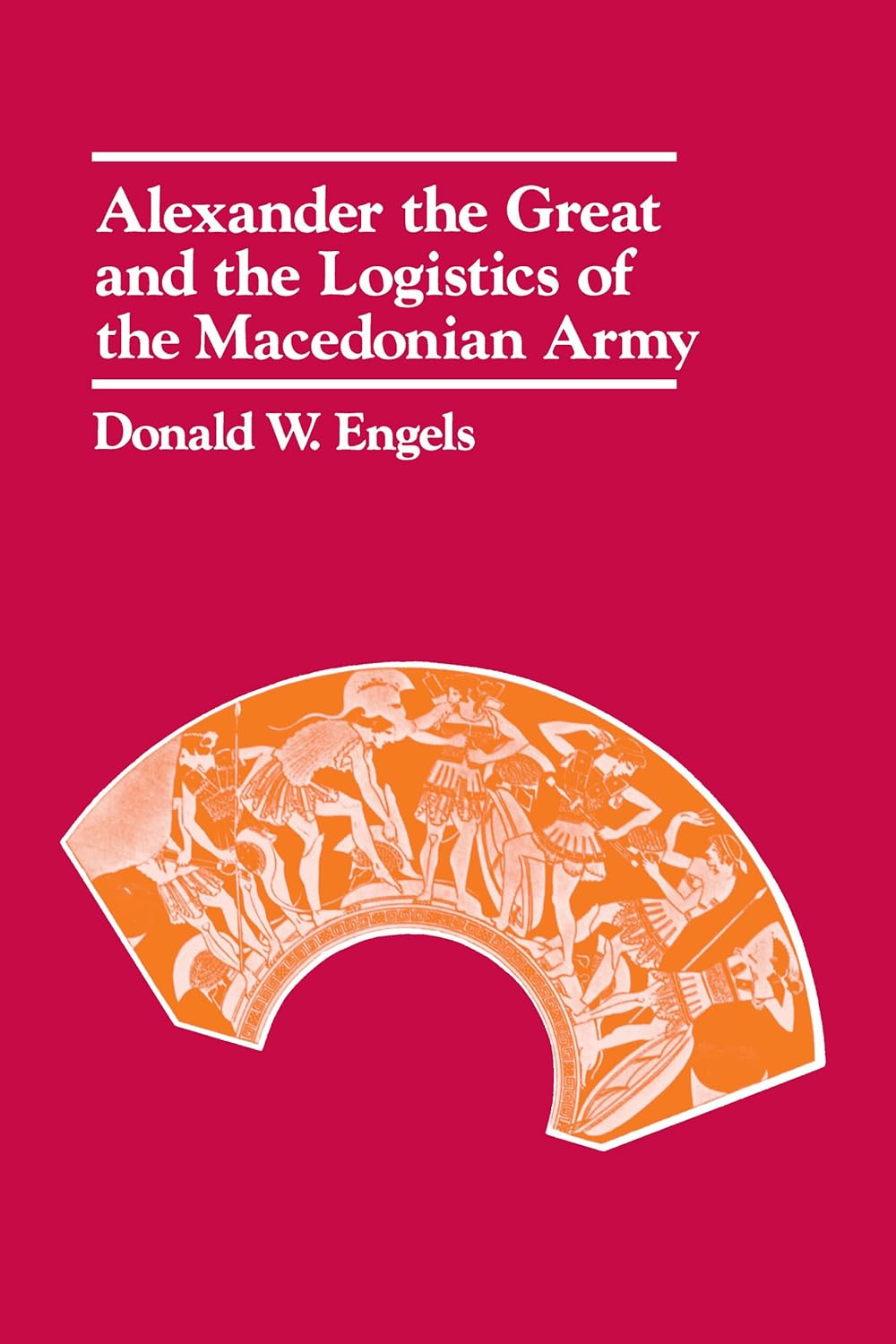
Few military commanders have succeeded quite like Alexander the Great. At the age of 33 he had conquered much of the known world. In this slim monograph (122 pages) first published in 1978, scholar Donald Engels argues that Alexander’s novel system of logistics was the cornerstone of his vaunted military machine.
Although the details of the Macedonian logistics system and the influence of the logistical concern were largely glossed over by the ancient historians, Engels argues, “supply was indeed the basis of Alexander’s strategy.” Alexander possessed an early, formidable advantage in the organization of his army, which had a radically reduced baggage train and camp followers by ancient standards – as much as three times smaller than contemporary Greek armies whose combatant-to-non-combatant ratio often reached 1:1.
The light nature of Alexander’s army, inherited from Philip, was a key asymmetric advantage in campaigning in Persia, where speed and mobility were critical tactical advantages in overcoming the limited capabilities of overland transportation and the limited capacity of provisions available in a subsistence agricultural community. Camp followers were dramatically circumscribed and the use of carts was forbidden. The real issue was the ratio of the system’s carrying capability and its consumption rate of provisions. For example, although a man can only carry a third of what a horse can carry (80 lbs. versus 200 lbs.), the man only consumes a third of what a horse does (7 lbs. vs. 20 lbs. of grain). Thus, manpower was as effective and efficient as horsepower in antiquity.
The army could not remain self-sufficient for more than four days when separated from navigable rivers or ports. The radius from which supplies could be effectively carried was only 60-80 miles. The army would have quickly consumed all the supplies within this radius if it remained stationary. Because all agricultural production occurred within a limited radius of human settlement, the army always marched through populous regions whenever possible and not through the countryside. Thus, arrangements for the army’s supply were made in advance with local officials that had surrendered to Alexander. This problem was intensified upon entering the Persian heartland, where Alexander could no longer present himself as a liberator. He would never commit his entire army for a campaign into a region that had not surrendered to him in advance. Instead, he would first obtain intelligence concerning the routes, climates and resources of the country and then strike out with a small, light force, while the bulk of the army remained behind at a base well supplied with provisions. Or the army would be divided into smaller units and dispersed if a suitable base with abundant supply was not available.
In short, advance intelligence and diligent logistical preparation was always an essential factor in Alexander’s successful operations, which were most of them. Engels makes his argument clearly and convincingly. Some advanced knowledge of Alexander’s campaigns is required to fully grasp the points made by Engels, but overall the monograph presents a cogent case that a system of nimble and flexible supply was a core element in Alexander’s strategic genius.
 What's Tim Reading Now?
Leave a comment