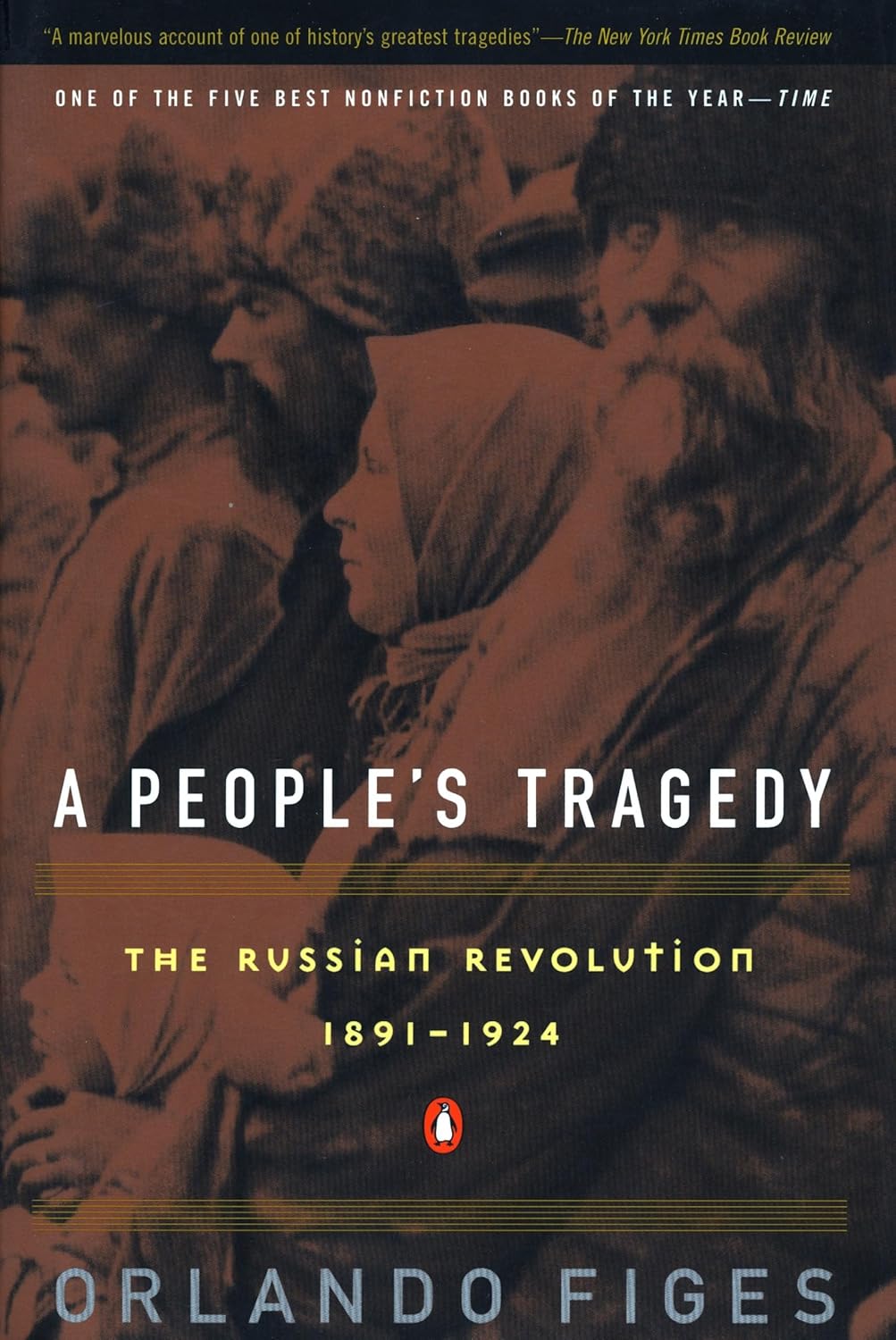
There are lots of books on the Russian Revolution. Few are as comprehensive and compelling as Orlando Figes’ “A People’s Tragedy: The Russian Revolution: 1891 – 1924,” first published to wide critical acclaim in 1997.
Figes takes a broad view of his subject; his history stretches over nearly two generations, from the famine of 1891 to the death of Lenin in 1924. He argues for the 1891 date because the whole of Russian society had been “politicized and radicalized” as a result of the famine crisis and the Tsarist regime’s inept response to it. Tsar Nicolas II remained wedded to autocracy in the face of increasing calls for reform from both the industrial centers of his country and the agricultural peasantry. Hostility and resentment would fester for decades.
The author ascribes great importance to the personal role played by Bolshevik leader, Vladimir Lenin, in the Revolution of 1917. “Much of Lenin’s success in 1917 was no doubt explained by his towering domination over the [Bolshevik] party,” Figes writes, “which distinguished [them] from the Mensheviks (who had no clear leader of their own).” Indeed, according to Figes, “few historical events in the modern era better illustrate the decisive effect of an individual on the course of history … Without his decisive personal influence, it is hard to imagine a Bolshevik seizure of power.”
That is not to say that a Bolshevik victory was foreordained. Far from it. Alexander Kerensky was, for a brief time, the most popular man in Russia and had a reasonable chance at establishing the authority of the Provisional Government. In Figes’ estimation, Kerensky and his allies failed to grasp the depth of war wariness among the Russian people. They believed that a last ditch offensive against the Germans might rally the country behind the Provisional Government in the national defense of democracy. They were badly mistaken. Had the Provisional Government adopted a similar policy as the Bolsheviks and immediately opened peace negotiations with the Germans in the summer of 1917, “no doubt the Bolsheviks would never have come to power,” says Figes.
The author also claims that Kerensky made critical errors in his handling of the so-called Kornilov Affair. “One of the most enduring myths of the Russian Revolution is the notion that Kornilov was planning a coup d’etat against the Provisional Government,” Figes says. “But the evidence suggests that Kornilov, far from plotting the overthrow of the Provisional Government, had in fact intended to save it.” Miscommunication and misunderstanding led to a rupture that in many ways sealed the fate of Kerensky and his Provisional Government.
The Bolsheviks, meanwhile, stumbled toward power. Lenin was ill-prepared for seizing power during most of 1917. For instance, Figes argues that the Bolshevik leader could have taken power during the spontaneous July Days uprising, if he had been prepared and willing. “With 50,000 armed and angry men surrounding the Tauride Palace” in July 1917, Figes writes, “there was nothing to prevent a Bolshevik coup d’etat.” When the next opportunity came in October Lenin would not be caught flat-footed. Figes claims that Lenin almost single-handedly seized power.
For the Bolsheviks of 1917, the revolution in Russia was only a part – and a small part at that – of the worldwide struggle between imperialism and socialism. The decision to make a separate and humiliating peace with Germany was, Figes says, “without doubt one of the most critical moments in the history of the party.” The newborn Soviet Republic lost 34% of her population, 54% of his industrial enterprises and 89% of her coalmines in the Brest-Litovsk Treaty. In Figes’ estimation, “The peace of Brest-Litovsk marked the completion of Lenin’s revolution: it was the culmination of October.” There was no longer any prospect of the revolution spreading to the West.
The subsequent Russian Civil War of 1918 to 1920 was brutal. The Whites assumed they could win the civil war without the support of the peasantry; or, at any rate, they seemed to think that the whole question of land reform could be put off until after victory. It couldn’t. “Whereas land reform was the first act of the Bolsheviks,” Figes writes, “it was the last act of the Whites,” and this goes a long way in explaining the outcome of the civil war. Both the Reds and the Whites were constantly crippled by mass desertion, by the breakdown of supplies, by strikes and peasant revolts in the rear. But their ability to maintain their campaigns in spite of all these problems depended less on military factors than on political ones. The Reds had one crucial advantage, Figes says: they were able to fight under the Red Flag and claim to be defending “the revolution.” Meanwhile, the Whites’ failure to recognize the peasant revolution on the land and the national independence movements doomed them to defeat. “In the end,” Figes writes, “the defeat of the Whites comes down largely to their own dismal failure to break with the past and to regain the initiative within the agenda of 1917.”
If you’re looking to read just one book on the Russian Revolution and have the stamina and fortitude to plow through 800 pages of dense historical writing, “A People’s Tragedy” is an excellent choice.
 What's Tim Reading Now?
Leave a comment