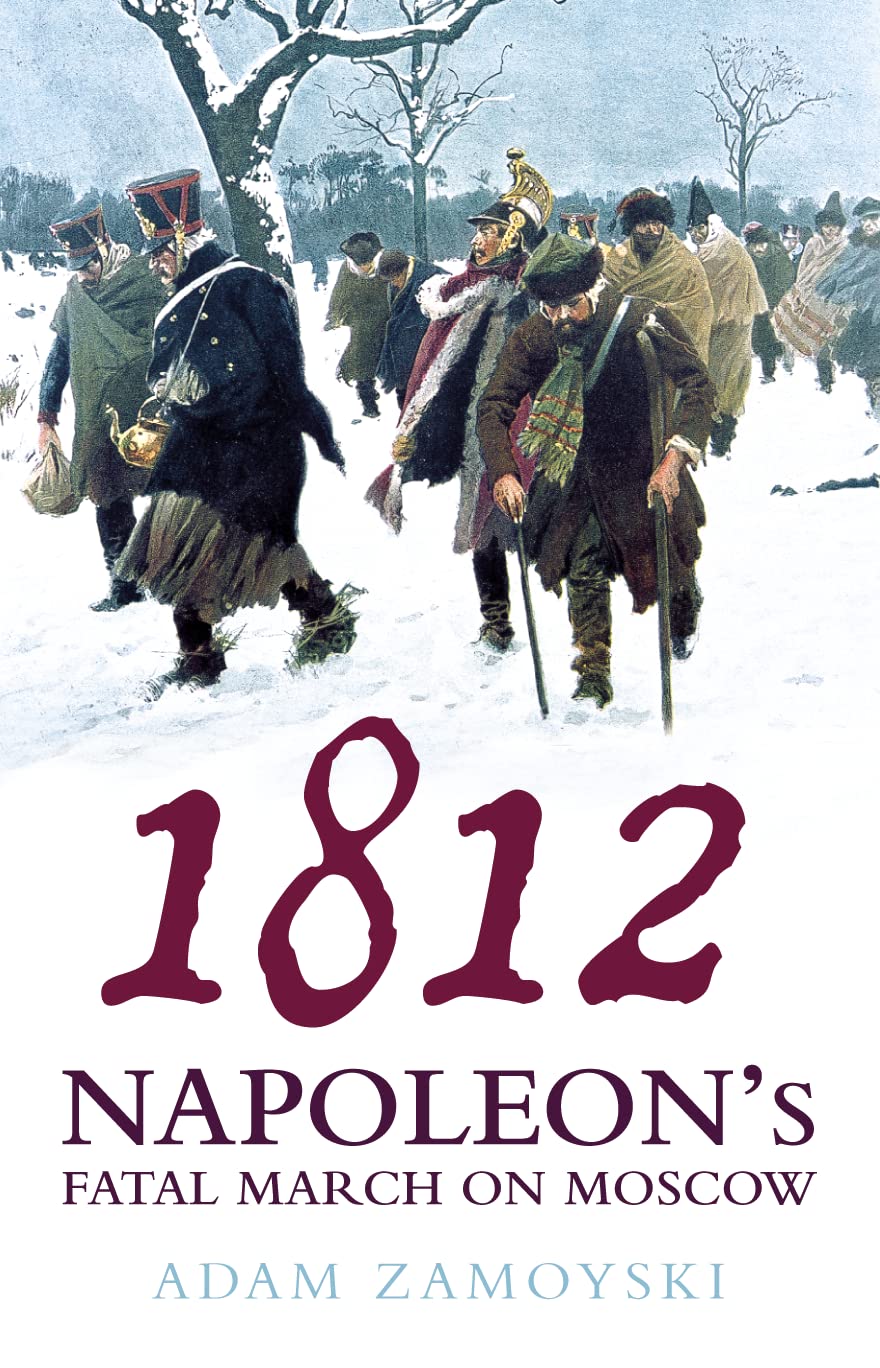
Napoleon’s Russian campaign of 1812 is legendary – and rightfully so. All I knew about it before reading Adam Zamoyski’s “Moscow, 1812: Napoleon’s Fatal March” was that the Russian winter defeated Napoleon’s Grand Armee. I had no idea how horrific the whole experience was for soldiers and civilians, alike, nor the historical context in which the campaign unfolded.
Perhaps the greatest tragedy is that the whole campaign was basically without purpose, at least according to Zamoyski. Napoleon felt that Russian Tsar Alexander was not living up to his commitments under the Treaty of Tilsit. The Russians had amassed forces on the borders of the Polish Duchy of Warsaw and had collaborated with England in defiance of the Napoleonic Continental System. This was an affront too blatant for the Emperor to ignore. In Zamoyski’s assessment, “In effect, [Napoleon] had assembled the greatest army the world had ever seen, with no defined purpose. And, by definition, aimless wars cannot be won.”
The great eastward march of the Grand Armee finally pinioned the Russian army at the insignificant village crossroads of Borodino. In what Zamoyski calls a “lackluster performance,” Napoleon guided the battle from deep behind the front lines. The Russians stood their ground and absorbed the absolute worst the Grand Armee could dish out. “It had been the greatest massacre in recorded history,” Zamoyski writes, “not to be surpassed until the first day of the Somme in 1916.”
“According to the parameters by which [Napoleon], and most European states and statesmen, operated, he had won the war,” according to the author. The Grand Armee marched out of Borodino confident that the campaign was over. Their attention was focused on the booty they might be able to carry back home to Western Europe. They could have – and should have – pursued the wrecked wastage of Kutuzov’s Russian army. “In the only brilliant decision he made during the whole campaign,” Zamoyski notes irreverently, “Kutuzov resolved to sacrifice Moscow in order to save his army.”
All of Russia mourned the loss of their traditional capital. The Tsar’s guardian of the city, Count Fyodor Rostopchin, vowed to destroy it rather than allow Napoleon to have it. The Grand Armee would spend five purposeless weeks in the burned out shell of a city, time mostly spent acquiring booty from the homes spared from Rostopchin’s conflagration. “Napoleon had climbed into a grave from which he would never emerge,” Zamoyski writes, “and the Russian nation would triumph.”
Ironically, Zamoyski says, the “somnolent Kutuzov” was the “perfect man for the moment, as time was working for the Russians and against the French.” While the Russian army regrouped itself south of Moscow, the Grand Armee loaded itself down with anything and everything of value that could be transported by man or beast. “It was no longer the army of Napoleon but that of Darius returning from a far-flung expedition, more lucrative than glorious,” according to one French officer. By early October, Napoleon reluctantly decided to withdraw, basically declaring victory and returning home. “Napoleon’s military success in the past had rested on his capacity to make a quick appraisal of any situation and to act intelligently and decisively on its basis, “Zamoyski writes. “Yet from the moment he set out on his ‘Second Polish War’ he displayed a marked inability either to make the correct appraisal or to act decisively.” The Emperor’s indecision and faulty judgments would doom his army.
Zamoyski, who quotes liberally from contemporary diaries and journals, describes the Grand Armee’s strategic withdrawal from Russian in painful detail. By early November the weather had turned brutally cold with temperatures regularly dipping to 30 degrees below zero Fahrenheit. How anyone could survive such conditions is beyond comprehension. The horrors of the march are laid out in page after page of almost indescribable human suffering: frost bite, starvation, lice, typhus, and eventually cannibalism. All the while, the remnants of Kutuzov’s Russian army, mounted Cossacks especially, harried the Grand Armee. French soldiers weighted down with booty and lacking winter clothes, were easy pickings.
“I beat the Russians every time,” Napoleon is said to have ranted, but that was beside the point. His army was defeated nevertheless. Zamoyski estimates that the Grand Armee was 500,000 to 600,000 strong in June of 1812 and that only 120,000 came back in December. Of the 400,000 casualties, he estimates that only a quarter were killed in combat, the rest succumbed to the elements. Russian losses are thought to be roughly equivalent. All told, perhaps a million people died between the Grand Armee’s crossing the Nieman at the end of June 1812 and the end of February 1813. To this can be added the loss of some 160,000 horses and a thousand cannon.
Napoleon’s entry into Moscow may very well have represented the high water mark of his dazzling career. As Zamoyski notes, the defeat had “punctured the general conviction that he was invincible and tarnished the aura of superiority surrounding his person.” The fate of the French Empire would run mostly downhill from the winter of 1812. The historical impact of the defeat was enormous, according to Zamoyski. “His own defeat and France’s resultant eclipse as a Great Power had paved the way for the dominance of both Russia and Prussia. They used that dominance to protect a status quo that impeded social, national, and religious emancipation, economic enterprise and political development in central Europe, thereby generating militant nationalisms and creating tensions that led to revolution and upheaval in the first two decades of the twentieth century and fed the ideologies which accounted for tens of millions of lives in the third, fourth, and fifth decades.”
All told, a brilliant military history of one of the great military disasters.
 What's Tim Reading Now?
Leave a comment