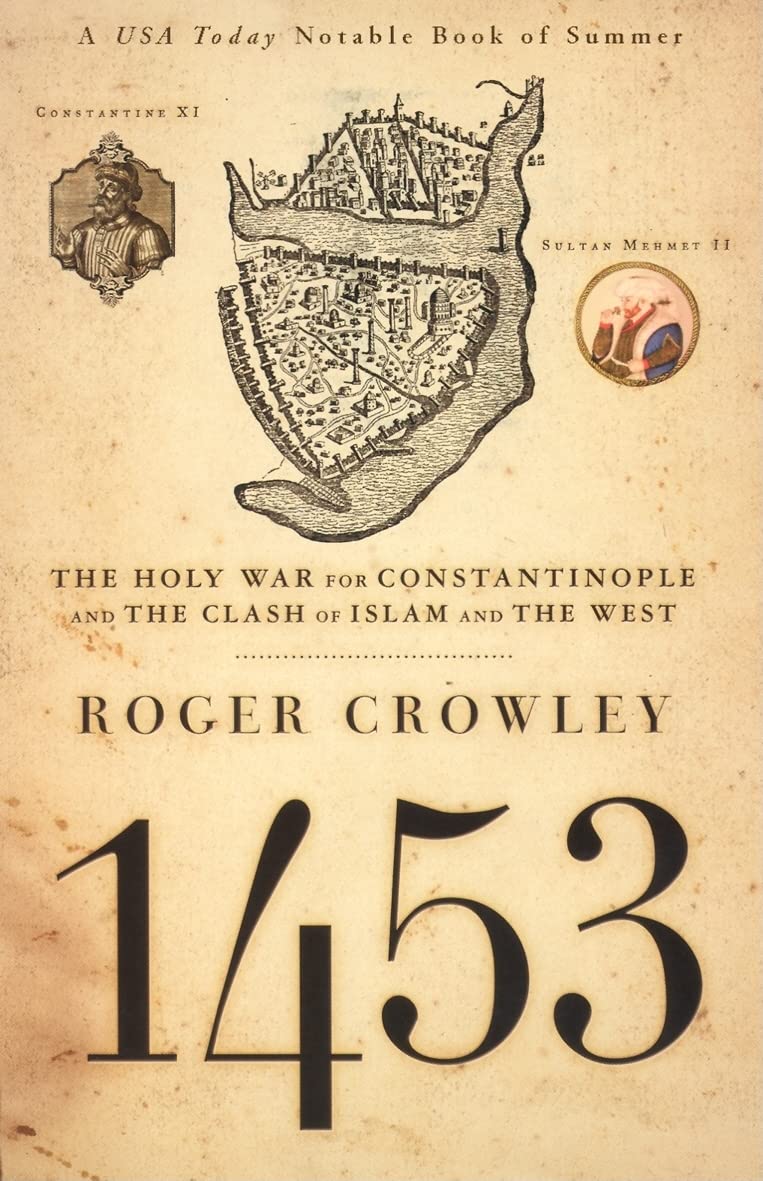
The city of Constantinople was the greatest defensive structure of the medieval world. In the course of its 1,123 year history up to the year 1453 it had been besieged 23 times, and only once successfully, ironically by the Christian knights of the Fourth Crusade in 1204. Muslim armies made only a handful of attempts, beginning in 669, just 40 years after the death of Muhammad, and were decisively defeated by a new war technology, “Greek Fire.” After another attempt in 717, the Muslims would not try again for another 650 years. “Constantinople had survived through a mixture of technological innovation, skillful diplomacy, individual brilliance, massive fortifications – and sheer luck: themes that were to be endlessly repeated in the centuries ahead,” the author concludes.
The fall of Constantinople was a half-millennium in the making, according to Crowley. The arrival of the mobile and relentless fighting force of the Turks in 1000 and their conversion to Islam was a major turning point in world history, punctuated by the Roman defeat at Manzikert in 1071. The Turks, Crowley writes, were “quick-witted, flexible, and open.” The Byzantines, on the other hand, were sedentary, heavy-handed in their imperial administration, and deeply divided among themselves and their Christian co-religionists in the West. The Venetians, for instance, “worried about pirates more than theology, about commodities rather than creeds.” By the 1400s, the decline of Byzantium appeared inexorable; the rise of the Ottoman Empire inevitable.
The principle actors in the drama – Constantine XI and Mehmet II – are both described as talented men, although possessing vastly different inheritances. Constantine inherited “bankruptcy, a family with a taste for civil war, a city divided by religious passions, and an impoverished and volatile proletariat.” Mehmet, “self-reliant, haughty, distant from human affection, and intensely ambitious,” meanwhile, had inherited a well-organized army, efficient administration, and a people welded together by pious commitment to jihad. In 1453, Constantine was 48-years-of-age, Mehmet just 21.
Crowley claims that the young Sultan was obsessed by the capture of Constantinople. It was a “bone in the throat of Allah.”…”psychological as much as a military problem for the warriors of the Faith.” His first act upon ascending to the throne was to build a vast fortress six miles up river from Constantinople on the Bosporus. Called Rumeli Hisari (The Throat Cutter), it ensured that the Turks had unimpeded access to Europe across the narrow waterway and also could control the flow of materials from the Black Sea to Constantinople and beyond. And Mehmet had another trick up his sleeve, “a technical revolution that would profoundly change the rules of siege warfare.” Greek Fire had proven decisive against the Muslim besiegers in 678; gunpowder and heavy artillery would turn the technical balance of power in their favor in 1453. Mehmet hired the best gun masters in the world, including “the know-how and advice of perfidious Europeans,” to design a “super gun,” a cannon 27 feet in length that could hurl 1,000 pound marble balls a mile or more. The once impregnable land walls of Constantinople were suddenly vulnerable.
The author stresses several points throughout his narrative. First, the Ottoman army was extraordinarily efficient and well organized, especially compared to the Christians. In short, “no army in the world could match the Ottomans in the organization of a military campaign.” Second, Mehmet could draw on a huge reserve of manpower, many of which were genuinely motivated to serve in his armies, either because of the attraction of war booty or holy war – or both. Third, Christians were seriously outnumbered. Crowley claims that the order of battle was something like 200,000 Muslims against perhaps 5,000 effective Christian defenders.
Bombardment began after Easter in early April 1453. Mehmet had some 70 cannons trained on the land wall, firing some 120 shots every day, including from the super gun. The walls began to disintegrate under the onslaught. Meanwhile, Mehmet had collected an armada of roughly 140 ships on the waters around the city. The fleet’s objectives were threefold: 1) blockade the city; 2) force entry into the Golden Horn (thus compelling the over-stretched Christian forces to man those walls, too); and 3) prevent any Christian relief force from reaching the city as “their only hope lay in holding on long enough for some relieving force from the West to muscle its way through the blockade.”
After it became clear that forcing their way past the chain and tall merchant ships protecting the Golden Horn was not practical, Mehmet ordered his ships to be carried overland around the chains and the independent Genoese city of Galata, and into the smooth waters of the Horn, “a strategic and psychological masterstroke, brilliantly conceived and executed,” according to the author. It was just one of Mehmet’s many effective improvisations. In addition, he had mortars crafted that could send in-direct fire over Galata and onto the Byzantine ships in the Horn; he built large, moving towers to approach the moats and land walls; he directed significant mining operations under the walls of the city.
The siege lasted just 53 days. Some 5,000 shots were fired on the city, reducing the effective defending force by as much as 50%. Mehmet decided to press home a final, all-out offensive for May 29, 1453, an attack that succeeded after 6 hours of non-stop carnage.
News of the fall of Constantinople was a thunderclap across Europe, a flashbulb memory for those that experienced it, like news of the Kennedy assassination or 9/11. It would fan the flames of anti-Islamic writings for centuries, despite Mehmet’s policy of “remarkable tolerance” toward Christians and other minorities after the city fell. The young Sultan had won an amazing victory, capping the Ottoman Turks “breathtaking ascent from tribe to empire in two hundred years.”
“1453” is a great popular history of a remarkable event in world history. I have no doubt that academic historians would recommend other dusty works of historiography over this one, but Crowley is a credible and incredibly readable historian. For those looking to learn more about the modern Middle East or simply hoping to bone up on local history before taking a trip to Instanbul, this is a great place to start.
 What's Tim Reading Now?
Leave a comment