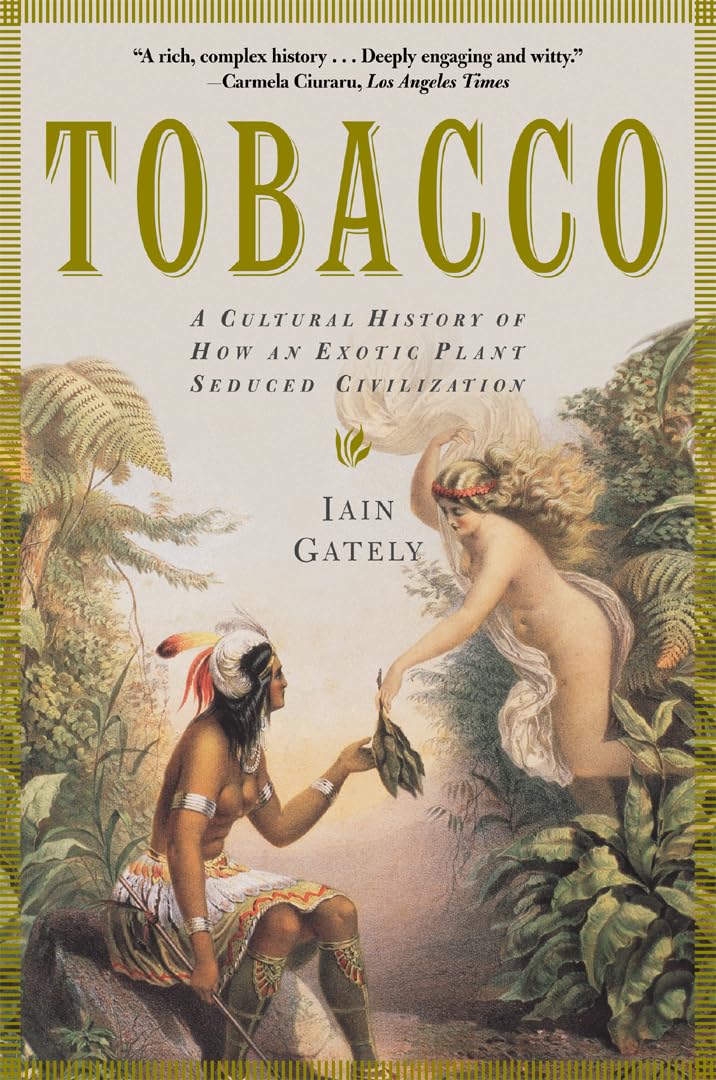
Biographies of basic commodities come in all shapes and sizes. Some are monumental achievements and major award winners, such as Daniel Yergin’s Pulitzer Prize winning history of oil (1990) and Sven Beckett’s Bancroft Award winning story of cotton (2014). Others are less inspiring, but fun nevertheless, such Mark Kurlansky’s books about salt (2002) and the codfish (1998) or Sidney Mintz’s more academic treatment of sugar (1986). “Tobacco: A Cultural History of How an Exotic Plant Seduced Civilization” (2003) by Iain Gately is the less inspiring variety of commodity biography. Fun to read, but not terribly insightful.
As the subtitle states, Gately’s book is a social and cultural history of tobacco, not an economic history, which the prize winners from Yergin and Beckett certainly were. “Tobacco” spends far more time exploring the shift in popular tobacco usage from snuff to cigars to cigarettes than it does on the economic impact of tobacco on the development of the US economy or the profits and influence of major tobacco companies, like Philip Morris, American Tobacco Company, or RJ Reynolds. Indeed, “Tobacco” tells us little about the specific macroeconomic impact of “the weed” (as he likes to call it) over the centuries, although he does argue that tobacco did more to shape the economic growth of the American colonies than anything else.
Tobacco is native only to the Americas. It likely originated in modern day Peru, but had spread to every corner of the American continents by the time Columbus arrived in 1492. (When Columbus first landed on American soil, the first natives he encountered offered him a gift of dried tobacco, although he didn’t bring any back with him on any of his voyages.) Gately says that indigenous Americans discovered that the lungs had a dual function – respiration and stimulation. It was “one of the American continent’s most significant contributions to civilization,” according to the author. Prior to Columbus, smoking was unknown to Europeans.
Tobacco was used widely by nearly all Native American cultures. It came to be most widely associated with cleansing and fertility, and as a symbol of the rite of passage between puberty and adulthood, but only for men. Not only was tobacco a novelty to Europeans in the early sixteenth century, so too was the idea of smoking something. “Europeans even lacked the vocabulary to describe smoking,” Gately writes. Gately also says that the idea of addiction was unknown in Europe, but I don’t see how that is possible in cultures that consumed vast quantities of alcohol.
Christian Europe was wary of smoking at first for a couple of reasons. First, smoking was closely associated with Native American pagan religious practices. Second, smoke was associated with the devil in the Catholic tradition. Protestant Europe would shed many of the Catholic superstitions around smoke and smoking. Consequently, smoking tobacco exploded amongst the Protestant English and the Dutch. In these countries, Gately writes, “Smoking soon developed from a curiosity into a craze.”
Europeans did more than smoke tobacco – they marketed it and traded it far and wide. “They took a ritual from one race and transplanted it as an unexplained habit to many other civilizations,” Gately writes. It was a strange substance – a commodity used solely for its pleasure that sold extremely well wherever it was introduced. Europeans had introduced tobacco as far away as Japan as early as 1542, less than fifty years after they had discovered it themselves. It was particularly embraced across the Muslim world as the Koran had no prohibition against a substance unknown in the Middle East at the time of its writing.
The most interesting part of the entire book (in this reviewer’s opinion) was the role tobacco played in the foundation of the United States. The Virginia Company was incorporated in 1606 with the aim of establishing commercially viable colonies in America. They established their base in a place they called Jamestown. The initial idea was to grow rich by manufacturing olive oil and wine. That didn’t work very well; half the colonists perished the first year alone. The colony only turned the corner in 1612 when John Rolfe (future husband of a local woman named Pocahontas) planted tobacco seeds he had acquired from Trinidad. He experimented with seeds and planting until he had established a uniquely flavored Virginia tobacco he branded “Orinoco.” It was a veritable “Eureka” moment. The Jamestown tobacco crop of 1618 was a modest 20,000 pounds. Four years later (1622) it had tripled to 60,000 pounds. Five years after that (1627) it topped 500,000 pounds, before tripling to 1,500,000 pounds just two years later. Between 1618 and 1629 the annualized compound growth rate (CAGR) was nearly 50%. By 1700, a little less than a century after the first Jamestown tobacco harvest, roughly 38 million pounds of tobacco was being exported from Virginia annually. It so dominated colonist’s lives it acted as their currency. “The discovery that tobacco could be successfully grown and profitably sold was the most momentous single fact in the first century of settlement [in Virginia],” Gately writes. The Virginia Company was dissolved in 1624 and the entire tobacco trade was reorganized as a royal monopoly.
Land to grow tobacco in the Virginia Tidewater region was virtually limitless; the labor to grow the crop was in much smaller supply. In 1619 a Dutch trading ship dropped anchor in the Chesapeake offering a wide range of goods for trade, including twenty African slaves. “In this manner,” the author says, “tobacco was responsible for the introduction of slavery to North America.” Between 1620 and 1640, 60,000 Englishmen arrived for a fresh start in the New World, but tobacco had already been established as a cash crop grown primarily by slave labor. In any event, the British American colonies were emerging under two highly different models. The first kind, in Virginia and further south, was based on tobacco, profit, and slavery. The second kind, in New England, was based on family, faith, and divine inspiration.
Tobacco’s first significant political opponent was England’s King James (1566-1625). Gately says that James hated tobacco and hated it intensely. He raised import duties by orders of magnitude and from his deathbed in 1624 forbid its domestic production. The crown’s campaign against tobacco was only interrupted by the English Civil War (1642-1651).
Meanwhile, the Dutch completely embraced tobacco both at home and abroad, where it served as an invaluable instrument of exchange (in some countries it was the only acceptable commodity the Dutch possessed) and became the first globally available luxury good. Gately equates tobacco to a contagious disease, although no one was sure why. (Nicotine wasn’t first discovered until two German chemistry students isolated it in 1828.) “Tobacco spread like an epidemic in the seventeenth century,” he says, “crossing borders and cultures at will.” In most cases the vector of this disease was the Dutch trader.
The British attempted to claw back some of this trade by passing Navigation Acts in 1651, which decreed that imports to England needed to come straight from the country of origin and be carried only in British ships, and 1660, which required colonists in North America to sell their tobacco only to England. Tobacco was North America’s principal export by value throughout the eighteenth century, representing nearly half of total exports in 1750. Slaves were often a tobacco growers greatest investment. (Slaves accounted for 43 percent of the Virginia population, up from just 10 percent in 1700.) A majority of the signers of the Declaration of Independence were involved in the tobacco trade in one form or another.
Nearly 100 million pounds of tobacco was imported in Great Britain on the eve of the American Revolution. The war caused the price of tobacco in England to skyrocket from three pence per pound to 38 pence per pound, a price increase of almost 1,200 percent. During the war the American colonies exported 87 million pounds of tobacco; the Royal Navy captured just under half of it. Benjamin Franklin even used five million pounds of tobacco as collateral on one of the critical loans he raised while in Paris during the war. American tobacco would go on to dominate the world market in the nineteenth century. By the end of the century, the United States was harvesting 425 million pounds of tobacco annually (20 percent more than India, the world’s second largest tobacco producer with 340 million pounds).
How tobacco was consumed varied by culture. The Dutch and English used pipes. In Spanish South America, cigars predominated (cigars didn’t arrive in England till 1735). However, in the eighteenth century the Fabrica del Tobacos in Seville began to manufacture nothing but snuff tobacco. It soon became a continent-wide craze. Snuff was inhaled with the intent of inducing a sneeze, a borderline orgasmic experience – or so Gately tells us. Before long all the big people were snuffing. Napoleon snuffed. King George III’s wife, Charlotte, snuffed (she was even known as “Snuffy Charlotte”). Gately writes that by the early nineteenth century snuffing had retained its position as “the preeminent British tobacco habit.” However, the Romantic literary movement and the Peninsular War paved the way for the reintroduction of smoking to the British upper classes, a process accelerated by the broadscale adoption of smoking by the British cavalry. In 1800 England imported 26 pounds of cigars; in 1830 it imported 250,000 pounds.
In 1839, a new process for curing tobacco was discovered by a slave working on a plantation in northern North Carolina. The new Piedmont leaf could be inhaled without causing intoxication. It led directly to the invention of the cigarette, which succeeded for a variety of reasons (cost, ease of use), but ultimately dominated other forms of tobacco ingestion because of superior taste. Gately says that cigarette smoking was considered highly effeminate at first, but the new form of smoking nevertheless experienced explosive growth, especially in the United States where national cigarette consumption jumped from 42 million in 1875 to over 500 million just five years later. By 1890 cigarette consumption topped 2.2 billion; thirty years later, after the First World War, it topped 100 billion! Over 80 percent of cigarette sales came from just three brands: Camel (RJ Reynolds), Chesterfield (Liggett & Myers), and Lucky Strike (American Tobacco Company). The dramatic growth in cigarettes was driven by a young and aggressive entrepreneur by the name of James “Buck” Duke. He combined the large-scale mass production of the cigarette made possible by the new Bonsacks machines with innovative nation-wide advertising campaigns. He manufactured cigarettes on an astonishing scale and was able to sell his packs of 10 cigarettes for a nickel, all while making a healthy profit. He faithfully plowed 20 percent of his profits back into advertising. Gately says that Duke “made cigarettes affordable and available and employed every marketing strategy in existence to ensure his products were in front of citizens throughout the nation.” In 1889 the 33-year-old Duke led the creation of the American Tobacco Company, better known as the Tobacco Trust, which eventually had nearly a hundred brands under its umbrella. The tobacco trust was eventually broken up by the Teddy Roosevelt administration in 1907. Duke went into retirement where he turned tiny Durham-based Trinity College into Duke University.
National opposition to the tobacco industry would ultimately focus almost exclusively on the cigarette. Meanwhile, tobacco consumption in the US grew to five pounds per head per year (it was three pounds per person in the UK). Leading American celebrities, such as Thomas Edison and Henry Ford, came out against smoking in the early twentieth century, but it was mostly too little, too late. The country was literally addicted to cigarettes. And then Hollywood “changed smoking forever,” according to Gately, “Cinema effectively knocked out the need to justify smoking.” Movie stars made smoking cool and sexy. At last neither sex nor age was a barrier to smoking.
The dangers of smoking, particularly lung cancer, first began to emerge in the 1930s. Ironically, it was Hitler’s Germany that was first to respond to the hazards of smoking. Smoking was banned in public places and on public transportation in Nazi Germany, while taxes on cigarettes were raised to punitive levels, ultimately accounting for 8 percent of total government income on the eve of the Second World War. Eventually, 80 percent of the price of a pack of cigarettes in the UK was taxes. “The sale of cigarettes in the UK,” Gately writes, “is principally a form of taxation and the main function of tobacco companies is tax collection.”
Between 1931 and 1956, the incidence of lung cancer in America grew by a factor of nine and it was determined that heavy smokers were fifty times more likely to develop lung cancer than non-smokers. The cancer rates grew not with smoking, but specifically with cigarette smoking. Cigarettes were clearly a causative factor in the etiology of lung cancer. By the 1960s Hollywood and Madison Avenue were no longer associating cigarette smoking with happiness, virility, love, or adventure. By New Years Day 1971 cigarette advertising was banned on American television. A year later the percentage of the adult male population that smoked fell below 50 percent for the first time in over half a century. A decade later it was below 40 percent. Meanwhile, the popularity of cigars surged in America. Cigar Aficionado magazine debuted in 1992 and cigar smoking remains both popular and more socially acceptable than cigarettes.
In closing, “Tobacco” is a relatively fun and informative read, somewhat along the lines one might expect from Mark Kurlansky.
 What's Tim Reading Now?
Leave a comment