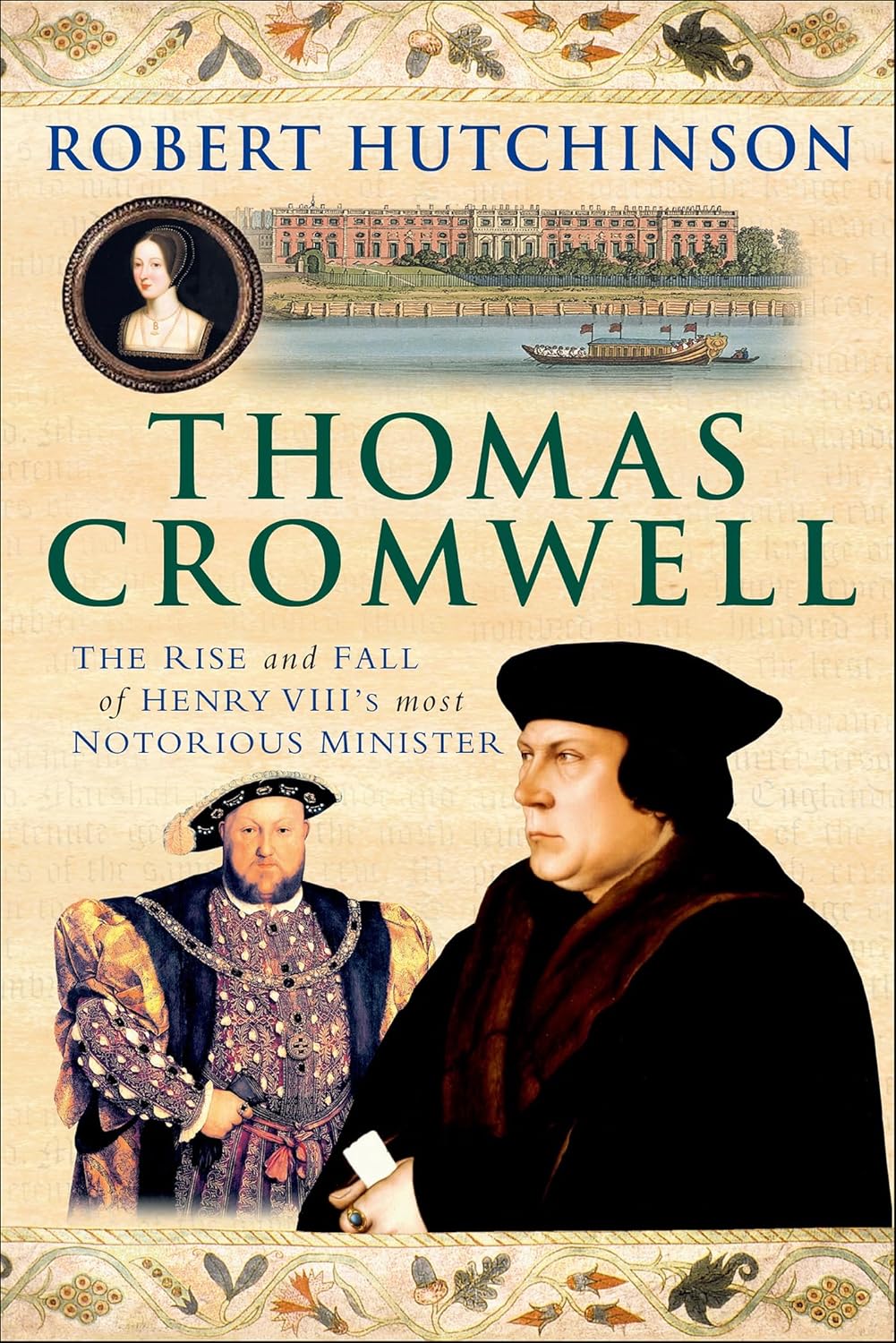
Sir Thomas More, canonized by the Catholic Church in 1935, was famously known as “A Man For All Seasons,” a brilliant, noble, pious, well-educated, devoted man and incorruptible defender of the crown and faith; he laid down his life in 1535 rather than sacrifice his religious beliefs. More’s life and death has inspired millions down to this day. Thomas Cromwell, More’s contemporary serving the court of Henry VIII in the 1530s, provides a very different example.
If Thomas More represents the best of humanity, it may be argued that Thomas Cromwell represents the worst. Born in 1485 the son of a brewer, Cromwell’s climb to the top of the royal administration of King Henry VIII was as improbable as More’s was likely. Cromwell managed to achieve his lofty ambitions with a potent blend of hard work, venality, luck, and genius. Or as author Robert Hutchinson describes it: “Equipped with a remarkable gift of low animal cunning, a capacity for raw deceit, and employing extraordinary political skills and vision, [Cromwell] clawed his way up from rough, humble origins to become the most powerful man in England – ranking only below his fickle and sometimes malevolent sovereign.”
Cromwell began his career, like More, as a lawyer; and evidently he was a good one. The path to becoming an attorney in sixteenth century London was not easy. It has been described in excellent detail in Peter Ackroyd’s 1998 biography “The Life of Thomas More.” The specifics of Cromwell’s legal education and early career, however, are a bit hazy as Hutchinson’s treatment of the subject seems to jump right to the late 1520s with Cromwell serving as a key aide to Cardinal Thomas Wolsey, Lord Chancellor to Henry VIII until 1529 when he was stripped of his power after failing to obtain an annulment to Henry’s marriage of Catherine of Aragon. How Cromwell, a man of incredibly humble origins in status-obsessed Tudor England, managed to ingratiate himself with someone of Wolsey’s stature in the first place is unclear and Hutchinson never really acknowledges the fact. Yet, somehow there he was in 1529, the right hand man to Cardinal Wolsey, and somehow he managed to politically and physically survive his mentor’s downfall.
Cromwell tactfully distanced himself from Wolsey while prominently displaying the value he could offer the crown. “His skills in drafting new laws and browbeating intractable legislators had become vital in achieving a lengthening agenda of controversial business in the Commons,” Hutchinson writes, “as was his ability to select suitably malleable candidates to fill by-election vacancies.”
Above all, in the wake of Henry’s split with Rome over his marriage to Anne Boleyn, Cromwell recognized the potential of seizing the vast wealth held by the various monastic orders spread all throughout England. It was a shake down of epic proportions. Hundreds if not thousands of abbots and priories and monasteries were confiscated beginning in the mid-1530s. Cromwell lined his pockets in any one of numerable ways. Some of the most valuable land and buildings he took personal possession of. In other cases, his accepted bribes from those who desired grants of monastic property. Or sometimes he accepted bribes from abbots and priors who wanted to save their property. In all of this, Cromwell and Henry became fabulously rich. “Henry was so delighted at the privatization of religious houses that he heaped more offices and honours on Cromwell’s willing head.” The humble brewer’s son was now Lord Privy Seal, His Mastership of the Rolls, Chancellor of the Exchequer, Master of the King’s Jewel House, Clerk of the Hanaper, and High Steward of the Queen’s Lands, just to name a few. All of these positions carried with them generous salaries and perks. Hutchinson estimates that by the late 1530s Cromwell was, after Henry and possibly the Duke of Norfolk, the richest man in all of England. He was also, in all likelihood, the most hated man in the kingdom.
The circumstances behind Cromwell’s downfall are somewhat strange, almost comical. In December 1538, Pope Paul III issued a belated papal bull that excommunicated Henry as a heretic and urged the Catholic superpowers of Spain and France to unite in an effort to force England back to papal authority. (The papal bull also actually singled out Cromwell by name as “that limb of Satan.) Henry was diplomatically isolated and facing an overwhelming military threat to his realm. He needed allies wherever he could find them. As it turned out, he was also looking for a wife. Jane Seymour, his third wife, had died after giving birth to Henry’s first son and heir, Edward VI, in October 1537. Cromwell, acting as Henry’s incomparable political fixer, was brought in to try and kill two birds with one stone. That is, find Henry a suitable wife that brought with her political and military connections on continental Europe that might counter balance the mighty weight of a hostile Spain and France. Cromwell’s choice, Anne of Cleves, turned out to be disastrous.
Anne brought with her a valuable alliance with her brother, William, leader of the Protestants of western Germany. Unfortunately, the 24-year-old princess was, at least to Henry’s eye, unacceptably homely. Mocked as the “Flanders’ Mare,” Henry rejected the union and placed the blame squarely on Cromwell’s shoulders. “The king had a long memory for grudges,” Hutchinson writes, “and an insatiable appetite for vengeance.”
Hutchinson stresses that the nobility never accepted Cromwell. “Almost to a man,” he writes, “they heartily detested him both for his lowly birth and his firm, apparently unshakeable grip on power and patronage in the realm.” Two powerful members of that nobility would unite to bring Cromwell down in 1540: Thomas Howard, Third Duke of Norfolk, and Stephen Gardiner, Bishop of Winchester. Cromwell’s fumbling of the Anne of Cleves situation provided them an opening, which they further exploited with accusations of religious heresy. Henry had always found Cromwell a bit too close to the German Lutherans “who preached such erroneous opinions.” The end result was a Stalinist show trial of sorts that featured a pathetic disingenuous admission of guilt by the now disgraced Lord Privy Seal: “I confess I am justly condemned and I urge you, gentlemen, study to preserve the good you possess and never let greed or pride prevail in you.” Cromwell was beheaded on 28 July 1540, the same day that Henry married his fourth wife, Catherine Howard.
In the end, Hutchinson actually goes out of his way to defend his subject: “Cromwell may appear authoritarian,” he writes, “cruel and malevolent to our modern eyes, with a cynical contempt for Parliament and justice, but his actions were always motivated by what he perceived to be the best interests of his royal master and his realm.” I’m not sure I completely agree. The man that Hutchinson so skillfully describes is devoid of all principle and scruples. All of his actions are in service to his own personal self-interest. To the extent that Cromwell served Henry well, it was only because in so doing he was advancing his own cause. Cromwell was, as Hutchinson delightfully describes him, a “Machiavellian panjandrum” who no doubt “would have felt comfortable in the government of a twentieth-century totalitarian state.”
 What's Tim Reading Now?
Leave a comment