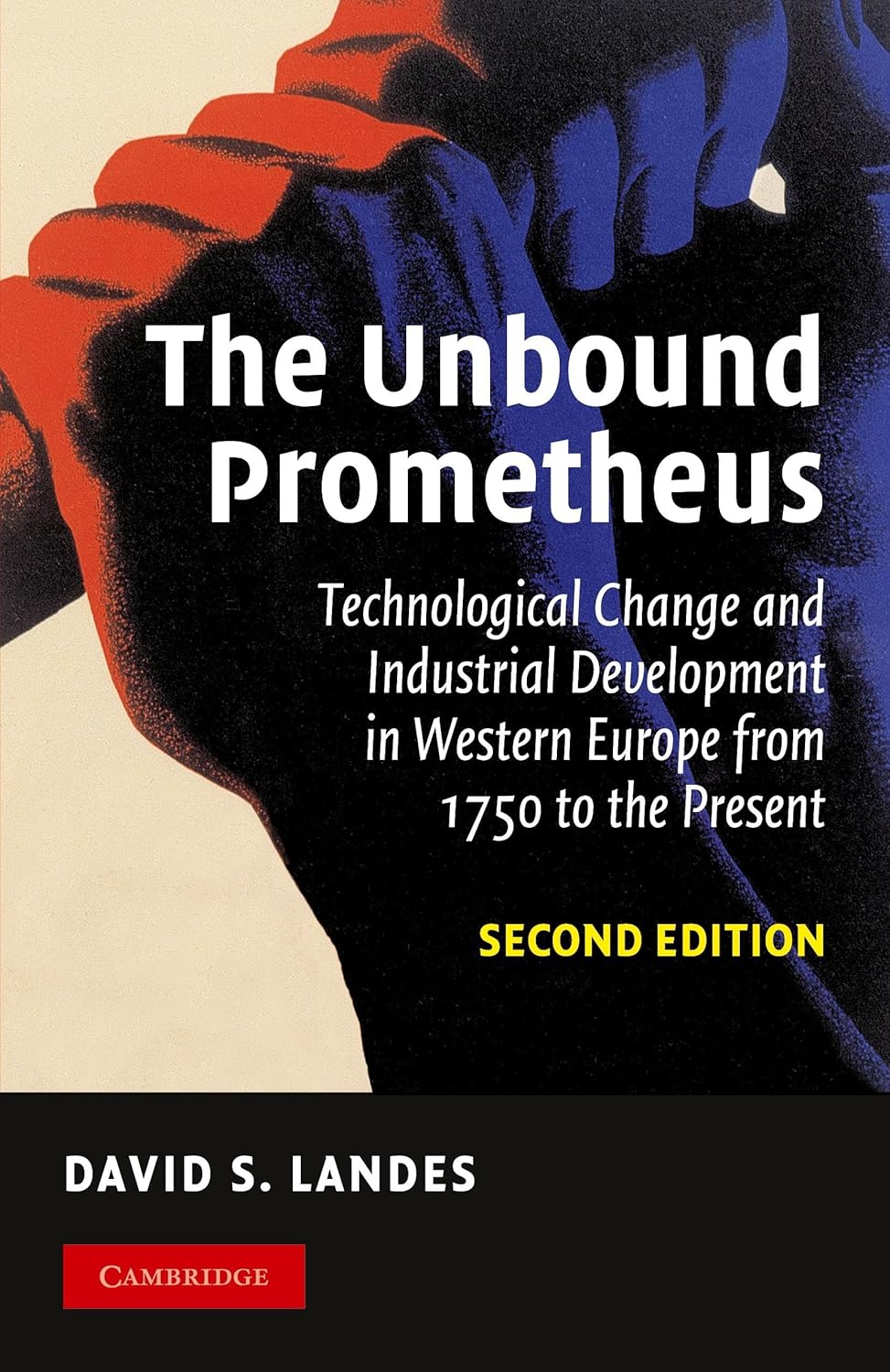
Harvard University’s David S. Landes was the doyen of modern Industrial Revolution Studies. This book, “The Unbound Prometheus: Technological Change and Industrial Development in Western Europe from 1750 to the Present” (1969) is a landmark in the field. The author’s arguments and theses laid out in “The Unbound Prometheus” framed the scholarly debate about the causes and impact of industrialization for the next half century.
Landes takes a rather heroic view of the Industrial Revolution. He says it changed man’s way of life more dramatically than anything since the discovery of fire and ever since has had an effect like Eve’s tasting of the fruit of the tree of knowledge. The revolution was wrought mainly by technological innovation, the effects of which were pervasive and profound. He says it ushered in “a new era of monotonic technological progress” that “initiated a cumulative, self-sustaining advance in technology whose repercussions would be felt in all aspects of economic life.” It is a perspective starkly at odds with those twentieth century scholars – such as Knick Harley, Erik Jones, and Rondo Cameron – who have emphasized the slow growth and narrow impact of the Industrial Revolution, what I like to call the “Ho-Hum School.”.
At the dawn of the Industrial Revolution in 1750, Britain was, for its time, remarkably prosperous, rational, pragmatic, urban, and free. This was important, Landes says. “Those economies that were freest seem to have been most creative; creativity promoted growth; and growth provided opportunities for further innovation, intended or accidental.” Moreover, Britain was the largest cohesive economic market in Europe, benefiting from bountiful geographic concentrations of coal and inland waterways. Landes says it was the only market big enough and connected enough to support full scale industrialization in virtual isolation.
According to Landes, the British Industrial Revolution was driven by innovations in three core areas: 1) the substitution of machines for human skill and effort; 2) the substitution of inanimate for animate sources of power (human and animal); and 3) the substitution of mineral (coal and iron) for vegetable (wood) sources of energy and construction. In combination, these three innovations were, in Landes’s telling, earthshaking. “The technology that we denote as the ‘Industrial Revolution’ implied a far more dramatic break with the past than anything since the invention of the wheel,” he says. But he is quick to add that the Industrial Revolution was not all about new machines and new techniques. Organizational innovation also played a pivotal part, namely the factory system.
The combination of new machines powered by new sources of energy organized in new factory systems was dramatic. For instance, in 1800 the British textile industry consumed 22 million pounds of raw cotton; fifty years later it was consuming 366 million pounds. The price of yarn dropped by 95 percent; two-thirds of it was sold abroad. By the time of the Crystal Palace Exposition in 1851, Britain was, with half the population of France, turning-out about two-thirds of the world’s coal and roughly half its iron and cotton cloth. Half of the British population was living in towns and cities compared to just a quarter in France and Germany. Landes stresses that early technological innovations that drove this impressive growth were not particularly capital intensive. Indeed, most of the famous machines of the Industrial Revolution – spinning jenny, water frame, mule – were “modest, rudimentary, wooden contrivances.” Rather, it was the “spirit of innovation” combined with “a society that interposed relatively few institutional barriers to fundamental change” that propelled the economy forward. Nowhere else in the world, Landes says, were “the pressures and incentives to change greater, the force of tradition weaker.”
Landes embraces a number of arguments that have been stridently challenged in the half century since the publication of “The Unbound Prometheus.” For instance, he accepts the argument that the Industrial Revolution was reinforced and carried forward by a simultaneous Agricultural Revolution and that the dramatic increases in agricultural production were mainly due to the enclosure of millions of acres of farmland between 1760 and 1815. (It’s a perspective that has been convincingly refuted by Knick Harley, who has shown that the enclosure movement increased agricultural productivity by at most 10 percent.) The author also subscribes to the demand-driven model of technological innovation, claiming that high wages in Britain stimulated technological innovation while low wages reinforced the labor intensive putting-out system on the Continent well into the nineteenth century. It’s a familiar thesis most recently reinforced by Robert Allen, but strenuously contested by other leading historians, especially Joel Mokyr. Finally, Landes sees cotton as virtually synonymous with the Industrial Revolution, as the famed British Marxist historian Eric Hobsbawm did, although rather widely rejected by many contemporary scholars (it must noted that Landes says the Industrial Revolution on the Continent was very different than in Britain and driven almost completely by coal and iron, not cotton). Cotton is nevertheless a remarkable plant. Cotton supply was far more elastic than that of wool. Cotton fibers were far more flexible and lent themselves better to mechanization. The market for cotton textiles proved to be vastly larger than wool owing to its ability to easily absorb dyes, its comfort, and its washability. In 1740 the British consumed sixty times more wool than cotton, but only cotton proved capable of supporting an Industrial Revolution.
Landes assigned a somewhat ancillary role to iron production and the steam engine, at least during the First Industrial Revolution. In his view, coal and iron and steam did not make the Industrial Revolution, “but they permitted its extraordinary development and diffusion.” The development of these technologies was slow and was advanced primarily by hundreds, if not thousands, of small innovations contributed by anonymous technicians. Steadily more efficient steam engines powering steadily more efficient machinery resulted in “a revolution like nothing ever experienced,” Landes says. More important of all, it never reached some point of equilibrium and stopped, like earlier periods of technological transformation. Indeed, the Industrial Revolution is still unfolding today as it enters its fourth phase, driven by artificial intelligence.
Britain’s industrial leadership lasted a century (1750-1850). Between 1850 and 1900, Continental Europe – and Germany in particular – quickly caught up and, by century’s end, surpassed the British in many fields associated with the Second Industrial Revolution: steel, railroads, electricity, chemicals and synthetics. Textile manufacturing rapidly receded in importance. Britain had lost her comparative advantage.The age of the industrious, self-taught, tinkering mechanic was over. The era of the highly educated, scientist-engineer had arrived.
If the First Industrial Revolution was arguably synonymous with cotton, the Second Industrial Revolution was synonymous with steel. Steel is an almost magical metal: hard, yet elastic. Its existence was known for centuries. The challenge was how to smelt it efficiently. Fast and accurate decarbonization became the Holy Grail of the metallurgy world.. Steel is produced by achieving a very specific ratio of carbon – from 0.2 percent to 2 percent – during the iron smelting process. The higher the carbon content, the harder the metal. Iron with over 2 percent carbon is called pig iron. It is stiff and brittle and must be cast to be made into things, such as pots, pans, and cannon. Iron that has been stripped of carbon is called wrought iron. It is soft and malleable enough to be worked by hand. It is often used to make tools, furniture, and fences.
The British once again provided the innovative genius that made high quality and affordable steel possible. In 1856, a British inventor named Henry Bessemer – “a high class tinkerer,” according to the author – announced a new and low cost way to rapidly produce steel by blowing air into and through the molten metal during the smelting process. (The Germans developed a competing process called the Siemens-Martin method that adds scrap steel to melting iron to adjust the carbon content.) The Bessemer process decarbonized the iron in just ten or twenty minutes, compared to the old puddling process that could take up to 24 hours. Virtually overnight, steel became competitive with wrought iron. Between 1860 and 1890 the real cost of crude steel dropped almost 90 percent, In 1861 the combined steel production of Britain, Germany, France, and Belgium was 125,000 tons. Production grew at over 10 percent a year for half a century. On the eve of the First World War the four countries were producing 32 million tons of steel, a growth factor of 83 times. “The invention of basic steel was an event of world import,” Landes says.
The Second Industrial Revolution was about more than steel, however. It was also about power, specifically electricity, although the internal combustion engine played a critical role at the tail end of the period. Landes says that, “In a sense, the story of power is the story of industrialization” and he calls electrical power “the consummation of the Industrial Revolution.” After the creation of the electrical grid, there was “no activity that could not be mechanized and powered,” he says. Electric railways, heavy electro-chemical manufacturing, such as aluminum, electro-metallurgy, fixed motor power, and the electrified factory all propelled various aspects of the Second Industrial Revolution forward. Germany once again played a leading role in all of them. German electrical manufacturing exports in 1914 were over double that of the United Kingdom and three times larger than the United States.
The combined (and highly unanticipated) effects of these technical efficiencies – power, manufacturing, and transportation – was massive price deflation, particularly from 1817 to 1896. “The price decline of the nineteenth century,” Landes writes, “was the consequence and barometer of European industrialization.”
“The Unbound Prometheus” is an undeniable classic of economic history. Although it shows its age in many ways, it is still a great starting point for anyone looking to understand the First and Second Industrial Revolutions in depth and breadth. Landes will serve as a great foundation for tackling more recent scholarship in the field, such as the twenty-first century books by Pommeranz, Allen, and Mokyr.
 What's Tim Reading Now?
Leave a comment