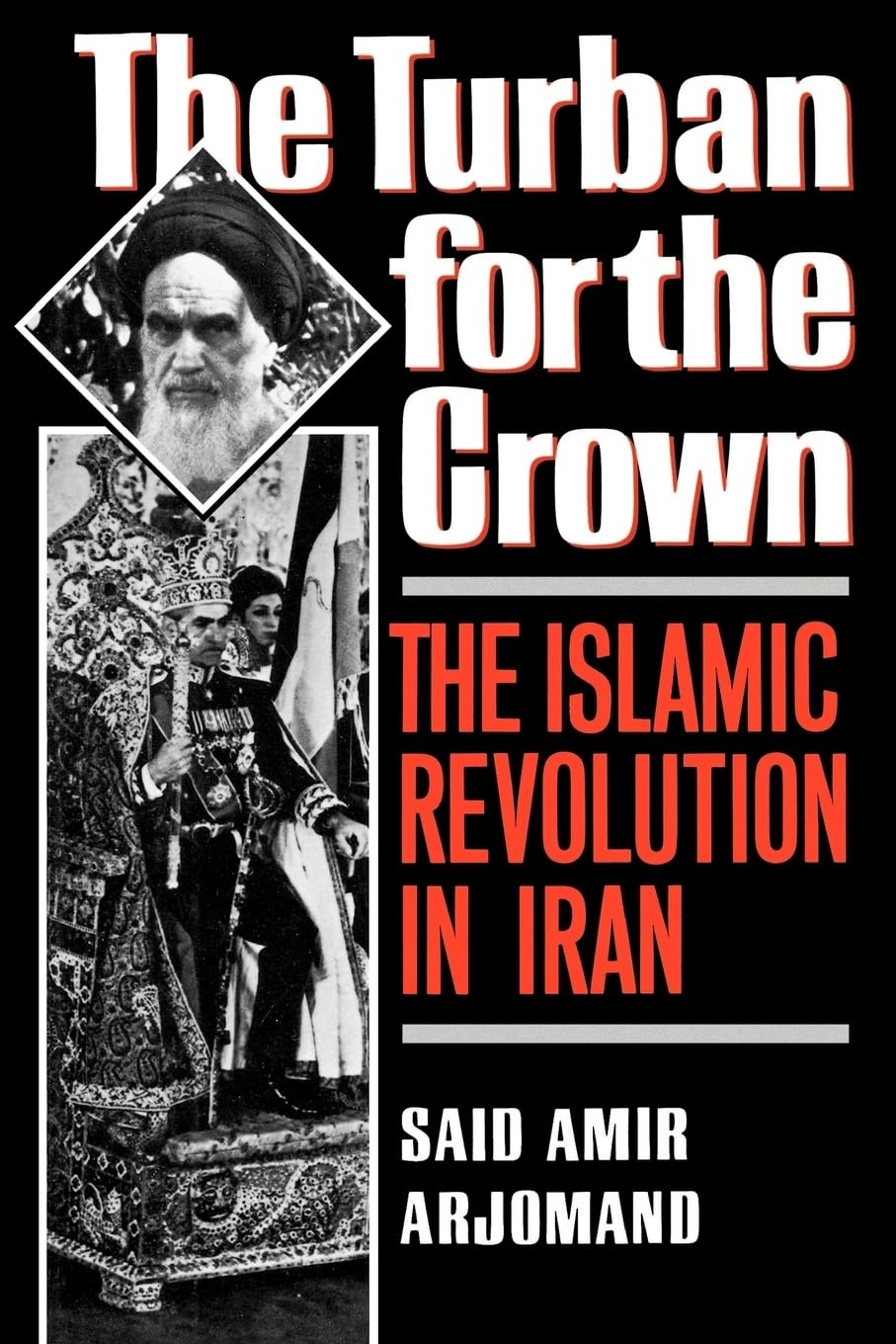
Said Amir Arjomand has been a professor of sociology at Stony Brook University on Long Island for over forty years. He received his PhD from the University of Chicago in 1980 just as his homeland was making its violent and chaotic transition from monarchy to theocracy. “The Turban for the Crown: The Islamic Revolution in Iran,” first published in 1988, remains one of the best explorations into the root causes of the Iranian Revolution ever written.
The political upheaval that gripped Iran in the late 1970s was unprecedented. It was a genuinely popular revolution that eschewed the usual calls for democracy and progress and instead promoted theocracy and a return to an earlier, more simple, less Western religious way of life. The outside world was largely incredulous. According to one White House aide: “The notion of a popular revolution leading to the establishment of a theocratic state seemed so unlikely as to be absurd.”
Arjomand endeavors to make sense of this seemingly inexplicable turn of events. In order to understand the Iranian Revolution, he says, “historical background is indispensable.” In Arjomand’s estimation, the seeds of the Iranian Revolution were first planted in 1501 when the ruling Safavid dynasty made Shi’ism the state religion of Persia. Thus was established a dual system of authority that would last for centuries: the secular, centralized bureaucratic state on the one side, the widely distributed and fiercely conservative Shia hierocracy on the other. Over time, the hierocracy would forge an enduring alliance with a small, weak, but burgeoning civil society, particularly the small-scale mercantile class of the bazaar, which stood united against various forms of foreign penetration and domination, first the Russians, then the British, and finally the Americans.
For centuries, the rulers of Persia, first the Safavids and then the Qajar dynasty, struggled to impose order and maximize tax revenues. They sought to develop a strong standing army and devise ways to pay for it reliably. To do both they needed to crush the power of the tribes, which had long made Persia a fragmented and disorganized political mess. The sublimation of the tribes in the early twentieth century may be the greatest political achievement of pre-Pahlavi era. When Reza Shah came to power in 1925, he was able to implement national conscription because the power of the tribes had been broken. He quickly grew the army from less than 30,000 in 1922 to nearly 200,000 by 1941 all while implementing a host of other programs designed to centralize and modernize the state, such as state monopolies on sugar, tobacco, cotton, and tea accounting for 35% of total government revenue, construction of the Tran-Iranian Railway, and establishment of the National Bank of Iran. Government revenue and expenditure expanded tenfold under Reza Shah. In short, Arjomand says, “The increased fiscal resources of the state, the creation of the new army, and the demise of the tribes thus made possible the rise of a centralized bureaucratic state.”
Even before Shah Mohammed Reza Pahlavi took over from his father in 1941, the newly centralized Iranian government was a service-rendering organization devoted to two main goals: national defense (40% of the national budget) and economic development (also 40% of the national budget). When Reza Shah took over there were perhaps 800 miles of roads in Iran. In his first two decades in power he built 14,000 miles of road and cut the cost of internal transportation threefold. But this aggressive modernization program entailed significant secularization of culture, including the unveiling of women in 1935, along with national integration, all of which radically altered the social structure of the country. According to Arjomand, this “devastated the institutional foundations of clerical power and cultural influence,” while simultaneously creating a reasonably homogenous nation of over thirty million. Ayatollah Khomeini would essentially hijack this recently unified political entity in the 1970s.
It has been argued that the Iranian Revolution began with the White Revolution, a collection of ambitious political and economic reforms announced in 1963 that accelerated the massive migration from the rural areas to the cities, particularly Tehran. Between 1956 and 1976, the urban population of Iran tripled, jumping from 31% to 47% of the population. Over ten million rural Iranians poured into the cities, most of them poor, uneducated and unemployed men. Over ten thousand religious associations flourished in Tehran alone, many of them focused on providing services to the dislocated young men recently arrived from the countryside. Arjomand says that a contemporary Islamic revival in the wake of unprecedented urbanization should have surprised no one, but it did. During the same time, the number of Iranians with higher educations quadrupled to 300,000. On top of all of this was added the economic chaos caused by the massive injection of oil money in the 1970s. The end result was a combustible mix of millions of dissatisfied young people living in over crowded cities with unreliable water and power.
The Shah’s breakneck industrialization and modernization programs alienated certain segments in Iranian society, especially the bazaar merchants whose livelihood was undeniably threatened by industrial production and modern retail distribution channels, such as supermarkets and shopping malls. “The hierocracy emerged as the champions of the Islamic nation against the economic penetration and cultural influence of foreign powers,” Arjomand says. It was a titanic battle of the Muslim nation of Iran against the imperialist infidels with the Shia hierocracy on the one side and the Shah on the other. The Shia hierocracy was no longer as amorphous as it had been in 1906 when competing tribes, poor communication networks, and illiteracy had combined to separate the people of Iran. Khomeini’s blunt attacks against the Shah fell on fertile ground: The Shah, he said, was an out-of-touch autocrat and puppet of the United States who flagrantly disregarded Islamic morals. There was a better way, he said, the Velayat-e faqih or Mandate of the Jurist, Khomeini’s call to rule on behalf of the Hidden Imam.
Khomeini’s political vision for Iran was, at best, half-baked. According to his Mandate of the Jurist, in the absence of the divinely inspired Imam, sovereignty devolves upon Shi’ite religious leaders who are the authoritative interpreters of the Sacred Law (Sharia) and therefore entitled to rule. Eventually, Khomeini’s followers would proclaim that Khomeini was actually the Hidden Imam himself, a shocking move that Arjomand says is unprecedented in Shia Islam’s 1,500-year history. Khomeini evidently didn’t try to dissuade anyone of that incredible judgment. Indeed, his followers began to attribute supernatural qualities to him. The fact that all of this was happening at the dawn of the fifteenth century of Islam gave added weight to the movement, Arjomand says. It is mindboggling to me that millions of otherwise sane and rational people voluntarily signed up for all of this.
Arjomand writes that “Khomeini’s charismatic leadership was undoubtedly a major factor both in the revolutionary politicization of Shi’ism and in the success of the Islamic Revolution in Iran.” I must confess, I’ve watched as many old clips of the Ayatollah from the 1970s as I can find, and he is not what one traditionally thinks of as charismatic. Wooden and inscrutable, yes; charismatic, no. Arjomand credits Khomeini with courage and unswerving determination in resisting the Shah. The cleric was, to many, the very embodiment of Islam, a tradition and way of life that many viewed as imperiled. Millions signed on to the movement, even those who had a lot to lose if he were successful, such as women.
No group’s defection was more decisive to the demise of the Pahlavi dynasty than the middle class. “Why,” Arjomand asks, “instead of ringing concession after concession from a desperate Shah and a frightened military elite, did [the Middle Class] choose to become subordinate allies of a man who treated them with haughty contempt and rejected their principles of national sovereignty and democracy?” Instead, he says, they simply caved to “the instant gratification of regicidal vengefulness.” Meanwhile, those with a vested interest in supporting the Shah never lifted a finger to save him. Arjomand witnessed these events firsthand and writes, “I was astonished at the utter lack of any moral commitment to the Shah’s regime among those who had a stake in it, the top civil servants and well-to-do entrepreneurs.” Instead, they just left. By the late 1970s, it was estimated that $1 billion month of private capital was leaving Iran. “The mammoth edifice of the state became hollow as a result of the complete withdrawal of moral commitment to its preservation.”
The collapse of the Pahlavi dynasty comes down to a lack of leadership, according to Arjomand. The Shah was weak, indecisive, bungling, and myopic. His contradictory impulses and policies did much to wreck the state apparatus and sever its bureaucratic and military wings. There was an obvious opening to split the Shia hierocracy by reaching out to the moderate Ayatollah Shariamadari in Qom, but he never did so. He had the fifth largest military in the world, largely intact and loyal, at his personal disposal, but he never used it. “The Shah, unlike his father,” Arjomand writes, “was a weak person and had failed to act decisively in all the major crises of his reign.”
The Shah had placed himself so firmly at the center of his modern centralized state that it couldn’t function without him. In order to prevent coups, Arjomand says the army had implemented a deliberately fragmented command structure that made it difficult for senior army officers to carry out the complicated maneuvers and coordination necessary for any form of concerted action in a crisis situation. With no unity and no experience of teamwork, the army failed to put together any independent plan for suppressing the uprising. The disunity and ineffectiveness of the armed forces emboldened the populace, as did the evident abandonment of the Shah by the US government. Arjomand says that by late 1978 US policy toward Iran had become “a complete muddle.” It took only 26 days for the entire monarchal edifice to collapse after the Shah fled Iran on January 16, 1979.
Arjomand says that there was very little the United States or anyone else could have done to save the Pahlavi dynasty. It was not the result of some intelligence failure or sloppy policy execution, although those things certainly happened. The author says only two things could have saved the situation in 1978: 1) a decisive and likely brutal leader unafraid to deploy the full powers of his secret police and armed forces against a treasonous citizenry; and 2) the Iranian middle class coming to its political senses to support the Shah against the hierocracy. It is estimated that 3,000 people were killed in the whole of Iran during the five months of revolutionary upheaval in 1978. Arjomand seems to suggest that is a piddling amount and many more should have been sacrificed to save the country.
By November 1979, Khomeini and his followers were showing their hand. They pushed forward clerical hegemony and the establishment of an Islamic theocracy along with the complete eradication of occidentalism (i.e. western cultural influence) that they believed had ravaged Iran for nearly a century. The judiciary was systematically desecularized and staffed with Shi’ite clerics.
Arjomand claims that Khomeini gave little thought to the modern theocratic state he would build in the wake of his victory over the Shah, although he suspected that much of the bureaucratic apparatus would quickly wither away. In fact, the opposite happened. The sprawling centralized state of the Shah dramatically expanded under the clerics. Government workers ballooned to over 2 million, 800,000 more than under the Shah. Virtually all industrial enterprises were eventually controlled by the state. Islamic ideological commissars were added to army units as small as the company level. A vast intelligence system “more far-reaching and far more prying than the Shah’s” was unleashed on the population. A variety of patrol groups – Vengeance of God, Army of God, and Helper’s of God – perform a variety of vigilante activities and generally terrorize the people of Iran. The Organization for Islamic Propaganda sent 225,000 domestic missionaries into the villages of Iran by 1985. Meanwhile, per capita income in Iran at that point had fallen 30% below the pre-revolution level. Then again, the revolution never claimed to be about economic improvement.
In closing, Arjomand shows that the Iranian Revolution was driven forward by the Shia hierocracy with strong support from the petite bourgeoisie (bazaar merchants) and the middle class (government workers, teachers, the intelligentsia), many of them progressives. Peasants, industrial workers, and the armed services played virtually no role. The colorless and ineffective Shah doomed the regime. The self-righteous and incompetent Carter administration didn’t help matters. In the end, Arjomand concludes, the Iranian Revolution was tragically unavoidable.
 What's Tim Reading Now?
Leave a comment