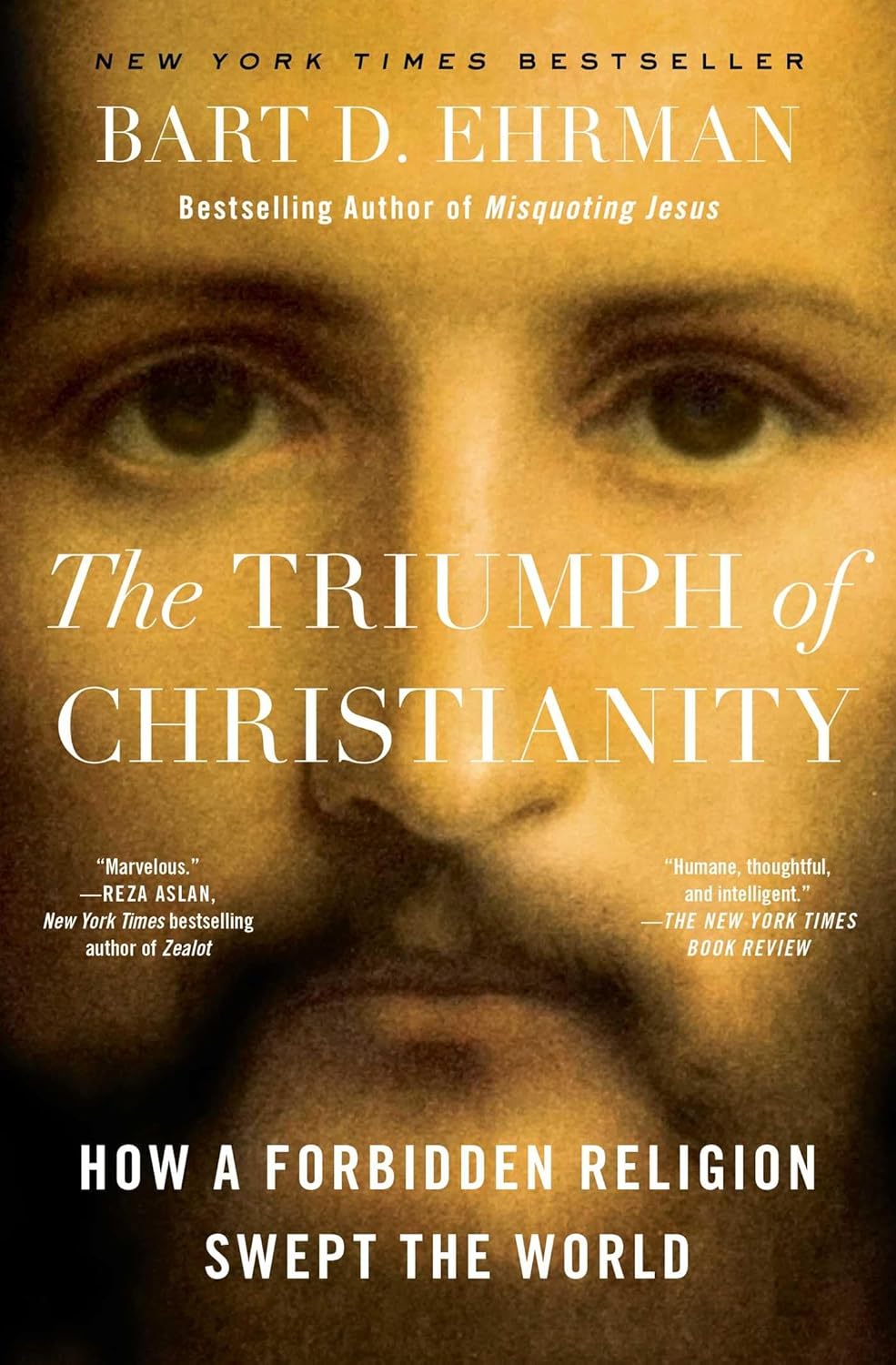
How did a small, fringe sect of perhaps twenty illiterate, Aramaic-speaking Jews in early first-century Palestine come to dominate the entire Roman Empire just four centuries later? That’s the central question posed by renowned religious scholar Bart Ehrman in “The Triumph of Christianity” — a deeply engaging and thought-provoking book.
The astonishing rise of Christianity, Ehrman argues, is less a tale of miracles and mass conversions than a story of steady, exponential growth—what he and other scholars, notably sociologist Rodney Stark, liken to the effect of compound interest. From the crucifixion of Jesus around 30 AD to the faith’s adoption as the empire’s official religion in 400 AD, Christianity likely grew at an average rate of about 40% per decade. This growth wasn’t driven by sweeping movements but by quiet, personal conversions: one believer persuading a friend or family member, who in turn did the same. The cumulative effect is striking. From an estimated 20 followers in 30 AD, the Christian population may have grown to 10,000 by 100 AD, 150,000 by 200 AD, 3 million by 300 AD, and 35 million by 400 AD. Ehrman emphasizes that this trajectory is not only plausible but mirrors the growth rate of the modern Mormon Church over the past century and a half.
But why did Christianity triumph? After all, the Roman Empire teemed with cultish religions during this period—especially in the East—yet none sustained anything close to a 40% growth rate per decade for centuries. On this point, I found Ehrman’s explanation less than persuasive. His core argument, echoing the thesis of classicist Ramsay MacMullen, is that Christianity spread because “the words of the Christians were backed up by stories of miracles.” In a world steeped in belief in the supernatural and the power of the gods, the Christian message—full of divine interventions and wonders—was tailor-made for popular appeal. As Ehrman puts it, “From the beginning, starting with the astounding life and ministry of Jesus himself and continuing through the work of his apostles and their successors, the power of God had been manifest in real and tangible ways.” But what Ehrman never adequately addresses, at least in my reading, is what made Christian miracle stories more compelling or credible than those of rival cults. Other religious movements surely claimed miraculous signs as well—so why did Christianity’s take hold while theirs faded?
Christianity possessed several distinctive features that made it a formidable rival to the pagan cults of the Roman world. As Ehrman puts it, the new faith was “evangelistic, exclusive, and totalizing.” Unlike traditional pagan religions—such as the cults of Dionysus or Apollo—which had long histories and little interest in recruiting outsiders, Christianity was aggressively missionary. Its followers actively sought converts. More significantly, Christianity demanded exclusivity. While pagan worshipers could pay homage to multiple gods without conflict, Christians insisted that adherents renounce all other deities. For the first time in the ancient religious landscape—apart from Judaism—the competition for followers became a zero-sum game. Moreover, Christianity offered more than ritual or occasional temple observance; it introduced a comprehensive system of beliefs, sacred texts, and moral teachings. It provided not just a way to worship, but a way to live—centered on love, charity, and ethical conduct. According to Ehrman, it was this combination of missionary zeal, exclusivity, moral vision, and the persuasive power of miracle stories that ultimately enabled Christianity to eclipse the many cults of the pagan world.
Finally, there is the question of Roman persecution of Christians. Ehrman argues that official persecution was a relatively late development, limited in scope, and ultimately ineffective at slowing the growth of the faith. In fact, empire-wide efforts to suppress Christianity occurred only during a few specific periods: in 250, from 257 to 258, and from 303 to 313. Before these episodes, persecution was sporadic, local, and typically carried out without formal state endorsement. Notably, Ehrman never mentions the often-repeated image of Christians being thrown to lions in the Colosseum—a striking omission that underscores how much of what we think we know about early Christian martyrdom is shaped more by legend than by evidence.
In 250 AD, Emperor Decius issued an edict requiring all Roman citizens to perform a public sacrifice to the traditional gods—a test of loyalty to the empire. Those who refused faced severe penalties, including exile, property confiscation, torture, and even execution. While it is widely believed that the edict was aimed primarily at Christians, Ehrman notes that this remains uncertain. What is clear, however, is that many Christians would have found compliance impossible, given their exclusive monotheism. Yet Ehrman emphasizes that the true scale of the persecution remains unknown; there is simply not enough reliable evidence to determine how many Christians were ultimately affected.
Valerian, who succeeded Decius, was the first Roman emperor to issue decrees explicitly targeting Christians, thereby initiating the first empire-wide persecution specifically directed at the faith. His edict of 257 mandated the execution of all Christian bishops, presbyters, and deacons in the city of Rome. It also required Christian members of the senatorial and equestrian classes to renounce their faith or face death. As a result, many prominent Christians—including the bishop of Rome—were executed. The persecution came to an abrupt end in 260 when Valerian was captured during a military campaign in Persia, and his successor rescinded the decrees.
Finally—and most significantly—came the persecutions under Emperor Diocletian, which Ehrman describes as “a persecution that dwarfed anything the empire had ever seen.” Diocletian’s first edict, issued in 303, outlawed Christian gatherings, ordered the destruction of churches, mandated the confiscation of Christian scriptures, and stripped high-ranking Christians of their social status. Yet despite the severity of these measures, Ehrman notes that enforcement proved uneven and inconsistent across the vast empire, which lacked a centralized police force. In 304, Diocletian issued a second, more extreme decree requiring all citizens to participate in public sacrifices, under threat of imprisonment, torture, or execution for noncompliance. The persecutions continued in various forms until 313, when Emperor Constantine, himself a Christian, issued the Edict of Milan granting religious tolerance throughout the empire. Although Christian tradition has long emphasized the brutality of this period, Ehrman cautions that the actual number of victims is unknown and likely numbered only in the hundreds—or at most, a few thousand.
In closing, The Triumph of Christianity offers an accessible and illuminating account of the first four centuries of the Christian faith. Ehrman presents a compelling narrative of how a small, obscure sect grew to dominate the Roman Empire. However, his central claim—that the spread of Christianity is best explained by the persuasive power of miracles, or stories of miracles—feels unconvincing. At best, it seems overly simplistic; at worst, it rests on assumptions that are difficult, if not impossible, to substantiate.
 What's Tim Reading Now?
Leave a comment