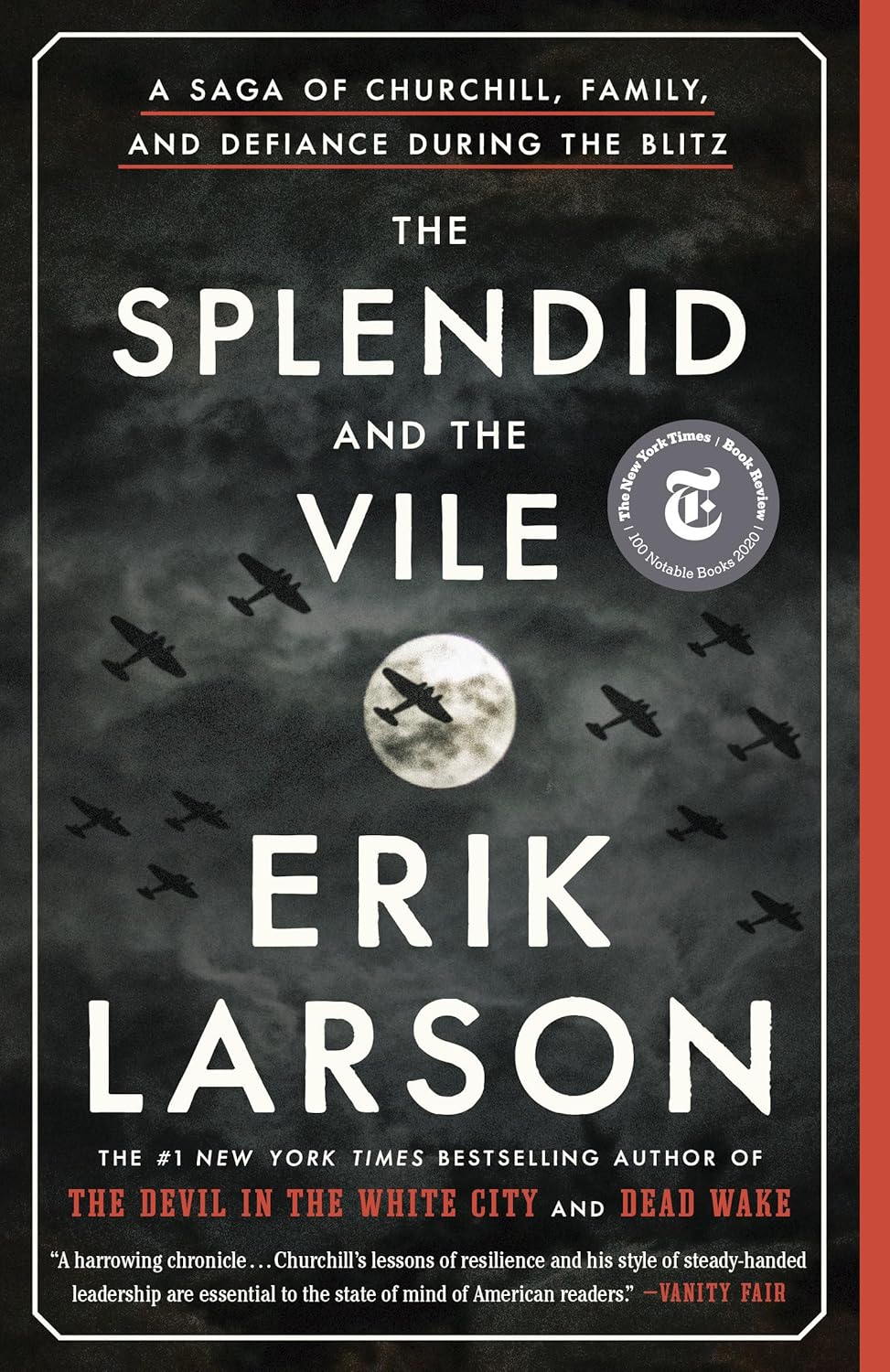
Erik Larson has a rare talent for making popular history read like gripping historical fiction. His trademark approach – finding lesser-known figures like serial killer Dr. H.H. Holmes or American diplomat Martha Dodd and placing them amid moments of great historical consequence – has yielded some of the most compelling nonfiction narratives of the past two decades. In “The Devil in the White City” (2003), Holmes stalks victims during the 1893 Chicago World’s Fair; in “In the Garden of Beasts” (2011), Dodd navigates a web of Nazi, Bolshevik, and Pulitzer Prize–winning lovers in 1930s Berlin. In “The Splendid and the Vile: A Saga of Churchill, Family, and Defiance During the Blitz” (2020), Larson turns to perhaps his most inherently dramatic setting yet: the Battle of Britain and the London Blitz between May 1940 and May 1941. Yet the private dramas he uncovers – while still salacious at times, such as Churchill’s daughter-in-law, 21-year-old Pamela’s affair with 49-year-old American envoy Averell Harriman – are often more ordinary than outrageous. This contrast between epic backdrop and intimate, sometimes mundane, personal stories is part of what gives the book its subtle power.
“The Splendid and the Vile” chronicles Winston Churchill’s first year as prime minister – a period in which, as Erik Larson puts it, “Churchill became Churchill.” Before May 1940, Churchill was known as a brilliant orator, but also as flamboyant, unpredictable, and a heavy drinker. (He once quipped, “I’ve taken more out of alcohol than alcohol has taken out of me.”) His rise to power at such a perilous moment made both King George VI and President Roosevelt uneasy, wary of entrusting Britain’s fate to such a volatile figure.
During the First World War, German dirigibles dropped 162 tons of explosives on Great Britain, killing 557 people. By contrast, between 1940 and 1941, nearly 45,000 civilians were killed and another 52,000 seriously wounded. On the night of May 10, 1941 alone, a Luftwaffe raid killed 1,436 Londoners (for reference, the most deadly year for Americans in Afghanistan was 2010, when 498 servicemen were killed). At the time, the RAF had no effective means of intercepting enemy aircraft after dark, and anti-aircraft fire was notoriously inaccurate – one estimate suggested it took 6,000 rounds to bring down a single plane. Still, the British maintained a high rate of fire, believing it boosted civilian morale. Despite the odds, the Luftwaffe suffered devastating losses during the Battle of Britain and the Blitz, with as many as 3,000 aircraft and 4,000 crew lost. At the war’s outset, it was widely believed that the Luftwaffe outnumbered the RAF by at least four to one; in reality, the advantage was closer to four to three – though the British almost knew as little about their own air order of battle as they did the Luftwaffe’s. One of the more astounding (and darkly amusing) anecdotes in “The Splendid and the Vile” is that the Air Ministry couldn’t account for 3,500 of the 8,500 aircraft supposedly ready for service. Churchill himself called the discrepancy “glaring.”
Just as the Germany Army revolutionized combined arms warfare that conquered France in six weeks in 1940, Goring’s Luftwaffe revolutionized airpower doctrine. First, German bombers were guided by converging radio beams, a new technology the Germans called “knickebein.” A vanguard unit of fire-starter bombers known as KGr 100 (the Pathfinders) would follow the radio beacon to the intended target where they would drop incendiary devices to ignite a conflagration around the target below; the resulting fire would then guide the heavy bombers behind them. The Messerschmitt Me 109 fighter plane could offer escort protection, but their fuel capacity only gave them about 90 minutes of flight time. At night the RAF was virtually powerless to intercept the bombers.
On August 13, 1940, Goring launched Adlertag (Eagle Day), a shock-and-awe campaign that Larson says intended to blacken the sky with aircraft “in a display of aerial might that would stun the world.” Twenty-three hundred aircraft were assembled to take part. Hitler ordered the construction of grandstands on the Pariser Platz in central Berlin to prepare for a forthcoming victory parade that would mark the end of the European war. Poor weather and the effectiveness of British radar and fighter control systems largely thwarted the attack. For the first several months of the air campaign Hitler ordered Luftwaffer chief Hermann Goring to avoid hitting London. The Fuhrer genuinely believed that the war was virtually over and had no desire to destroy the British Empire or permanently alienate the British people. The first bombs to land on London did so in error on August 24, 1940, roughly three months after the air campaign began; the German bombing crews had intended to hit an oil depot east of London and got off track. Churchill responded immediately by ordering the bombing of Berlin. The campaign had unintentionally entered a new, deadly, and terrifying phase.
On the night of November 14–15, 1940, the Luftwaffe launched Operation Moonlight Sonata against Coventry, the primary manufacturing hub for RAF aircraft. More than 500 bombers dropped over 500 tons of high-explosive and incendiary ordnance during an eleven-hour assault, killing more than 500 civilians and devastating the city. The raid set a grim new standard for the destructive power of massed aerial bombardment. In its aftermath, the RAF began measuring the impact of its own bombing raids over Germany in terms of “Coventries.”
The unlikely hero of Larson’s narrative is Canadian-born Max Aitken – better known as Lord Beaverbrook and derisively nicknamed “the Toad” – “a man who drew controversy the way steeples draw lightning,” according to the author. American military attache, General Raymond Lee, referred to Beaverbrook as “a violent, passionate, malicious, and dangerous little goblin.” On his very first day in office, Churchill established the new Ministry of Aircraft Production and, in a bold and unconventional move, appointed Beaverbrook to lead it. Though he had amassed his fortune in newspapers and had no background in aviation or industrial manufacturing, Churchill entrusted him with one of Britain’s most critical wartime responsibilities.
Perhaps even more surprising than his appointment was how remarkably successful Lord Beaverbrook was at accelerating the production of Spitfires and Hurricanes. Just one month into the job, he reported that aircraft were rolling out of factories at a rate of 363 per week – up from 245 – a nearly 50 percent increase in a matter of weeks. One of the book’s biggest frustrations is that Larson never fully explains how Beaverbrook achieved such extraordinary results, which consistently confounded German intelligence. The Luftwaffe believed the RAF was only days away from depleting its aircraft reserves, unaware of the scale of British production. Over the twelve months between May 1940 and May 1941, the famously combative and fiercely independent Beaverbrook – who once called himself “the cat that walks alone” – tendered his resignation fourteen times.
The Battle of Britain became a potent symbol in Churchill’s persistent effort to secure American support. As Britain fought for its survival, Churchill implored President Roosevelt for material aid to sustain the war effort. At the same time, Germany was determined to knock Britain out of the conflict, hoping this would discourage U.S. involvement and allow the Wehrmacht to focus on a single-front war against the Soviet Union. Anglo-American relations were strained in part by Joseph Kennedy, the U.S. ambassador to the United Kingdom from October 1938 until his recall in October 1940, whose defeatist outlook clashed with British resilience. To better assess Churchill and Britain’s prospects, Roosevelt sent two trusted envoys—Harry Hopkins (January to March 1941) and Averell Harriman (early 1941 to 1943). Roosevelt first floated the idea of the Lend-Lease program during a press conference in December 1940. The legislation passed the House (260–165) on February 8, 1941, the Senate (60–31) on March 8, and was signed into law by Roosevelt three days later, on March 11.
In “The Splendid and the Vile,” Erik Larson reveals how, even amid the chaos of nightly aerial bombardments, life in wartime Britain carried on with surprising normalcy. Much of the book reads like historical fiction, rich with love affairs, petty rivalries, and illicit entanglements playing out against the backdrop of the Blitz. Churchill’s loyal aide, Jack Colville, devoted much of his 1940–1941 diary to chronicling his melancholy pursuit of various high-society debutantes. Meanwhile, Churchill’s wife, Clementine, and his daughter-in-law, Pamela, grappled with the emotional toll of Randolph Churchill’s destructive addictions to alcohol and gambling. At the same time, Churchill’s 18-year-old daughter, Mary, found herself the object of affection from Eric Duncannon, a disreputable British playboy whom no one in the family could quite tolerate.
Meanwhile, Churchill was not above maneuvering within his own cabinet when it suited his purposes. When the British ambassador to the United States, Lord Lothian, died unexpectedly in December 1940, Churchill seized the opportunity to sideline his chief rival for the premiership, the sitting Foreign Secretary, Lord Halifax. Churchill dispatched Halifax to Washington as the new ambassador – a clear demotion masked as a critically important diplomatic appointment. Halifax accepted the reassignment with characteristic grace, and Anthony Eden was appointed to succeed him as Foreign Secretary.
As the Luftwaffe’s campaign against Britain dragged on and the bombing focus shifted from rural factories to densely populated urban centers – especially London – the civilian population grew increasingly weary. Fear of bombs gradually gave way to the nightly hardships of blackouts and the cumulative toll of sleep deprivation. Yet remarkably, public morale remained high. Larson credits Churchill with this improbable resilience, noting the prime minister’s “rare ability to deliver dire news and yet leave his audience feeling encouraged and uplifted.” After the evacuation of nearly 340,000 troops from Dunkirk and as the Battle of Britain began in earnest, Churchill famously observed, “It would be foolish to disguise the gravity of the hour. It would be still more foolish to lose heart and courage.” Such resilience was sorely needed. In the span of a year, Britain had endured a string of demoralizing setbacks – from Norway (April 1940) to Dunkirk (June 1940), Dakar (September 1940), and Greece (April 1941). The bleak pattern prompted Under-Secretary of State for Foreign Affairs Alexander Cadogan to quip in his diary that evacuations were “all we’re really good at.”
A year after becoming prime minister, Churchill faced mounting doubts from some senior members of the British government, led by former Prime Minister David Lloyd George, about his ability to lead the country to victory. Wounded by the criticism, Churchill nonetheless welcomed a scheduled House of Commons debate on the conduct of the war, effectively inviting an implicit vote of confidence in his leadership. He was resoundingly vindicated on May 7, 1941 when the members voted 447 to 3 in his favor.
A few days later one of the most surreal episodes of the entire war occurred on the night of May 10th – the deadliest night of the Blitz for Londoners. Rudolf Hess, Adolf Hitler’s longtime deputy and one of the highest-ranking officials in Nazi Germany, secretly flew solo from Germany to Scotland in a Messerschmitt Bf 110. He parachuted just south of Glasgow on a self-appointed peace mission, hoping to broker a treaty between Britain and Germany. (Instead, he was arrested, declared mentally unstable, tried at Nuremberg, and imprisoned at Spandau Prison in Berlin, where he remained until his death in 1987.)
In closing, Churchill’s first year as prime minister may well have been his finest. Confronted by military disasters abroad and relentless bombing at home, with the RAF often powerless to stop the devastation, Churchill nevertheless held the nation together through the force of his words, will, and unshakable belief in ultimate victory. He didn’t just lead – he inspired. “Somehow, through it all,” Larson writes, “Churchill had managed to teach [the British people] the art of being fearless.” In “The Splendid and the Vile,” Larson captures this remarkable transformation with the narrative power of a novelist, reminding us that leadership in the darkest hours is not about certainty or strategy alone, but about giving people the courage to endure.
 What's Tim Reading Now?
Leave a comment