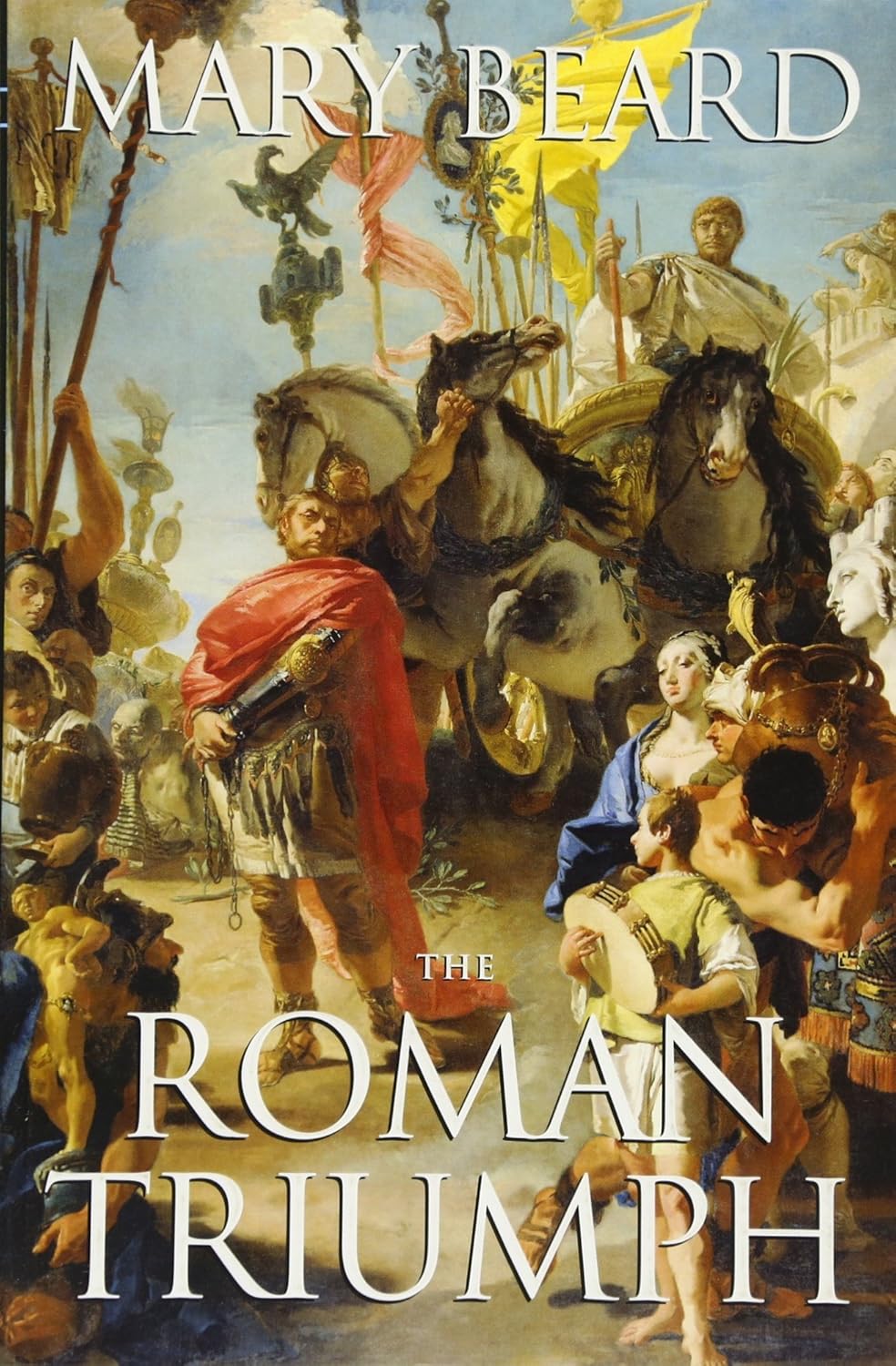
The triumph is perhaps the best known – and misunderstood – event in ancient Roman history. There were relatively lots of them, perhaps over three hundred distinct triumphs in the millennium between the founding of the city in 753 BC and the collapse of the Empire in 476 AD, although in some periods, such as the mid-Republic, triumphs were held nearly every year for years on end, while in others, such as the forty years between Trajan’s posthumous triumph of 118 and Marcus Aurelius’s’ triumph over the Parthians in 166, there were none. Distinguished British ancient historian Mary Beard seeks to unravel the mystery of the Roman triumph to better understand its roots, its cultural significance, and its details. In so doing she shows that much of what we think we know about the triumph is either poorly documented, pure conjecture or outright fabrication.
During the Republican period a triumph was arguably the greatest civic achievement a Roman citizen could hope for. The only thing greater than a triumph was multiple triumphs. Julius Caesar presided over a record five triumphs. Camillus, the semi-legendary statesman and general of the early fourth century, is said to have celebrated four, including his extravagant triumph in 396 BC over the Etruscan city of Veii that set the standard for centuries. Octavian famously celebrated three separate triumphs (Dalmatia, Actium, and Egypt) in one year, 29 BC. Pompey the Great led three triumphs, the first of which he achieved before the age of 25 (Plutarch wrote “He got a triumph before he grew a beard) and the last, over King Mithridates in 61 BC, which was said by many to be the most spectacular triumph in history. According to Pliny, Pompey subjugated over 1,500 towns and killed or captured over twelve million men. He returned home from Asia with over 75 million drachmae in silver coins, more than the annual tax revenue of the entire Roman empire, and ultimately paid into the Roman treasury over 50 million denarii. “The triumph was about display and success,” Beard writes, “the success of display no less than the display of success.”
In many ways, triumphs brought the glory and conquest of the Roman legions home to the Roman people in a tangible way. Battles were literally re-enacted. The biggest and most fearsome of the enemy POWs were paraded in chains before the gawking multitude. Sometimes the triumph showcased the meritocratic nature of the Roman system. On at least one occasion (when Publius Ventidius Bassus celebrated a triumph over the Parthians in 38 BC), a former prisoner in a triumph went on to gain Roman citizenship and lead a triumph over someone else.
When it comes to the Roman triumph, Beard emphasizes that there is much we can only speculate about, including some of the most basic questions, such as: Who was allowed to celebrate a triumph? After what kind of victory? Against what kind of enemy? The author says that the origins of the triumph are “objectively unknown.” She further notes that triumphs were requested by victorious generals and not proactively bestowed by the senate on behalf of a grateful nation. Rome’s elite thus often went out “triumph hunting” (cupiditas triumphi in Latin). Securing a triumph usually required a lot of cajoling by the conquering commander, and even then he may come up short. Just consider Cicero, one of the most celebrated statesmen of the Republican period, who wrote six hundred individual letters to senators requesting a triumph in 50 BC, only to settle for a less prestigious supplicatio (roughly 20% of supplicationes were eventually followed by a triumph, but not Cicero’s)..
The one thing we do know with some certainty about the triumph is who was awarded a triumph and when. One of the most historically important artifacts ever discovered in the ruins of ancient Rome is the Fasti Triumphales. It includes the names of each general awarded a triumph from the founding of Rome in 753 BC to the triumph of Lucius Cornelius Balbus in 19 BC. After Balbus, only emperors or their immediate family were allowed to celebrate triumphs. No longer would a triumph be the ultimate brass ring for the Roman elite to strive for. The last recorded triumph occurred in 534 AD when Belisarius defeated the Vandals in Africa.
Beard emphasizes that even the most familiar features of a Roman triumph – for instance, the conquering Roman general with his face painted red, riding in a horse drawn chariot, with a slave standing behind him, holding a crown over his head and whispering in his ear, “Look behind you. Remember you are a man” while the crowd chanted “Io triumpe!” – are at best directionally accurate observations recorded by often unreliable, second-hand historians writing many decades after the fact. Everything we know about the triumph is actually stitched together from multiple sources, she warns, such as the works of Pliny, Juvenal, Dio, Josephus, Tertullian, Jerome, and Philostratus. For instance, the claim that at least 5,000 enemy soldiers had to be killed in a single battle in order to qualify for a triumph is only attested to in one source (Valerius Maximus). In short, “No ancient writer presents the whole picture,” the author reminds us. “Precedents could be remembered or forgotten,” she says, “rules defended, adjusted or discarded, and political partisanship dressed up as principle.” Yet, contemporary writers often describe the triumph using mostly “conjecture, wild extrapolation, and over-confidence,” she says, the result being “a brilliant series of deductions, a perilous house of cards, or a tissue of (at best) half-truths and (at worst) outright misrepresentations and misreadings.”
Beard reminds us that potentially misleading depictions of triumphs don’t just come exclusively from Hollywood, but also the world of art and architecture, from the triumphal frieze of the Arch of Trajan (115) to Andrea Mantegna’s nine-canvas “Triumphs of Caesar” (1492) and Karl von Piloty’s “Thusnelda in the Triumph Procession of Germanicus” (1873).
In the end, Beard concludes that the entire triumph business is complicated and poorly understood. “The fact is that the Roman triumph, like all rituals, was a porous set of practices and ideas, embedded in the day-to-day political, social, and cultural world of Rome, with innumerable links and associations, both personal and institutional, to other ceremonies, customs, events, and traditions.” There is much we don’t know and likely never will know. Unfortunately, the lack of a reliable historical record makes “The Roman Triumph” an unsatisfying read.
 What's Tim Reading Now?
Leave a comment