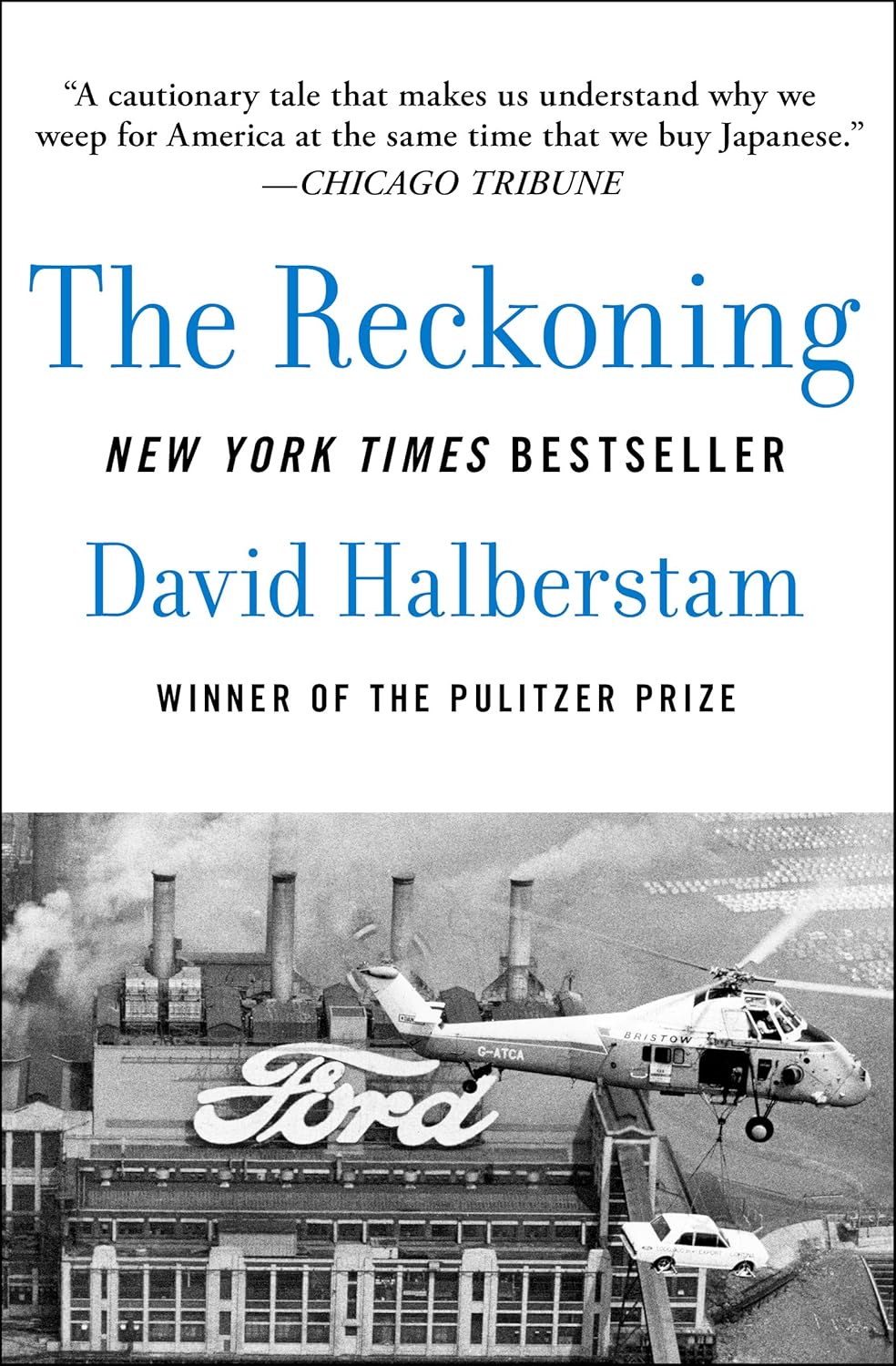
David Halberstam’s “The Reckoning” first came out in 1986. That summer my middle school friends and I went to see the movie “Gung Ho,” starring Michael Keaton. It was a comedy about a failing auto plant in Detroit taken over by an upstart and hyper efficient Japanese automaker. Perhaps the only memorable thing about the film is that it successfully captured the nation’s collective angst about being overtaken by the Japanese. From the perspective of 2023, fear of the Japanese seems almost risible, but I can tell you from personal experience that the national anxiety was palpable in the 1980s.
America was panicking about much more than just cars. Defeat in the global auto industry was about more than that. According to Halberstam: “It might mean not only that the Japanese made better autos, that they had newer plants, that the relationship between workers and managers was better, but that Japanese society, with its greater harmony, its greater belief and discipline in basic education, its more limited personal freedoms, was better prepared for the coming century. That was the real crisis, the grimmer one that hung over America.”
The title of the book refers to the long term consequences of American post war economic policy in Japan. General Douglas MacArthur and his team forced upon the Japanese in 1945, virtually at bayonet point, a liberal democratic market economy. Moreover, they put a blanket prohibition on industries with warmaking potential, such as aviation, which then funneled the brightest young engineers into the handful of industrial enterprises that remained, namely steel and automotive. Thus, American foreign policy essentially created the Japanese auto industry – and forty years later there would be “reckoning.”
Halberstam is a gifted narrative historian and he tells the tale of Japanese-American national competition brilliantly through the stories of two leading automakers: Ford and Nissan. At first I was puzzled why the author didn’t choose the two leading companies – GM and Toyota – but in hindsight I think it was because the main actors at Ford and Nissan were such colorful characters.
The Ford Motor Company was founded in 1903. From the start, it was “a highly political place, filled with cliques and feuds and constant infighting.” The company had less than 10% market share when the Model T was introduced in 1908. It sold for $950 ($32,000 in 2023 dollars) when most other cars sold for $1,500 ($50,000) or more. It was a sensation. By 1921, Ford’s market share had exceeded 60%. The Model T remained in production, virtually unchanged, for 19 years. Over 15 million were produced. Henry Ford and his team put all of their energy on one thing: efficiency. They would pass most of the savings on to the consumer. By 1927, the last year of production, the price of a new Model T had dropped to just $300 ($5,000), a 65% decrease. “The world had never seen anything remotely like it,” Halberstam says. Yet, Ford fundamentally misunderstood the very industry he had created. To him, an automobile was just a consumer utility, like a refrigerator, something you bought based solely on some combination of price and reliability, to perform a basic household task. It would be the men at General Motors, led by Alfred Sloan, who recognized the love affair Americans would have with their cars.
Henry Ford’s grandson, Henry Ford II (aka “Hank the Deuce”), took over the company in 1945 at the tender age of 28. Halberstam says he was a man “both spoiled and hard” who “turned out to be a shrewd, industrious executive capable of the coldest scrutiny of those around him.” His stony and unsparing calculation was desperately needed as the company he inherited was a total mess. “Henry Ford had outlived his era and usefulness,” Halberstam says, “probably no major industrial company in America’s history was run so poorly for so long.” The company was losing $10 million a month ($170 million in 2023) and market share had dropped to just over 20%.
The original Henry Ford’s disdain for bankers and accountants had caught up to him. His company’s financials were in utter disarray. His grandson would pivot hard in the other direction. In 1946, Ford hired a group of Army Air Force veterans who had worked in an advanced logistical and organizational group known as Statistical Control. History would remember them as “The Whiz Kids.” Led by Charles “Tex” Thornton, many of the original Whiz Kids would go on to play important leadership roles at the Ford Motor Company. Robert McNamara would become president before being named secretary of defense. Arjay Miller would become president in the 1960s before eventually becoming dean of the Stanford Business School. Several other Whiz Kids rose to be general managers of Ford divisions. J. Edward Lundy was perhaps the most influential Whiz Kid of them all. He rose to CFO and would remain a dominant figure within Ford Motor Company till his retirement in 1982. He embodied the cold statistical regime he had helped to create and implement. “[Lundy] was a decent man,” Halberstam writes, “but the system he created was not.” The Whiz Kids turned Ford into the most closely statistically managed company in the automobile industry, if not the world. However, as Halberstam notes, the Whiz Kids, almost to a man, lacked any innate sense for product or design, and most of them had little personal interest in their own chosen industry. The problem with Ford, many critics argued, was “too much information, too many options, too little feeling about the cars.”
Yet, these men and their system and their acolytes retained an iron grip on the company till the 1970s. As a result, for a quarter century Ford cars remained remarkably the same. “The impulse of product,” Halberstam writes, “to make the best and most modern cars possible, was giving way to the impulse of profit, to maximize the margins and drive both the profit and the stock up.” The finance men ran the company; manufacturing became a backwater.
Meanwhile, a titanic leadership battle was brewing at Ford between the dissolute and imperious Henry Ford II and the flamboyant upstart Lee Iaccoca. Reminiscent of the first century power struggle between Roman Emperor Tiberius and Praetorian Prefect Sejanus, it would end in somewhat similar fashion. The self-made son of Italian immigrants from Allentown, Pennsylvania, the swashbuckling Iaccoca could not have been more different from his boss. Iaccoca was president of Ford Motor Company from 1970 to 1978. Halberstam devotes hundreds of pages to chronicling the toxic relationship between president and chairman, a colossal struggle between merit and privilege. When Iaccoca was finally fired, he confronted Ford seeking an explanation. The chairman is said to have responded simply, “I don’t like you.” Iaccoca would soon get his revenge, publishing a best selling memoir in 1984 that excoriated his former boss.
By 1980, Ford Motor Company was at rock bottom, “a sterile company living smugly off its past,” Halberstam says, and losing $1 billion a year. The new president was Phil Caldwell, described by Halberstam as “a careful,relentless, and thorough man.” He became the first non-family member to run the company when Henry Ford II stepped down as chairman. Caldwell had a lot on his plate. The oil shocks precipitated first by the Yom Kippur war in 1973 and then the fall of the Shah of Iran in 1979 sent gas prices skyrocketing. The price of a barrel of oil, which had remained relatively steady at $2 per barrel from 1948 to 1971, quadrupled in two months in 1979. Americans could no longer afford the big, boxy, rear-wheel drive, 13-mile a gallon, gas guzzlers that were so profitable to make. Ford had to start making smaller, more fuel efficient front-wheel drive cars that were every bit as complicated to make as large cars, only with much smaller profit margins. Top Ford brass hated it: “small cars mean small profits,” they said. Moreover, a series of generous concessions to the United Auto Workers had inflated auto labor costs 60% higher than the American industrial worker average and several times greater than the average foreign auto wage. Despite the higher wages, Detroit consistently put out an inferior product at a higher price. Direct feedback from Hertz showed that their Ford fleet broke down at nearly twice the rate of their Toyota fleet.
American automakers, once so arrogant, were begging for help. The Japanese had brought the Big Three to their knees. It was estimated that the Japanese could build a far more reliable car for $1,000 less per vehicle (about 10%) than Detroit. In 1982, Japan voluntarily agreed to limit exports to 1.7 million cars in order to avoid the implementation of an American tariff. How the mighty had fallen. Caldwell would lead a resurrection of sorts with the Taurus program that would go on to become one of the biggest successes in automotive history.
The story of Nissan is just as interesting as Ford’s, and it helps illustrate how the Japanese came to dominate the global automotive industry. Believe it or not, Nissan was essentially founded by an American named William Gorham. He came to Japan in 1918 to design airplanes. By 1933, he had designed his first production automobile, the Datsun. He became a Japanese citizen (but never learned to speak Japanese), took a Japanese name (Katsundo Goahamu), and even elected to stay in Japan during the Second World War. American authorities decided not to charge him with treason. He died in Tokyo in 1949.
According to Halberstam, the Japanese thought about automobiles very differently than Americans. “Americans liked styled, hot-looking cars, while for the Japanese, to whom transportation was an end in itself, something more functional, a simple piece of machinery, was adequate.” Consequently, Americans built cars meant to be replaced in three or four years. Japanese cars, on the other hand, were meant to last. In 1945, Datsun/Nissan was a tiny producer of underpowered, but durable pickup trucks. Japan’s powerful Ministry of International Trade and Industry (MITI) put heavy emphasis on building out the automotive industry because others were off limits. “Japan’s only resource was its people,” Halberstam writes, “dutiful, obedient, disciplined, educated, eager to restore their nation to greatness.” All they lacked was confidence. Katsuji Kawamata, a forty-two year old executive from the Industrial Bank of Japan with no experience in automobiles or even industrial manufacturing was put in charge.
In 1953, a critical event took place that arguably set the stage for Japan’s long run triumph in the automotive industry. The far-left, possibly proto-communist, Japanese automotive labor union was defeated in a nasty strike at Nissan. In its place, a far more accommodating company union took its place. Thus, Japanese automakers never had to deal with something like the massive and unified United Auto Workers, an organization capable of flexing its muscle to extract generous concessions for its hundreds of thousands of members. Instead, each Japanese automaker had its own in-house union to represent its workers. Halberstam says that company union leadership were, for all intents and purposes, part of management. Eventually, the combination of favorable labor costs and a highly manipulated currency exchange rate favoring the yen put American automakers in an untenable position.
Detroit never took Japanese automakers seriously. By the late 1950s, the Golden Age of the American automotive industry, Japanese automakers were still puny by comparison. For example, in 1959, Ford produced about one million cars; Nissan produced just 33,000. But times were changing – and fast. Five years later Nissan’s numbers jumped to 213,000. “The Japanese were accomplishing in a period of ten or fifteen years something that earlier in the century had taken the United States forty or fifty,” Halberstam writes. The Japanese weren’t just suddenly building lots of cars – they were building lots of high quality, low maintenance cars. Japanese automakers had become fanatical adherents to the principles of American quality management guru W. Edwards Deming, who preached a culture of quality and continuous improvement. Nissan would win the coveted Deming Prize in 1960.
Halberstam describes the domestic Japanese automotive market as brutally Darwinian. Those that survived to become automobile exporters were incredibly lean and efficient and ready for combat. Nissan, then under the brand name Datsun, entered the American market in 1958 with the Datsun 1000 Sedan. It sold only 146 units in three years. From such tiny acorns did a mighty oak grow. The effort was led by Yutaka Katayama, a longtime and innovative Nissan executive who was eventually more at home in Los Angeles than he was in Tokyo. Perhaps more than any one man, Katayama was responsible for the successful Japanese auto invasion of America. While he was making $25,000 a year, Lee Iaccoca was making $750,000.
“It had always been a part of the basic theology of Detroit that it could roll back the foreigners anytime it wanted,” Halberstam writes. Imports reached 5% in 1959 and then 10% in 1968. Volkswagen commanded 63% of the import market at that time, but they didn’t represent the true threat. In that year the VW Bug sold 420,000 units in the United States; NIssan sold just 22,000. Nissan introduced the Datsun 510 and sold 100,000 cars, vaulting Nissan from sixth to third on the list of auto importers and pushing Japan past West Germany at the leading importer of automobiles to the United States.
In America, dealers played a central role in promoting their cars. American automakers typically offered their dealers 12% of gross profits; Katayama offered his Nissan dealers 20%. This would have an enormous impact when the size and prices of automobiles shrank dramatically after the oil shocks.
Despite Japan’s Confucian tradition that stressed obedience, respect for authority, and unity of purpose, Halberstam says that Nissan became every bit as much of a political viper pit as Ford. Strong personalities, like union boss Ichiro Shioji, flexed and often flaunted their power in conspicuous ways, both inside the company and outside, where tabloid magazines frequently photographed them on their yachts cavorting with young women in bikinis. It was all very immodest, very un-Japanese.
American automakers ultimately survived the Japanese onslaught, but it was a near run thing. They had inexcusably been caught flat-footed. “America had taken a temporary historical accident and construed it as a permanent condition,” Halberstam says. Many of the handicaps they labored under, especially grossly inflated labor costs, were entirely self-made. We no longer fear the Japanese the way we once did, but they still make incredibly successful automobiles. As of 2022, the US car market is divided like this: American 47%; Japanese 34%; Korean 10%; German 6%; Other 3%.
 What's Tim Reading Now?
Leave a comment