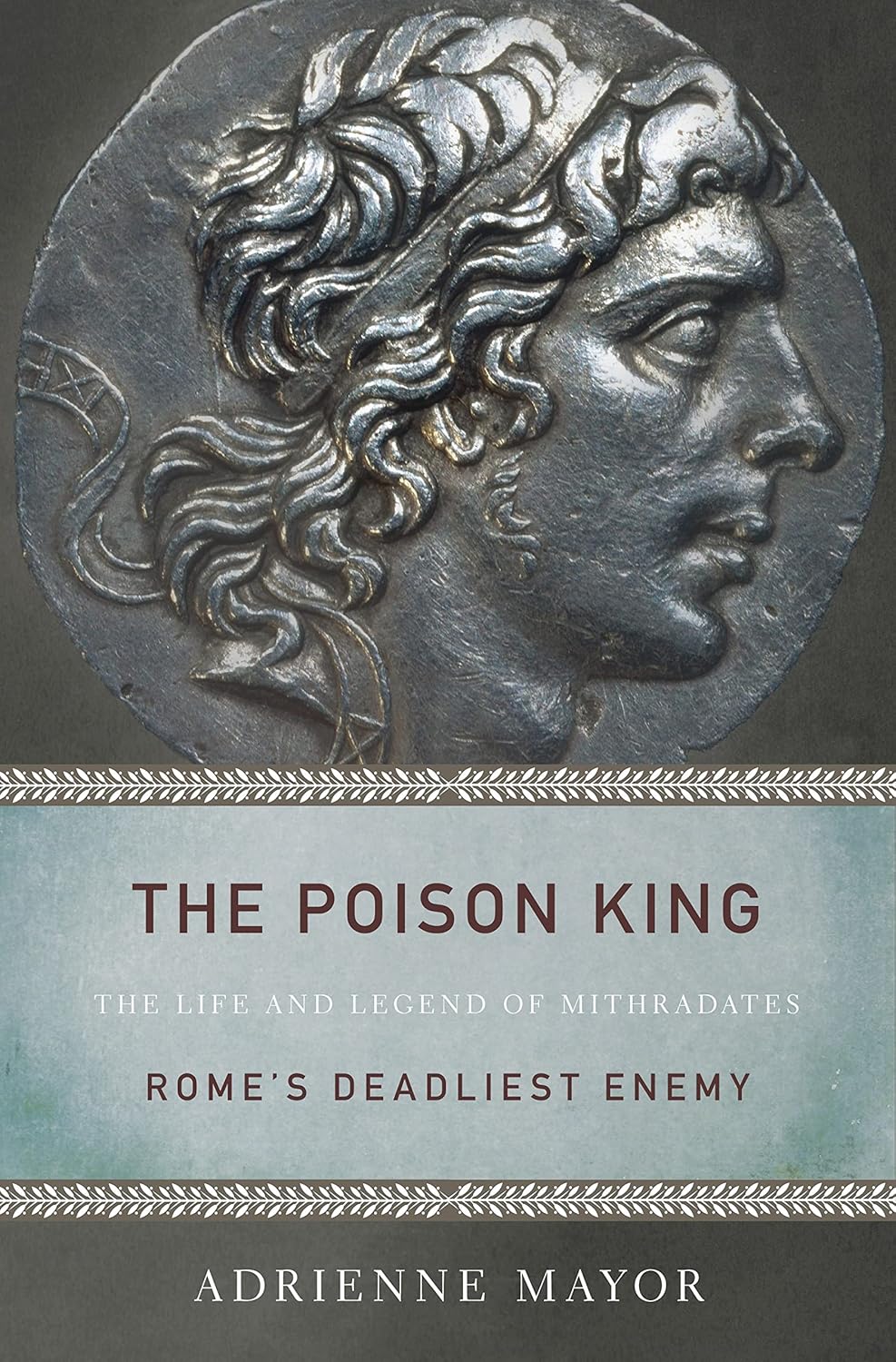
Only a handful of enemy generals gave the Roman legions fits over multiple campaign seasons: Hannibal Barca (d. 183 BC), Vercingetorix (d. 46 BC), and Mithridates IV of Pontus (d. 63 BC). Mithridates is the least well known of this triumvirate today, but he resisted Rome the longest, almost thirty years, challenging imperial authority in a series of so-called Mithridatic Wars. Adrienne Mayor, research scholar in classics at Stanford University, brings the life and times of this legendary general to a modern audience in “The Poison King: The Life and Legend of Mithridates, Rome’s Deadliest Enemy” (2010).
Nearly fifty ancient texts provide context and details to Mithridates’s life, but virtually all of them are Roman sources, most notably Appian, Cassius Dio, and Plutarch’s Lives of Sulla, Lucullus, and Pompey. Nowhere do we get Mithridates’s side of the story. He was born in 135 BC in Sinope, the capital city of Pontus on the southern shores of the Black Sea. A magnificent comet appeared in the sky in the year of his birth. It was interpreted as an omen, a sign of hope. Mayor writes that Mithridates receives a perfect score of 23 on the mythic hero index (by comparison Buddha, Joan of Arc, and Robin Hood score 13 to 16; even Jesus and Mohammed score under 20). And he certainly was impressive. Mithridates was eventually one of the richest men in history (richer than Kings Midas and Croesus combined, according to the author), spoke a dozen languages fluently (a book in several languages is still called a “mithridates”), and was virtually impervious to poison thanks to a daily regimen of microdosing arsenic and other highly toxic substances.
Mithridates claimed to be descended from Cyrus and Darius, and would vigorously pursue Alexander’s vision of Greco-Persian cultural fusion. Unlike his father, Mithridates would not be an official Friend of Rome. He became king in 119 BC when he was just fourteen years old. His mother, Queen Laodice, served as regent; it was said she favored Mithridates’s younger brother for the throne. The adolescent Mithridates fled Sinope and spent five years roaming Anatolia with his childhood friend, Dorylaus, a confidante and future lieutenant very much in the spirit of Alexander’s companion Hephaestion. Mithridates returned to his capital in 115 BC, overthrew his mother in a bloodless coup, and married his sister (he would soon execute her for adultery). He quickly tripled the size of his Kingdom of Pontus and began to carve out a foreign policy that marked his independence from the hated Rome, “a brash, uncivilized newcomer,” in Mithridates’s estimation, “dangerous and powerful, but with an impoverished cultural history.” The Romans believed that Anatolians were stupid and inferior, but their homeland was something of an El Dorado, overflowing with gold and natural resources, making Anatolia an ideal target for their unique brand of systematic enslavement and imperial exploitation.
In 133 BC, Rome inherited the territory of Phrygia in central Anatolia, bestowed by the dubious last will and testament of the Phrygian King Attalus. Mayor says that this quick and unanticipated expansion of Roman power deep into the heart of the Anatolian plateau was the proximate cause of the Mithridatic Wars. Mithridates believed that accommodation with Rome was impossible. The example of Jurgurtha in North Africa provided a clear illustration of what awaited even “friends of Rome” if they were too weak to resist Roman domination.
Mayor says that the young Mithridates possessed a bold vision for his Kingdom of Pontus and beyond. He planned to consolidate control over the Black Sea and the Anatolian peninsula. “The idea,” Mayor writes, “was to secure a co-prosperity trade zone and tax it fairly … Mithridates’s farsighted vision offered a positive alternative to Rome’s rapacious greed and violent resource extraction in its early period of conquest.” In short, instead of continual war and economic dislocation, Mithridates promised peace and prosperity.
Mayor stresses that Mithridates was inspired by Alexander the Great and sought to replicate his vision of a new and diverse Greco-Asian empire that was powerful enough to resist the encroachment and exploitation of the Roman legions. Debt was considered a morally deplorable condition in the Persian-dominated culture of Anatolia, which helps to explain why the Romans were so vehemently detested. “For a savior-prince predestined for mythic glory,” Mayor says, “there was only one honorable path” for the young Ponitc king to pursue and that was to confront Rome head-on.
Mithridates would face half-a-dozen Roman commanders before he was finally defeated. The first was Aquillus, who invaded Pontus with two legions without Senatorial approval in 89 BC. Appian claims Mithridates was waiting with 250,000 infantry and cavalry. He defeated the combined Roman and allied armies. Aquillus was captured and publicly executed by having molten gold poured down his throat, surely one of the most painfully symbolic ways to go. Mithridates next quickly consolidated his victory by relieving public and private debts, canceling loans owed to Roman creditors, and paused the collection of taxes for five years. The First Mithridatic War (89-85 BC) was an extraordinary success that capitalized on domestic political turmoil back in Rome. “In less than a year [Mithridates] had gone from a minor king of a rich little realm on the Black Sea to one of the most powerful rulers in the ancient world,” according to Mayor. He did so by a combination of military victory and savvy political leadership. Mayor claims that Mithridates “offered a real alternative to Rome’s oppressive administration.”
To consolidate his control over Anatolia, Mithridates orchestrated a coordinated assault against all of the Roman men, women, and children residing in the region. It is estimated that 80,000 civilians were massacred making it “the most horrendous and the most successful single act of terror in ancient history,” according to the author. She calls it “the Roman 9/11.” Another 20,000 Roman citizens were later killed on the Roman-controlled Greek island of Delos. The Romans would respond by deploying five legions and one of their most fearsome commanders: Lucius Cornelius Sulla.
Mithridates’s next objective was the liberation of Rhodes and Greece. He failed in his attempt to take the former, but succeeded in landing a 120,000 man occupying force in Greece. Athens joined the savior-king Mithridates and declared war on Rome. Sulla then laid siege to Athens, ultimately destroying the city in 86 BC and executing Aristion, the city’s last democratically elected leader. Next, Sulla’s vastly outnumbered army shredded the Mithridatic forces at Chaeronea, “one of the greatest battles in ancient history,” according to the author. “Sulla’s tactical skills and amazing personal power over his troops were factors in the spectacular upsets in Boeotia (Chaeronea and Orchomenus); his battle-hardened legions’ loyalty and courage constituted another.” Nevertheless, the crushing defeat in Greece would prove to be Mithridates’s Tet Offensive, according to Mayor – a disastrous major military campaign that nevertheless proved to be a major public relations victory. Meanwhile, back at Rome, Marius and Cinna were liquidating Sulla’s supporters.
Mithridates still possessed an army of 80,000 and was now back on home turf, but he was reeling in the face of the brutal efficiency and professionalism of Sulla’s legions. The King of Pontus took advantage of Sulla’s keen desire to get back to Rome, celebrate a triumph (Pliny the Elder says he displayed 115,000 pounds of silver and 15,000 pounds of gold), and settle domestic political scores. The Treaty of Dardanus was signed in 85 BC, which ended the First Mithridatic War and required Mithridates to pay a relatively modest war indemnity of two thousand talents and provide seventy fully equipped war ships, in exchange for a general amnesty and resetting territorial possessions to status quo ante bellum. Sulla would almost immediately violate the terms of the treaty and impose a staggering 20,000 talent fine on the inhabitants of the province in Asia for siding with Mithridates. Mayor says the money went directly into Sulla’s personal bank account.
The Second Mithridatic War (83-81 BC) between Sulla and Mithridates was a continuation of the first. Despite staggering battlefield defeats, Mithridates refused to let go of his dream of consolidating political, economic, and military control over the Black Sea, Anatolian plateau, and both side shores of the Aegean Sea. At this point, Rome was still open to accommodation with Mithridates if relinquished his expansionist dreams and instead retreated back into his Pontic homeland.
The third and final Mithridatic War (76-63 BC) began over the alliance between Mithridates and Sertorious, a Roman general and ally of Marius serving in Spain who became disillusioned with the greed and harshness of Roman imperial administration. “Without ever meeting,” Mayor says, “they had recognized their similar spirits and common interests.” (Sertorius would be murdered in 73 BC during a dinner party while fighting Pompey in Spain.) Mithridates raised another army, this time a monstrous 140,000 infantry, 16,000 cavalry, and 400 ships, according to Appian. Lucius Licinius Lucullus, a protege of Sulla, was elected co-consul in 74 BC and was sent to Anatolia with five legions (30,000 men) to defeat Mithridates once and for all. After the siege of Cyzicus in 72 BC, Lucullus’s army rolled up the Mithridatic forces even more decisively than Sulla did in Greece. Plutarch writes that although Mithridates escaped, 300,000 of his soldiers and camp followers were killed or captured. Lucullus prematurely (but understandably) declared victory.
Mithridates retreated across Anatolia and then into Armenia, where he allied himself with the powerful King Tigranes and his massive polyglot army, a quarter-million-man force that the author derisively labels a “ponderous juggernaut.” Lucullus pursued at the head of an increasingly exhausted and surly army. Mithridates eschewed direct engagement with the invincible legions and instead relied on an asymmetrical strategy of feints, ambushes, withdrawal, and delay. When the armies met head-to-head at Tigranocerta in 69 BC, Lucullus and his relatively tiny band of hardened legionnaires crushed Tigranes’s massive force in a “battle like no other,” according to the author. “Never had the Romans been so outnumbered,” she says, “and never had they won so decisively against overwhelming odds.”
It may have been a Pyrrhic victory as Lucullus’s exhausted army was on the verge of mutiny. They had had enough. In 67 BC the unbeaten Roman legions sat down and refused to get up. Mithridates came surging back phoenix-like and defeated the legions at Zela, killing 24 tribunes and 150 centurions in the process, the largest number of officers ever killed in an ancient battle, according to the author. Lucullus was recalled in 66 BC. He was allowed to celebrate a Triumph, which showcased sixty of Mithridates’s captured generals and advisors, and 2.5 million silver coins. Lucullus used his war profits to take up a life of luxury so extravagant that today “lucullan” means “extremely luxurious (especially of food).”
Mithridates’s final foe was Pompey the Great. Also a protege of Sulla, Pompey was ruthless and efficient. He pursued Mithridates across Anatolia and into Colchis in a deadly game of cat-and-mouse. Mithridates crossed the Caucasus Mountains (a feat more impressive than Hannibal’s crossing the Alps, according to the author) and continued running. In a fit of delusional grandeur he proposed marching his small band of warriors around the Black Sea, into present-day Eastern Europe, and then plunging down into Italy to attack Rome directly the way Hannibal did 150 years before. Finally, seeing the hopelessness of the situation, Mithridates attempted suicide by taking poison in his palace in Pantikapaion in 63 BC. His lifelong theriac made him invulnerable. He had to ask a bodyguard to slay him. For centuries many believed that he faked his death.
Mithridates had reigned for fifty-seven years. Cicero called him the greatest king since Alexander. Plutarch likened the death of Mithridates to the destruction of ten thousand enemies in a single blow. “It was his mastery of poisons and his long life that made Mithridates a household word in Western literature and popular culture,” Mayor writes. The universal poison antidote developed by Mithridates and used daily by every Roman emperor after Nero (64 AD) became the most popular and longest-lived prescription in history, available in Rome as recently as 1984. Dramas would be written about Mithridates (Racine in 1673, Scarlatti in 1707, Mozart in 1770), as would poems, including Ralph Waldo Emerson (“Mithridates” in 1847), John Greenleaf Whittier (“Mithridates at Chios” in 1864), and James Joyce (“Though I Thy Mithridates Were” in 1907).
 What's Tim Reading Now?
Leave a comment