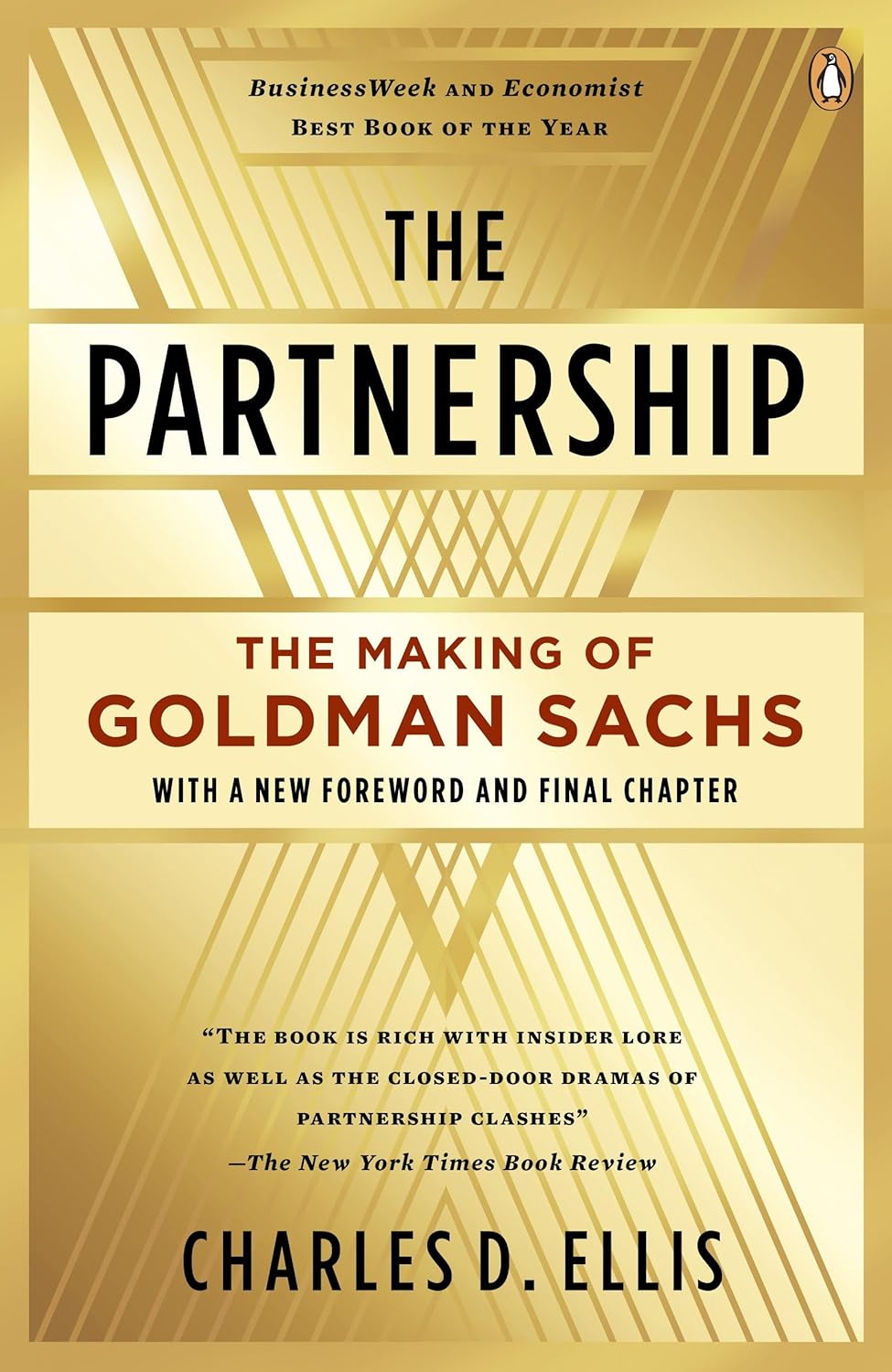
Today, Goldman Sachs sits unrivaled atop the world of international investment banking. That hasn’t always been the case. In fact, for much of the firm’s 150-year existence Goldman Sachs has been a relatively small and inconsequential second-tier player on Wall Street. So what happened? That is what I was hoping to find out when I picked up “The Partnership: The Making of Goldman Sachs” by longtime Wall Street insider Charles D. Ellis. At over 700 pages in length you’d think that the reasons behind Goldman Sachs’s unlikely triumph would be clearly explained, but you’d be wrong.
There are a few things prospective readers of “The Partnership” should know up front. First, the book reads like an official history of the firm. In a 2009 article for Rolling Stone, Matt Taibbi memorably referred to Goldman Sachs as “a great vampire squid wrapped around the face of humanity, relentlessly jamming its blood funnel into anything that smells like money.” “The Partnership” is definitely not the book for those that think like Mr. Taibbi or anyone else in the Occupy Wall Street crowd. Ellis doesn’t shy away from chronicling some of the firm’s major embarrassments over the years, such as the bankruptcy of Penn Central in 1970 or the firm’s entanglement with Long Term Capital Management in 1998, nor does he gloss over some of the bitter rivalries among its senior leadership, like Jon Corzine and Hank Paulson in the late 1990s, but the narrative nevertheless feels heavily airbrushed. It’s kind of like visiting a presidential library: it is an opportunity for that president to tell the story of his life and administration exactly the way he’d like it to be told. The end result isn’t necessarily wrong or misleading, but it is certainly heavily stilted.
Founded in 1869 by German immigrant Marcus Goldman, the firm had humble beginnings and for many decades a rather humble existence managing commercial paper offerings for mid-tier enterprises across the northeast. Goldman took on his son-in-law Samuel Sachs as a partner and for nearly half-a-century the firm remained a small, tightly controlled Jewish family business. Marcus’s son, Henry, was senior partner by the time of the First World War. For one reason or another, Henry was an outspoken teutonophile who stridently supported the Kaiser and vetoed the other partners’ decision to support the sale of Liberty Bonds. Soon the word on the street in New York and London was that Goldman Sachs was a “German bank” and the firm’s business and reputation suffered accordingly. Henry Goldman agreed to leave the firm to end the dispute but it was not an amicable separation. According to Ellis, the Goldman and Sachs families never spoke to each other ever again. (In an ironic twist of fate, Henry Goldman later retired to Germany only to have his possessions confiscated by the Nazis; he was barely able to escape back to the United States with his life).
The firm desperately needed a new and dynamic leader after the unpleasant departure of Henry Goldman. In what at first seemed to be something of a coup, Goldman Sachs brought on Waddill Catchings as a partner in 1918. Tall, handsome, and debonair, Catchings had graduated from Harvard and Harvard Law School before joining the blue chip law firm, Sullivan & Cromwell. He would lead the firm through much of the Roaring Twenties. Ellis describes Catchings approach to business as fast-paced to the point of recklessness. He developed and launched the Goldman Sachs Trading Corporation; a type of early hedge fund that took controlling interests in a variety of publicly traded companies. When the stock market crashed in 1929, the fund collapsed. Ellis writes that the Goldman Sachs Trading Corporation “became one of the largest, swiftest, and most complete investment disasters of the twentieth century…the harm done to the firm and its reputation was comparably horrific.”
Thus, Goldman Sachs entered the Depression years severely wounded and barely solvent. “Over the twenty years from 1927 to 1947,” Ellis writes, “Goldman Sachs made $7 million – and lost $14 million.” The firm would be led out of the wilderness by a man possessing one of the greatest rags-to-riches stories in American history: Sidney Weinberg.
Born the third of eleven children to a wholesale liquor dealer in Brooklyn, Sidney Weinberg dropped out of school in the seventh grade in 1907 and went looking for a job. He went to the fanciest looking building he could find in lower Manhattan and started knocking on doors. He went to the 43rd floor and began working his way down until he eventually made it to the third floor offices of Goldman Sachs. They hired him as an assistant to the janitor at $3/week. He would eventually be made partner in the 1920s and then led the firm as senior partner and chairman for 37 years. When he died in office in 1969, Weinberg had completely rebuilt the firm’s reputation into one of the most respected banks on Wall Street. During his illustrious career Weinberg sat on over 40 corporate boards, including Ford Motor Company (Goldman Sachs led Ford’s IPO in the 1950s, the largest ever public offering at the time), General Electric, and General Foods. He was, Ellis says, a man of deep integrity who personified the gentlemanly Wall Street investment banker that served his corporate clients loyally and discretely for decades. It must be noted that after nearly forty years at the helm of Goldman Sachs, Weinberg possessed a total net worth of just $5 million when he died (roughly $45 million in 2020 dollars). That’s about what current Goldman Sachs CEO David Solomon earned in 2021 alone.
Weinberg had rescued Goldman Sachs from the disasters of the Trading Corporation and the Great Depression, but the firm still remained second tier behind the likes of First Boston, Lehman Brothers, Dillon Reed, and Morgan Stanley, the unquestioned leader of the pack. These firms had long ago locked up nearly all of the Fortune 500 accounts, forcing Goldman Sachs to scurry for clients among the long tail of small and mid-sized corporations. Beginning in the 1970s, the firm would make moves that would position Goldman Sachs to enter the first rank of global investment banks and then eventually unseat Morgan Stanley for the overall leadership position.
It seems to me that Goldman Sachs emerged as the leading investment bank in the world some time over the course of the 1980s and 1990s. In reading Ellis’s highly detailed account, there’s no obvious explanation for how Goldman Sachs pulled off the seemingly impossible task of knocking Morgan Stanley from its century-long perch atop the investment banking world nor is there any discussion about precisely when that changing of the guard occurred. Rather, it appears to be the result of shrewd management innovations, decisive tactical decisions, and, perhaps most importantly, sustained, aggressive and highly competitive recruitment at the world’s leading business schools.
Ellis credits co-CEO John Whitehead with leading a fundamental restructuring of business operations that positioned Goldman Sachs for tremendous growth in the 1980s and beyond. The changes Whitehead implemented seem rather simple, even obvious, in retrospect, but evidently they were quite innovative, almost daring, at the time. In short, Goldman Sachs would be divided between frontline client relationship and business development professionals and back office experts dedicated to executing specific transactions. Sidney Weinberg himself perhaps best exemplified the traditional model of investment banking. The banker would cultivate a close relationship with a client and then personally advise him on a wide variety of financial transactions. “Ironically,” Ellis writes, “Sidney Weinberg had mastered the investment banking business that his protégé, John Whitehead, made obsolete.” The new model featured a client relationship team dedicated exclusively to cultivating new business and then handing off execution to teams dedicated to executing M&A or commercial paper transactions. Ellis writes that the new organization turned Goldman Sachs into a finely tuned financial services machine that easily outperformed the competition still relying on the old jack-of-all-financial-trades model.
Next, Goldman Sachs carved out a unique niche for itself amid the corporate raiding frenzy of the 1980s. The firm launched a new service called Tender Defense dedicated to helping small and mid-sized firms fend off hostile takeovers. Alone among the leading investment banks, Goldman Sachs publicly committed itself to non-participation in hostile takeovers, establishing itself as something off a white knight to corporate America. It was a classic case of turning a weakness into a strength. Because Goldman Sachs had virtually no clients among the Fortune 500 that were conducting the hostile takeovers, it was relatively easy to declare that they wouldn’t support the execution of any hostile takeovers. It was a position that the firm retained until 1997 when Hank Paulson broke with tradition and agreed to support German industrial conglomerate Krupp’s hostile takeover of Thyssen.
At the same time it was building tender defense it was also aggressively building out a highly sophisticated quantitative trading organization led by MIT’s Fischer Black, the co-creator of the Nobel Prize-winning Black-Scholes model for managing derivative financial instruments. Black was a prime example of the firm’s commitment to recruiting and retaining the most outstanding professionals in the world, which may, in the end, be the “silver bullet” I’m looking for to explain the firm’s triumph over its banking rivals.
Corporate America talks a lot about the importance of talent acquisition and human capital management, but in my experience corporations do an average job at best in executing on their words. They often assign the task of recruiting to an HR organization, which itself is made up of average talent, and leave it at that. A handful of elite professional services firms, like McKinsey & Company and Goldman Sachs, may be the exception. “Of all the firm’s competencies,” Ellis writes, “recruiting must be the most consequential.” Much like a major, successful college football program, recruiting at Goldman Sachs is everyone’s job, from the most senior partner to the most junior associate. The firm regularly sends its top leaders to personally interview and recruit at the world’s leading business schools. According to Goldman Sachs CEO and former treasury secretary Hank Paulson, “John Whitehead told me that the most important thing we did as senior management was recruiting.” For instance, according to Ellis, in one year in the late 1980s, one partner, Bob Menschel, personally interviewed over 900 candidates from 35 business schools and made only 23 offers. There is an old adage in business that “A’s hire A’s – and B’s hire C’s.” In other words, great talent attracts other great talent, but average talent hires poor talent. Exceptionally talented, hard working, and ambitious men and women want to be around people just like themselves. Some time toward the end of the twentieth century, Goldman Sachs evidently got this talent flywheel spinning and it has paid incredibly handsome dividends over the past few decades. Just as Nick Saban’s program at Alabama toppled the likes of Florida and Georgia by more effectively and consistently recruiting five star athletes, Goldman Sachs has done the same to Morgan Stanley and First Boston.
In closing, I enjoyed “The Partnership” and learned quite a bit, but I would have liked to learn even more. Ellis is an industry-insider and he writes as though he expects you are, too. For instance, he introduces things like “commercial paper” and “block trading” without ever really explaining what they are or how they work. I had to Google a lot of terms in “The Partnership” just to keep up with the narrative. Also, for some reason Ellis rarely comments on Goldman Sachs’s size over the years. How many partners did the firm have in 1930 versus 1970 versus 2000? He never really says. The same could be said for overall employees and annual revenue or profits. Clearly, the firm was growing like a rocket in the last decades of the twentieth century but he only provides piecemeal insight into the hard numbers behind that growth. For instance, at one point he notes that the firm had profits of only $50 million when John Whitehead and John Weinberg became co-senior partners in 1976 and that they mushroomed to $800 million by the time Weinberg retired in 1990, but the comparative referencing of such numbers by Ellis is rare. Finally, I would have loved for Ellis to provide his direct explanation as to how Goldman Sachs triumphed over Morgan Stanley. Yes, Goldman Sachs put a premium on recruiting and establishing a culture of teamwork, but surely Morgan Stanley thought they were doing the same thing the whole time. What was the fundamental difference? That’s admittedly a tough nut to crack, but I would have liked to hear Ellis’s thoughts on the matter.
 What's Tim Reading Now?
Leave a comment