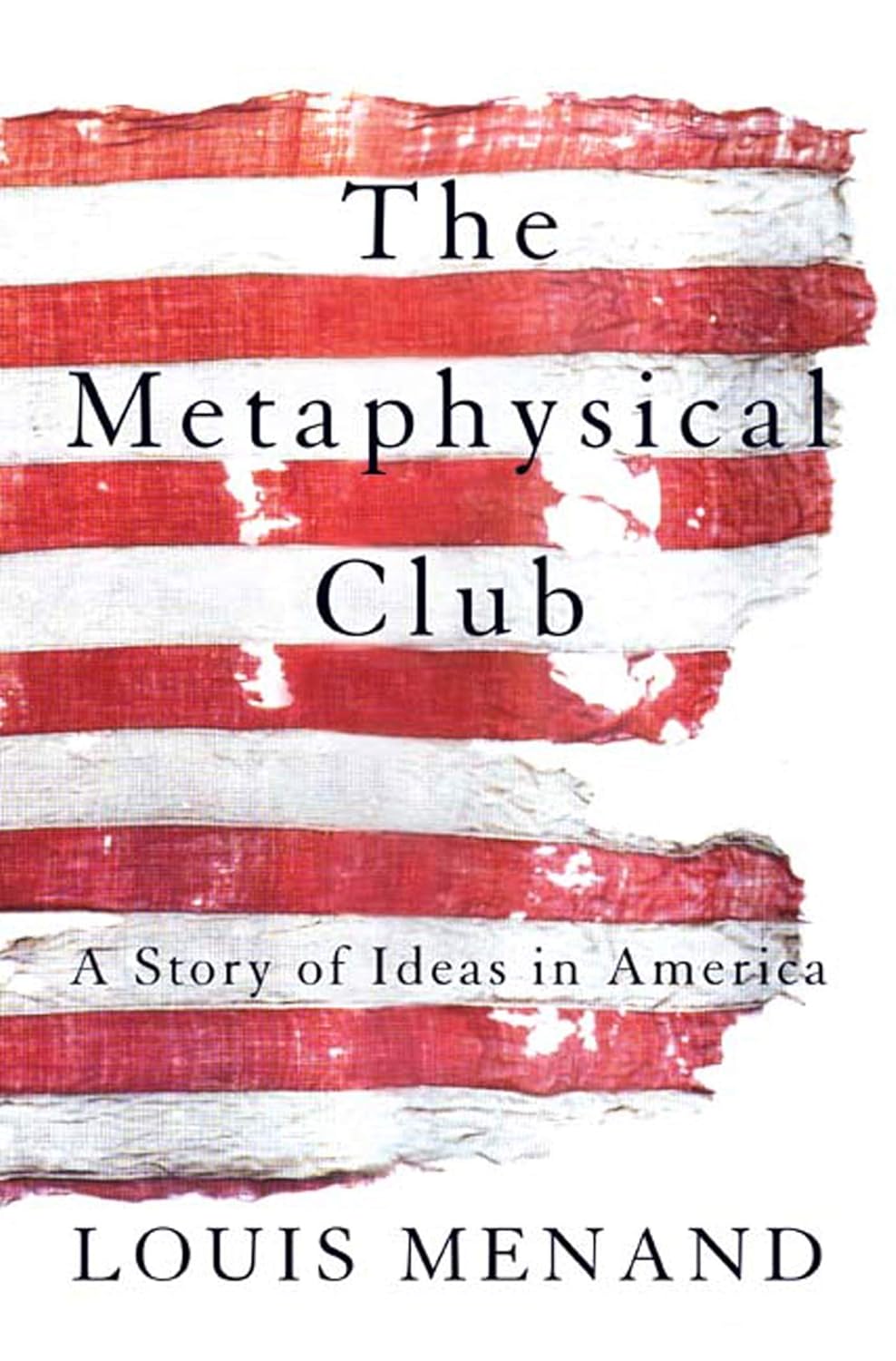
Socrates (or possibly Eleanor Roosevelt) reportedly once said, “strong minds discuss ideas, average minds discuss events, weak minds discuss people.” No matter what kind of mind you possess, Louis Menand’s 2002 Pulitzer Prize winning “The Metaphysical Club: A Story of Ideas in America” might be the book for you because it discusses lots of ideas, events, and people.
I really wanted to like this book. I especially wanted to learn from it. The premise behind “The Metaphysical Club” is ambitious. As Menand explains in his Introduction: “The Civil War swept away the slave civilization of the South, but it swept away almost the whole intellectual culture of the North along with it. It took nearly half a century for the United States to develop a culture to replace it, to find a set of ideas, and a way of thinking that would help people cope with the conditions of modern life. That struggle is the subject of this book.” Menand quite succinctly captures here the key questions he’s looking to answer. Unfortunately, he never is able to do so with the purported answers.
“The Metaphysical Club” is one of those books where each individual chapter is fluent, engaging, and comprehensible, but for some reason they never coalesce into something bigger and more insightful. I was left frustrated because I was really looking for some credible answers to the terrific questions the author presented in the preface. Given the book’s many critical accolades, I can only presume that other educated readers were somehow able to figure things out for themselves. I don’t know, perhaps “The Metaphysical Club” is better thought of as a complex novel. The first thing they teach you in creative writing class is “Show, Don’t Tell.” That is, if your character is a raging alcoholic, you never say that; instead, you show them falling down drunk at the holiday Christmas party. I felt that Menand refused to come out and say explicitly what he believes the intellectual culture of the post-bellum world really amounted to, nor how it directly influenced political and economic life, so he leaves it up to the reader to complete the picture based on his many interesting biographical vignettes of leading thinkers of the age.
That said, if there is one simple answer to Menand’s core question, I suppose it is “pragmatism,” a philosophy developed by William James and refined by others from the short-lived Metaphysical Clubs established at Harvard and then Johns Hopkins in the 1870s. Menand makes much of pragmatism, but I’m not sure why. By the late nineteenth century, American attitudes toward social and economic life were informed, Menand says, by an “accumulated mixture of Christian piety, laissez-faire economics, natural law doctrine, scientific determinism, and popular Darwinism.” These philosophies and perspectives make perfect sense to me and I can see how they demonstrably influenced American political, economic, and intellectual life at the turn of the century. The pragmatism of William James was, I guess, layered onto this pre-existing philosophical mix sometime after the 1870s.
As Menand describes it, pragmatism is painfully simplistic and not obviously useful. First, he distills the essence of it down to just six words: “First we decide, then we deduce.” In other words, Menand is saying that pragmatism’s most basic claim is that “what people choose to believe is just what they think it is good to believe.” A bit later on in the book, he notes that, “Everything James and John Dewey wrote as pragmatists boils down to a single claim: people are the agents of their own destinies.” How exactly do these banal statements add up to anything resembling a coherent and practical philosophy, let alone one that supposedly shaped American thinking and culture in the modern age? Menand never really explains, or at least I never recognized or understood his explanation if he did indeed offer one up.
Pragmatists rejected the concept of certainty and instead argued that ideas as tools, not truths. Earlier philosophies, especially from Europe, sought universal truths (e.g. Hegel, Descartes, Kant); the American thinkers Menand profiles questioned whether such certainties were possible or even desirable. A core concept of pragmatism is that truth is not static: An idea is “true” if it proves useful or effective in a given context. Furthermore, they were highly anti-dogmatic, encouraging flexibility and experimentation whenever an idea stops working. Pragmatism became the first distinctively American philosophy and laid the groundwork for modern liberalism.
Menand acknowledges that pragmatism wasn’t for everyone. “James’s pragmatism was not a philosophy for policy makers, muckrakers, and social scientists,” he writes. “It was a philosophy for misfits, mystics, and geniuses – people who believed in mental telepathy, or immortality, or God.” So if pragmatism wasn’t a philosophy for the intellectual elite, the very people who shape popular opinion and govern human affairs, how and why was it so influential to American life in the industrial and progressive eras? How and why did this new pragmatism manifest itself in day-to-day life? Again, Menand never really explains.
The core of the philosophy is that reality and truth are merely what we decide it to be. For instance, as James explained in 1907 during a lecture on pragmatism: “Truth happens to an idea. It becomes true, is made true by events. Its verity is in fact an event, a process: the process namely of its verifying itself.” Or, as he later explained, “If behaving as though we had free will or God exists gets us results we want, we will not only come to believe those things; they will be, pragmatically, true.” Fair enough, I suppose; but I fail to see how these philosophical insights amount to “a set of ideas, and a way of thinking that would help people cope with the conditions of modern life,” as Menand lays out in his preface.
Menand contends finally that pragmatism played a pivotal role in supporting the development of academic freedom and freedom of speech, both of which are “quintessentially modern principles” in the author’s estimation. If truth is only what you believe it to be, which is what the pragmatists essentially argue, it naturally follows that there is no universal truth. Everyone possesses their own truth and should be allowed to articulate it as they see fit. “The political system their philosophy was designed to support was democracy,” Menand writes. “And democracy, as they understood it, isn’t just about letting the right people have their say; it’s also about letting the wrong people have their say. It is about giving space to minority and dissenting views so that, at the end of the day, the interests of the majority may prevail.”
The philosophical portions of “The Metaphysical Club” admittedly left me in knots. I enjoyed much more the biographical sketches that the author provides on the main protagonists in his narrative – the harrowing battlefield experiences of the young Oliver Wendell Homes, Jr., the privileged but zany childhood of William James, the bizarre biological experiments of Louis Agassiz, the various sexual indiscretions of Charles Sanders Peirce, the forward-leaning social programs of John Dewey. Perhaps my heightened enjoyment of these personal stories singles me out as having a “weak mind.” If so, “oh, well.”
In closing, I really wish Menand had written a crisp summary chapter explaining the key insights and central arguments of his book. He did an admirable job laying out what he was trying to do in the preface. If only he had done the same with a forceful conclusion.
 What's Tim Reading Now?
Leave a comment